1. Mental health in Quebec: a subject leaving taboo behind
Quebec has made significant progress in recent years normalizing mental health care. Many employers offer Employee Assistance Programs (EAPs) including free psychology sessions. Universities and cégeps have free counselling services for students.
For newcomers, the immigration process itself — the break from your home country, cultural adaptation, uncertainty, sometimes isolation — is a recognized stress factor that may require professional support.
You have the right to seek help.
Immigrating is one of the biggest stresses a human being can go through. You left your bearings, your language, your network, sometimes your profession and social status, to start over elsewhere. It's normal to feel anxiety, sadness, loneliness, fatigue, sleep problems, or a sense of grief for what you left behind.
This is sometimes called culture shock or migratory grief: these are not weaknesses — they're human reactions to a huge change. Many newcomers go through a hard stretch in the first or second year, then feel better, especially with a bit of support. Caring for your mental health isn't a luxury for other people: it's an essential part of settling in successfully, just like finding housing or a job.
2. What the public system covers
RAMQ does not cover psychologist consultations in private practice for adults. It covers:
- Psychiatry consultations when medically necessary and prescribed by a doctor
- Psychology sessions in some CLSCs or hospitals when requested by a family doctor or in emergency
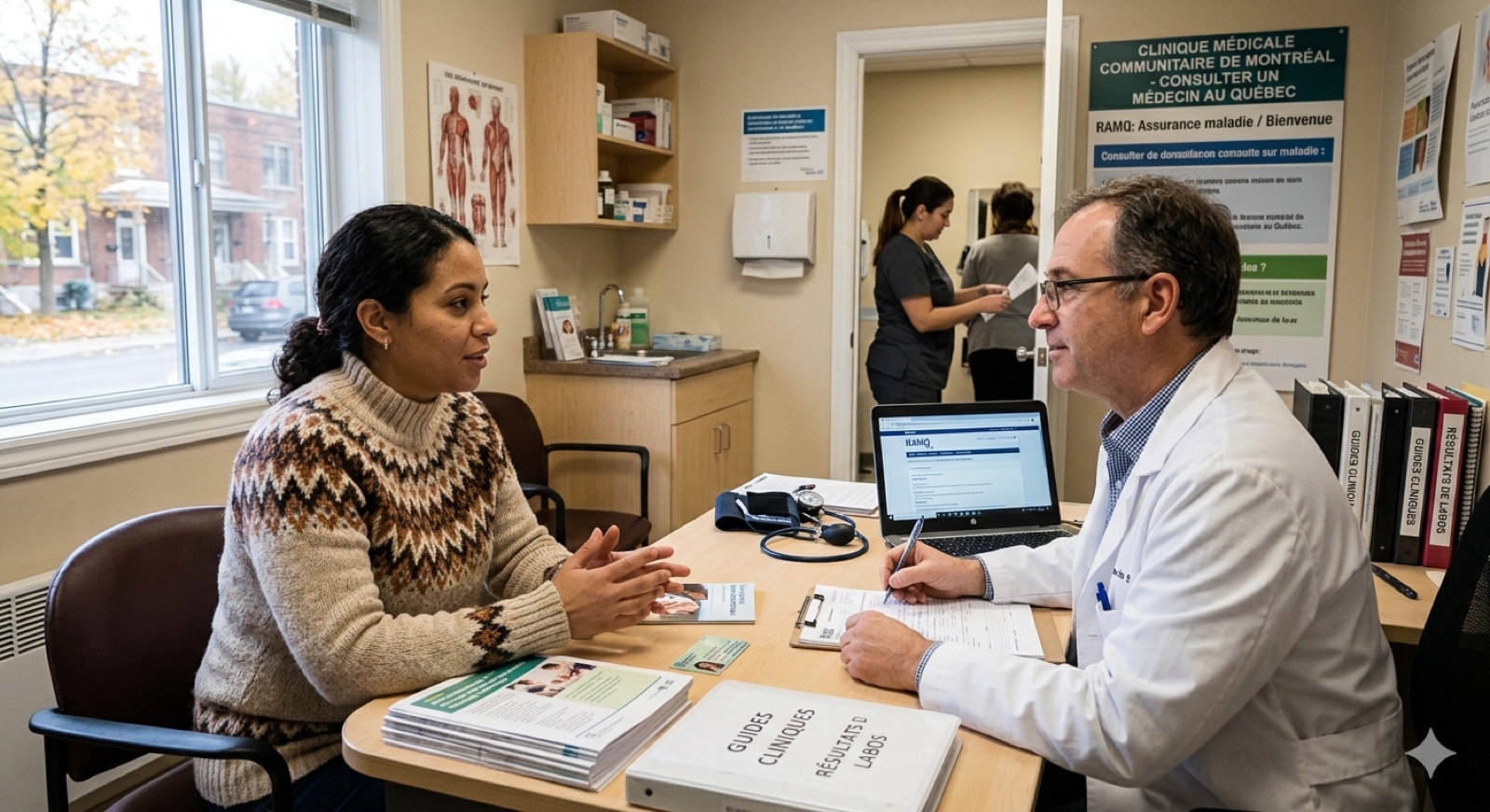
To access a psychologist through the public system → go through your family doctor who makes a referral. Wait times: several weeks to a few months for a non-urgent consultation.
3. Free or low-cost resources
Several free or low-cost mental health resources in Quebec:
- 988 — Canada's Suicide Crisis Helpline: available 24/7 in French and English, by phone or text. In Quebec, 988 automatically routes you to 1 866 APPELLE (1-866-277-3553), the provincial suicide-prevention line, also reachable by text at 535353. Call or text 988 if you or someone you know is in crisis.
- Tel-Aide Montréal — free listening line 24/7: 514-935-1101
- University psychology clinics (UQAM, Université de Montréal): consultations at reduced or no cost by advanced students under professor supervision.
- Employee Assistance Programs (EAP): many employers include 3–8 free psychology sessions — check your collective agreement or HR.
- Immigrant support organizations like PRAIDA or PROMIS: sometimes offer psychosocial support adapted to immigration realities.
- Relief (formerly Revivre) — a listening line and support for anxiety, depression and mood disorders: 1 866 738-4873, Monday to Friday.
- Aire ouverte (ages 12–25) — free health-and-well-being services, with or without an appointment, built for youth.

4. Psychologists in private practice
If you choose to see a private-practice psychologist without insurance, a survey by the Ordre des psychologues du Québec (OPQ) found that most private-practice psychologists charge between $120 and $180 for an hour-long psychotherapy session, depending on the professional's experience and specialization — there is no legally fixed rate in Quebec.
Some psychologists do direct billing with private insurers — check if your insurance partially covers consultations.
Online platforms like Dialogue, Inkblot or Maple offer faster and often cheaper mental health consultations than in-person, especially for an initial assessment or lower-intensity follow-up.
To find a psychologist: use the Ordre des psychologues du Québec directory.
Important: make sure the person belongs to a professional order (the Ordre des psychologues for psychologists). The title psychothérapeute is protected in Quebec; be wary of unregulated 'therapists'.
5. Frequently asked questions
Common questions newcomers have about accessing mental health support in Quebec.
I'm feeling overwhelmed. Where do I start to get help?
Start with 811 (Info-Santé / Info-Social) — a free provincial line available 24/7. A social worker or nurse can listen, assess your situation, and guide you toward the right resource, whether that's a CLSC, a community organization, or a more urgent referral.
You can also walk into your nearest CLSC without a referral and ask to speak with a psychosocial worker — CLSCs offer free frontline mental health support. If you have a family doctor, they can also provide a referral to a psychologist or psychiatrist within the public system.
Is therapy covered by RAMQ?
Partial coverage exists, but it depends on the context. RAMQ does not cover private-practice psychologist consultations for adults — you pay out of pocket or through private insurance. However, RAMQ does cover psychiatry consultations when medically prescribed, and some CLSCs and hospital-based mental health programs offer free psychology sessions through the public system following a doctor's referral.
Many employers also offer an Employee Assistance Program (EAP) that includes several free therapy sessions — check with your HR department.
Can I get help in my first language?
Yes, options exist, though availability varies. Several community organizations in Quebec — particularly in Montréal — offer psychosocial support in languages other than French, including English, Spanish, Arabic, and others.
The 811 Info-Social line can connect you with an interpreter if needed. University psychology clinics sometimes have students who speak other languages. When searching for a private psychologist, the Ordre des psychologues du Québec directory lets you filter by spoken languages. Don't hesitate to ask about language when you make your first call — mental health support works best in the language you feel most comfortable in.
What to do in a crisis or if I'm having suicidal thoughts?
You are not alone, and help is available right now. If you or someone near you is in immediate danger, call 911 — emergency services will respond.
If you are experiencing a mental health crisis but are not in immediate physical danger, call 811 (Info-Social) — a social worker is available 24/7 and can support you through the moment and help you access the right care. 988 (Canada's Suicide Crisis Helpline, by phone or text) is also available 24/7 in French and English; in Quebec, 988 automatically routes you to the provincial 1 866 APPELLE (1-866-277-3553) line. Going to the emergency room of a hospital is always an option if you feel unsafe. You don't have to manage this alone.
Can getting mental-health help hurt my immigration file?
No. Using a help line, the CLSC or a psychologist is confidential and not reported to immigration authorities. Caring for your mental health does not count against you.
6. See also
These related guides may be useful:
- Seeing a doctor in Quebec — how and where to get care.
- Crisis lines — to talk to someone right now.
- RAMQ — your basic medical coverage — understanding provincial health insurance.
- Community resources in Quebec — social support and family services.
7. Official sources
- Info-Social — 811, option 2
- For mental health resources: MSSS — msss.gouv.qc.ca
- 211 for community organizations · 9-8-8 for a crisis
The Ordre des psychologues, Relief and Aire ouverte are linked directly in the relevant sections of this guide.
Author's Note: if you've never consulted a mental health professional in your home country, know that the process is different from a confession or a conversation with a friend. The psychologist listens, reflects back and offers tools — they are not a judge. Confidentiality is legally protected in Quebec. There is no shame in seeking help to adapt to a new country.