1. What is Francisation Québec?
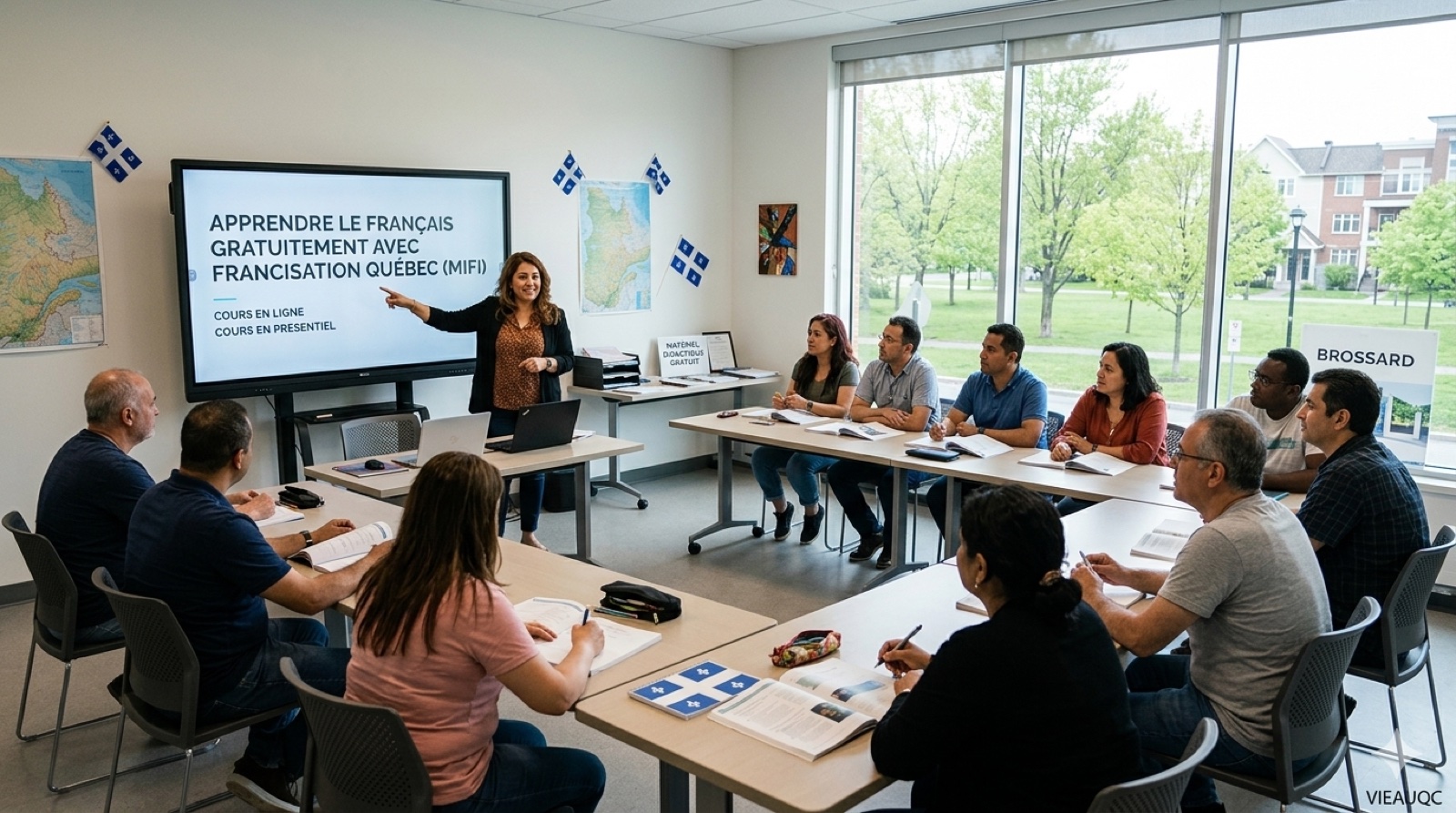
Francisation Québec is the government service that groups together all free French courses offered to immigrants. It was created in June 2023 by the Ministère de l'Immigration (MIFI). It is today the only official portal to register for a French course in Quebec.
A useful distinction so you don't get lost: the MIFI and Francisation Québec are not the same thing. The MIFI is the ministry — the government body responsible for immigration, francisation and integration. Francisation Québec is the service that ministry created: the portal, the name, and the registration page you actually use.
You will see the MIFI acronym on your official documents (your reference number comes « from the MIFI »), but you always register for courses through Francisation Québec.
2. Who can register?
The Francisation Québec courses are free for anyone aged 16 or older living in Quebec, or planning to settle in Quebec. This includes permanent residents, Canadian citizens, temporary workers, international students, and asylum seekers.
3. Course types
Four main formats are offered by Francisation Québec. The right choice depends on your availability, your family situation, and the learning pace you want.
A format for every profile:
- Full-time course — newcomer without a job, fast progress; 25 to 30 hours per week, the most intensive pace.
- Part-time course — with a job or dependent children; 4 to 24 hours per week, daytime, evening or weekend.
- Online course — self-directed study at your own pace, no fixed class times.
- Specialized courses by employment field — remote, vocabulary of a specific sector (health, engineering, administration).
Practical reference: a financial aid is possible for immigrants, under certain conditions, in the full-time, part-time and specialized courses. Full-time is the fastest pace, at 25 to 30 hours per week: ideal for a newcomer without a job who wants to progress fast. For those already working, part-time remains the realistic path, with its evening and weekend classes.
| Format | Duration | Hours/week | Levels |
|---|---|---|---|
| Full-time course | 10 weeks | 25–30 h | Beginner, intermediate |
| Part-time course | 8–12 weeks | 4–24 h | Beginner, intermediate |
| Online course | At your own pace | — | Intermediate, advanced |
| Specialized courses by employment field | 10 weeks | 6 h | Intermediate, advanced |
4. Financial assistance
Government financial aid is possible for immigrants, under certain conditions, if you take a full-time, part-time or specialized course by employment field. Depending on your situation, this aid can cover:
- A weekly participation allowance, reserved for full-time courses
- Transport costs to get to class, also full-time only and limited to certain situations
- Childcare fees for your children, available for both full-time and part-time (at different amounts)
5. How to register
You must file an online admission application on the Francisation Québec portal. The process is entirely free. You fill out a form with your personal information and then receive an individual reference number from the MIFI.
To register, you'll need a few documents:
- A photo ID (passport)
- Proof of your status in Canada (permanent resident card, CSQ, work or study permit)
- A Quebec address
- For online courses: a computer with a high-speed Internet connection
6. Frequently asked questions
The most common questions about Francisation Québec: what French level can be reached, the wait between registration and class start, whether you can work during francisation, whether the program is really free, and what happens with absences.
What French level will I reach by the end of the program?
The program covers levels 1 to 12 of the Échelle québécoise des niveaux de compétence en français, roughly A1 through C2 in the European framework.
Reaching level 7 or 8 (B2 level) typically takes 10 to 14 months full-time, or 18 to 24 months part-time. That's generally the minimum required for a job that demands daily French use.
How long between registration and the start of classes?
According to Québec.ca's pages on applying for full-time courses and applying for part-time courses, for a first application, full-time courses generally begin within 50 working days and part-time courses within 70 working days.
According to the same pages, your course can begin at any time of year.
Can I keep working during francisation?
Yes for the part-time, online, and specialized formats. Full-time in-person demands 25 to 30 hours per week in class — incompatible with a full-time job, but possible with evening or weekend work.
The participation allowance is $230 per week, according to Québec.ca's financial assistance page for immigrants, but it is available only for full-time courses — part-time, online, and specialized formats do not receive it. In other words, this allowance supports you when you have no work income at all; it isn't meant to top up reduced part-time earnings.
Is the program really free?
Yes, entirely. No registration fees, no material fees, no session fees. Courses, textbooks, and online-platform access are provided at no cost.
Be wary of any site or service that claims to sell access to Francisation Québec — that's necessarily a scam. The only official portal is quebec.ca/francisation.
What happens if I miss classes?
Attendance is mandatory for in-person courses — particularly for full-time where the participation allowance depends on attendance.
One or two absences justified by a medical note or valid reason are generally accepted. Beyond that, your spot may be given to someone on the waitlist and your allowance suspended for the current session.
7. See also
These related guides may help:
- Working in Quebec without French — the parallel path while you learn French.
- Recognizing your foreign diplomas — often required in parallel for regulated professions.
- Finding a job in Quebec — to put your French to use in a professional context.
8. Official sources
For official, always up-to-date information, see these pages:
- Learn French — main page
- Full-time courses for immigrants
- Online French courses
- Ministère de l'Immigration — Francisation Québec
You can also call Services Québec at 1-877-644-4545, anywhere in Quebec.
Author's Note: Learning French is one of the most useful decisions you can make for your life in Quebec. The program is free, varied, and gives you access to a whole community. Register early — in-person spots fill up quickly.