1. Drug insurance is mandatory
In Quebec, drug insurance is mandatory.
Two options:
- Private insurance through your employer (if offered) → you must use it
- Public plan through RAMQ (default otherwise)
2. The public RAMQ plan
The public RAMQ plan:
- Monthly deductible: about $21
- Coinsurance: 30% of the remaining cost
- Monthly maximum: about $105 (varies by income)
- Children and seniors: enhanced coverage
An annual premium is also paid through your Quebec tax return. Some people — social-assistance recipients, low-income seniors — pay less or nothing. Amounts change every year: check the RAMQ site.
3. Private first, public otherwise
The logic is simple:
- If you have access to a private plan — through your job, your spouse's job, or a professional order — you're generally required to join it, and to cover your spouse and children too.
- If you have no private plan, you must register with the public plan of RAMQ.
- When you get a job offering group insurance, you stop being eligible for the public plan and must switch to the private one.
In short: you don't get to be uninsured, and private takes priority when available.
| Criterion | Public plan (RAMQ) | Private plan (group) |
|---|---|---|
| Who it's for | People with no access to a private plan | People with access through work, a spouse, or a professional order |
| Joining | You must register yourself | Usually automatic through the employer |
| Is it mandatory? | Yes, if you have no private option | Yes, you must join if you have access |
| Covers spouse/children | Each person per their own situation | Usually yes, as dependents |
| Cost | An annual contribution via your tax return | A premium, often shared with the employer |

4. Pharmacies in Quebec
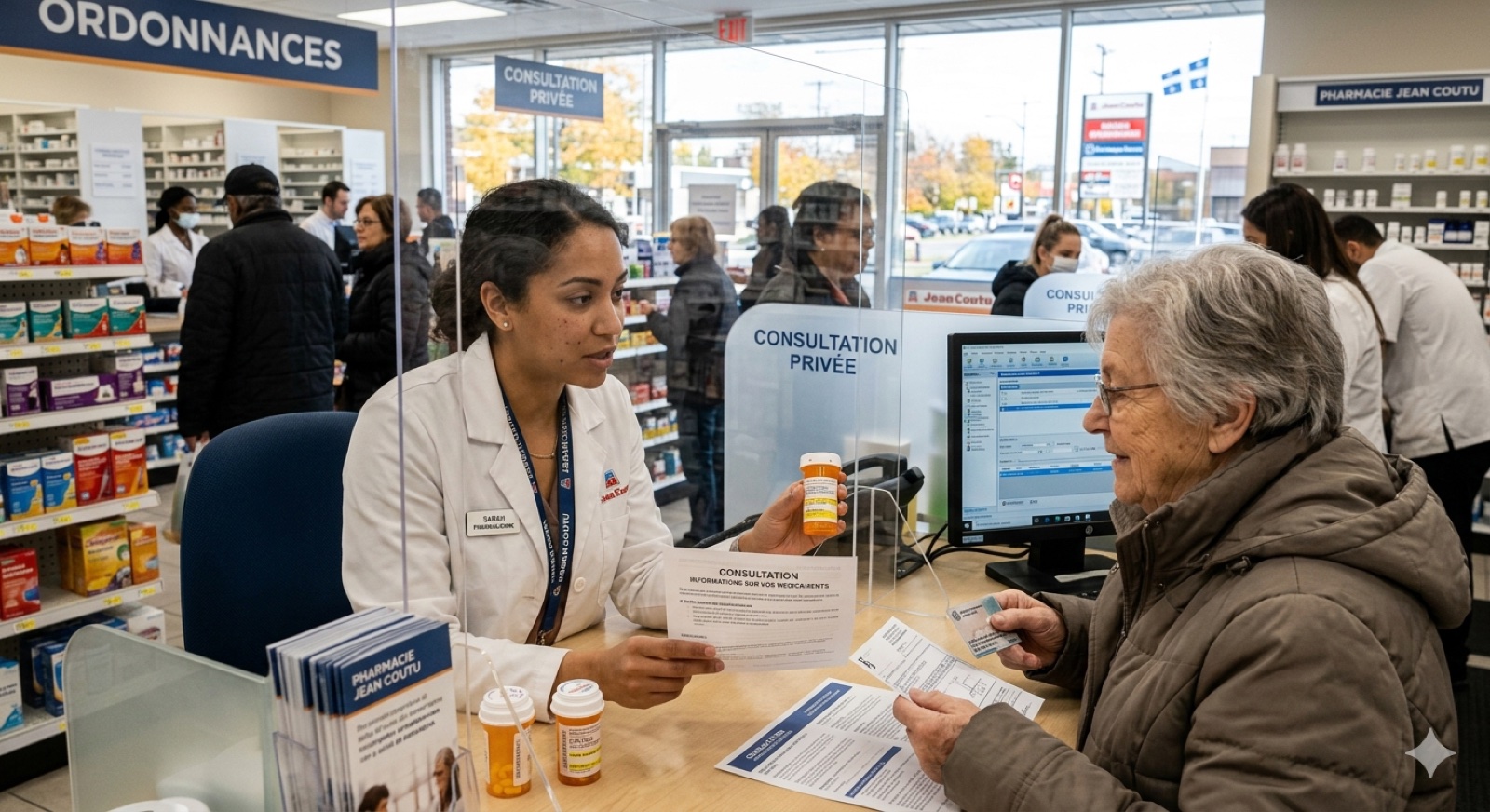
In Quebec, the neighbourhood-pharmacy network is dense. Four chains dominate the landscape:
- Jean Coutu — the largest chain in Quebec, also present in Ontario and New Brunswick.
- Pharmaprix — the Quebec banner of the Shoppers Drug Mart group (outside Quebec).
- Uniprix — a network of independent pharmacist-owners based in Quebec.
- Familiprix — another large Quebec network, often found in the regions.
- Brunet — a Quebec chain with a strong regional presence.
Most pharmacies are open 8 am–10 pm on weekdays, with reduced hours on Sundays; some Pharmaprix locations in Montréal are open 24/7. To find the nearest one outside normal hours: search “pharmacie ouverte” on Google Maps.
All accept the public RAMQ drug insurance card as well as private plans. The price of the same drug can vary by a few dollars between chains, but the gap stays modest: the list of covered drugs and the maximum price billable to the public plan are the same everywhere. Choose mainly by proximity, opening hours and service quality.
5. Compare the chains at a glance
The four main chains are similar on the essentials. Here are the practical differences.
No chain has a structural price advantage on prescription drugs — the maximum tariff billable to the public plan is regulated. Promotions mostly target over-the-counter products and cosmetics.
For a regular prescription, your best bet stays the pharmacy closest to home, where the pharmacist will know your file.
| Chain | Presence | Particularities | Ideal if |
|---|---|---|---|
| Jean Coutu | All of Quebec, Ontario, New Brunswick | Largest network; mature mobile app | You want the same chain everywhere |
| Pharmaprix | All of Quebec; tied to Shoppers (Canada) | Often open late; wide cosmetics range | You live in an urban setting |
| Uniprix | Mostly Quebec | Independent pharmacist-owners | You want a close, personal relationship |
| Familiprix | All of Quebec, including the regions | Strong presence in regions and suburbs | You live outside major centres |
6. The pharmacist's expanded role
In Quebec, the pharmacist does far more than dispense medication. They can notably:
- Prescribe for several minor conditions: uncomplicated UTIs in adult women, mild eye infections (conjunctivitis), mild eczema and dermatitis, some fungal infections, hay fever, cold sores, mouth ulcers, mild hemorrhoids, warts, and emergency contraception.
- Extend an existing prescription while you wait for a medical appointment.
- Adjust doses as needed.
- Administer injections (flu vaccine, travel vaccines, etc.).
- Evaluate a minor condition and direct you to a doctor if needed.
Some of these acts are covered by RAMQ when you are enrolled in the public plan; others trigger fees billed to your private plan or to you. Always ask the rate before the consultation to avoid surprises.
7. Over-the-counter drugs
Over-the-counter drugs are available directly on shelves:
- Pain relievers: Tylenol (acetaminophen), Advil (ibuprofen).
- Syrups for cough and cold.
- Antihistamines for allergies (Reactine, Claritin, Aerius).
- Nasal drops, basic creams, vitamins.
These products are almost never covered by insurance, except in rare cases prescribed by a healthcare professional. The pharmacist gives free advice without an appointment: don't hesitate to ask before buying, especially if you already take other medication. Some combinations carry a real interaction risk.
8. Frequently asked questions
The most common newcomer questions about Quebec pharmacies: why drug insurance is mandatory, who pays what between you and RAMQ, whether chains really have different prices, whether you can see a pharmacist without an appointment, and how to transfer a prescription between pharmacies.
Why is drug insurance mandatory in Quebec?
Quebec is the only Canadian province with universal drug insurance. The principle: every resident must be covered, either by an employer group plan that includes drug coverage, or by the RAMQ public plan. The goal is to make sure no one foregoes a necessary prescription for financial reasons.
If your employer offers eligible group coverage, you must use it — you cannot opt for the public plan instead. Failing to enrol exposes you to an annual contribution at tax-filing time.
Who pays what between me and RAMQ for a prescription?
Under the public plan, you pay a monthly deductible plus a percentage coinsurance on the rest of the cost, up to a monthly maximum that caps your out-of-pocket. RAMQ pays the rest directly to the pharmacy. The pharmacist applies these splits automatically when you present your card — you only see your share at the counter.
Children under 18 and certain seniors receiving the Guaranteed Income Supplement pay nothing. Exact amounts are reviewed periodically; check the RAMQ page in the Sources for current figures.
Do pharmacies really have different prices?
For prescription drugs covered by the public plan, the price billable to RAMQ is regulated, so the gap between chains stays small — a few dollars at most. For over-the-counter drugs and cosmetics, prices vary more freely and weekly promotions matter.
The biggest savings on prescriptions come from asking the pharmacist about a generic version when one exists, not from changing chain. Once you've picked a home pharmacy, sticking with it lets the pharmacist see your full file and catch interactions.
Can I see a pharmacist without an appointment?
Yes, in most cases. Quick advice — what to take for a sore throat, whether two over-the-counter drugs interact, how to use an inhaler — happens at the counter, free.
For a clinical evaluation that may end in a prescription (urinary tract infection, hay fever, etc.), most pharmacies prefer a brief appointment, often the same day. Some chains let you book online. Fees for a billable consultation may apply; ask up front.
How do I transfer my prescription from one pharmacy to another?
It's the new pharmacy that handles the transfer — you do not have to call the old one. Walk into the new pharmacy with your insurance card, your ID, and the name of the previous pharmacy (or a recent label of the medication).
The new pharmacist contacts the previous one to retrieve your file. You only need to do this once: from then on, every renewal happens at the new pharmacy. No fees.
How do I register for the public plan?
Fill out the RAMQ registration form online (or by mail) with your name, date of birth, Social Insurance Number and address. RAMQ sends you a drug-insurance card to present at the pharmacy. If your employer later offers group insurance, switch to it and notify RAMQ.
What happens when I change jobs?
Your drug coverage follows your situation. After leaving a job with group insurance, register for the RAMQ public plan promptly if your new employer has none — don't leave a gap. Conversely, when a new job offers group insurance, switch to it and notify RAMQ.
9. See also
These related guides may be useful:
- Get your RAMQ health insurance card — the base of your health coverage, including prescriptions.
- Seeing a doctor in Quebec — how to get a prescription on the front line.
- Going to the dentist in Quebec — another health service largely outside RAMQ.
10. Official sources
For official information:
- Ordre des pharmaciens du Québec
The official page of the RAMQ public drug insurance plan is linked directly in section 2.
Author's Note: The pharmacist can solve half of everyday small ailments without a doctor's appointment. Learn to use this resource.