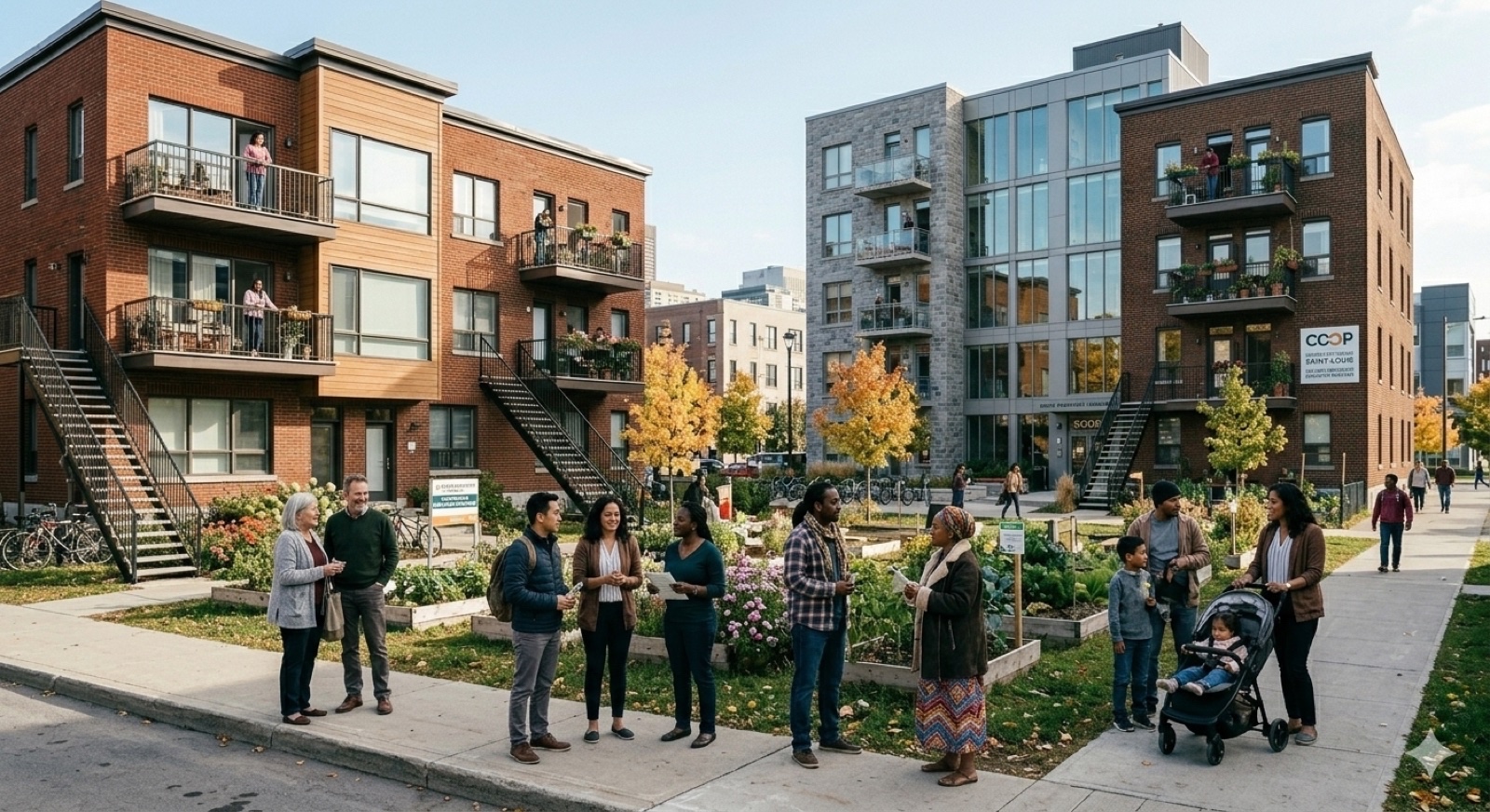
1. Three different programs, grouped under the same roof
Social housing in Quebec is overseen by the Société d'habitation du Québec (SHQ) and managed locally by municipal housing offices. In Montreal, it's the OMHM (Office municipal d'habitation de Montréal); each major city has its equivalent (OMH of Quebec City, the Office d'habitation de l'Outaouais in Gatineau, etc.).
When you apply for social housing, your file is considered for three distinct programs:
- HLM (Habitation à loyer modique) — traditional public housing managed by the municipal office. Rent equals 25% of household income.
- PSL (Programme de supplément au loyer) — you live in a private apartment, a coop, or a non-profit, but pay the same rent as in an HLM (25% of income); the state subsidizes the rest to the landlord. For a PSL unit in a coop or a non-profit, you apply directly to that organization.
- Logement abordable — notably for households whose income is above the HLM ceiling but who still struggle with market rates. Rent is below market and not tied to your income.
One application covers both HLM and PSL — but not affordable housing. Per the OMHM, a subsidized-housing application “is valid for both low-rent housing and PSL housing”. Affordable housing requires a separate step (in Montreal, a phone call to 514 483-4118). So do not assume one form covers all three.
Your registration is valid for one year only. The OMHM again: “Your place on the eligibility list is valid for one year” — you must renew it every year, and update it whenever your address, contact details or household composition change. An unrenewed application stops progressing, which is the costliest mistake on a list where people wait years.
| Program (in Montreal, per the OMHM) | Managed by | For whom | Rent |
|---|---|---|---|
| HLM | The municipal office | Households meeting the seven criteria | 25% of income |
| PSL | The office, a coop, a non-profit or a private landlord | Same criteria as an HLM | 25% of income |
| Affordable housing | The office | Income may be above the HLM ceiling (other criteria apply) | Below market |
2. Are you eligible? The seven standard rules
To be added to the registry of your office, you must meet seven standardized provincial conditions:
- Status: Canadian citizen or permanent resident living in Quebec.
- Local residency: have lived within the office's territory for a minimum period — in Montreal, at least 12 months over the last two years in the Montreal Metropolitan Community. Victims of domestic violence and people with reduced mobility may be exempted from this rule.
- Autonomy: able to meet your essential needs, alone or with the help of a caregiver or outside support.
- Asset ceiling: the combined value of all household assets cannot exceed a set amount — verify the current limit on your office's site (the OMHM's for Montreal).
- Full-time student: not eligible unless you have a dependent child living with you or are at least 20 weeks pregnant.
- Good record: no debt to a low-rent housing landlord for unpaid rent or damage, and not be a former HLM tenant whose lease was cancelled for abandonment (leaving without notice), for a debt or as a result of a decision by the Tribunal administratif du logement (TAL).
- Income ceiling: your total gross household income from the previous tax year must be equal to or below provincial thresholds by household composition — verify the current thresholds on your office's site (in Montreal: the OMHM's eligibility criteria).
If you check all seven, you're eligible for the registry. That does not guarantee housing — it puts you on the list.
3. The application: step by step
Allocation isn't first-come, first-served. A points-based system ranks candidates; its criteria include household income and the number of children. The steps:
- Get the official form — the Demande de logement à loyer modique — from your local office's site or by phone (in Montreal: OMHM, 514 868-5588). Fill it out and sign it by hand.
- Gather your documents: proof of residence for the last two years (copies of your current and previous leases), proof of citizenship or immigration status and, for every adult who will live in the unit, their most recent detailed notice of assessment from Revenu Québec (if not yet received: their latest tax return and all their slips).
- Submit by mail or in person to your office's main location. Contact details vary by city — verify the current address on the official site.
- Wait for the written confirmation that your application was received, then your reference number in the list. Processing time varies — check current delays with your office.
Once admitted, your file is scored by a selection committee using the provincial grid. Your rank depends on your points — household income, how long your application has been on file, minor children and certain psychosocial factors — not just on your registration date: it's not a simple queue.
4. Priority processing: exceptional situations
Priority processing goes to eligible households that were displaced by one of these situations (OMHM):
- a disaster that made the dwelling unfit to live in;
- a municipal by-law declaring the dwelling unfit to live in;
- a household member is a victim of violence and is no longer safe in the dwelling;
- an expropriation.
If you're in one of these situations, mention it explicitly at first contact with the office and attach the documents that show it. The emergency procedure is faster but still procedural — other resources can take over while you wait: SOS violence conjugale 1 800 363-9010, regional shelters, 211 for guidance.
5. During and after the wait
During the wait, two reflexes:
- Keep your file up to date — any change in income, address, or household composition must be reported to the office. An outdated file can lose your spot or delay evaluation.
- Check your rank in the list. Several offices, including the OMHM, let you check your rank online with your tracking number; at the OMHM, ranks are updated every month, around the 20th.
When a unit is offered to you, you have 7 days to accept or refuse; not answering in time counts as a refusal. A refusal gets your name struck off the list for one year, except in the cases the regulation provides for (for example, a unit that does not match the choices you indicated) — be careful.
Once moved in, your rent is reviewed each year, at lease renewal, based on your household income. An income increase may raise your rent; a decrease may lower it. That's why it's called rent adapted to income, not simply « low market ». Note too that once you live in subsidized housing, you are no longer eligible for Revenu Québec's shelter allowance.
Frequently asked questions
Here are the most common questions about social housing in Quebec: how long the wait is, and whether your immigration status counts.
How long is the wait?
Often a long time — social housing has more applicants than units; in Montreal, the OMHM puts the average wait at 5 years. That's not a reason to skip it: apply as early as possible — the time your application has been on file counts toward your points. While you wait, look at the housing allowance and co-ops as complementary options, and keep your file up to date so you don't lose your place.
Does my immigration status count?
Yes — you must be a Canadian citizen or permanent resident and have lived for a minimum period in the local office's territory, among other criteria. The exact rules vary, so don't assume you're excluded or included — check the current conditions with the local housing office (the OMH) before applying, or ask a housing committee to review your situation.
See also
Related guides that may be useful:
- Revenu Québec's Housing Allowance — monthly help while you wait on the list.
- Housing co-operatives — another route to an affordable rent.
- Your rights as a tenant — useful as soon as you sign a lease.
- Assessing a rent with the TAL grid — to judge whether the asking price is reasonable.
Official sources
- Société d'habitation du Québec (SHQ, French only)
- Office municipal d'habitation de Montréal (OMHM)
- Office municipal d'habitation de Québec (OMHQ, French only)
- Office d'habitation de l'Outaouais (French only)
- Éducaloi
- Tribunal administratif du logement (TAL)
- 211 Greater Montréal
Income ceilings, the asset ceiling, minimum residency duration, and processing delays change regularly — each item in this guide points to the relevant official site rather than citing a fixed number that could mislead you.
Author's note: the social-housing application is a long-term investment. The wait is often counted in years — in Montreal, the OMHM puts the average at 5 years. Do it anyway if you're eligible: it's quick to fill out, and puts you in the system in case your situation evolves. While you wait, look into the Allocation-logement from Revenu Québec, housing cooperatives, and your tenant rights if you've already signed a lease.