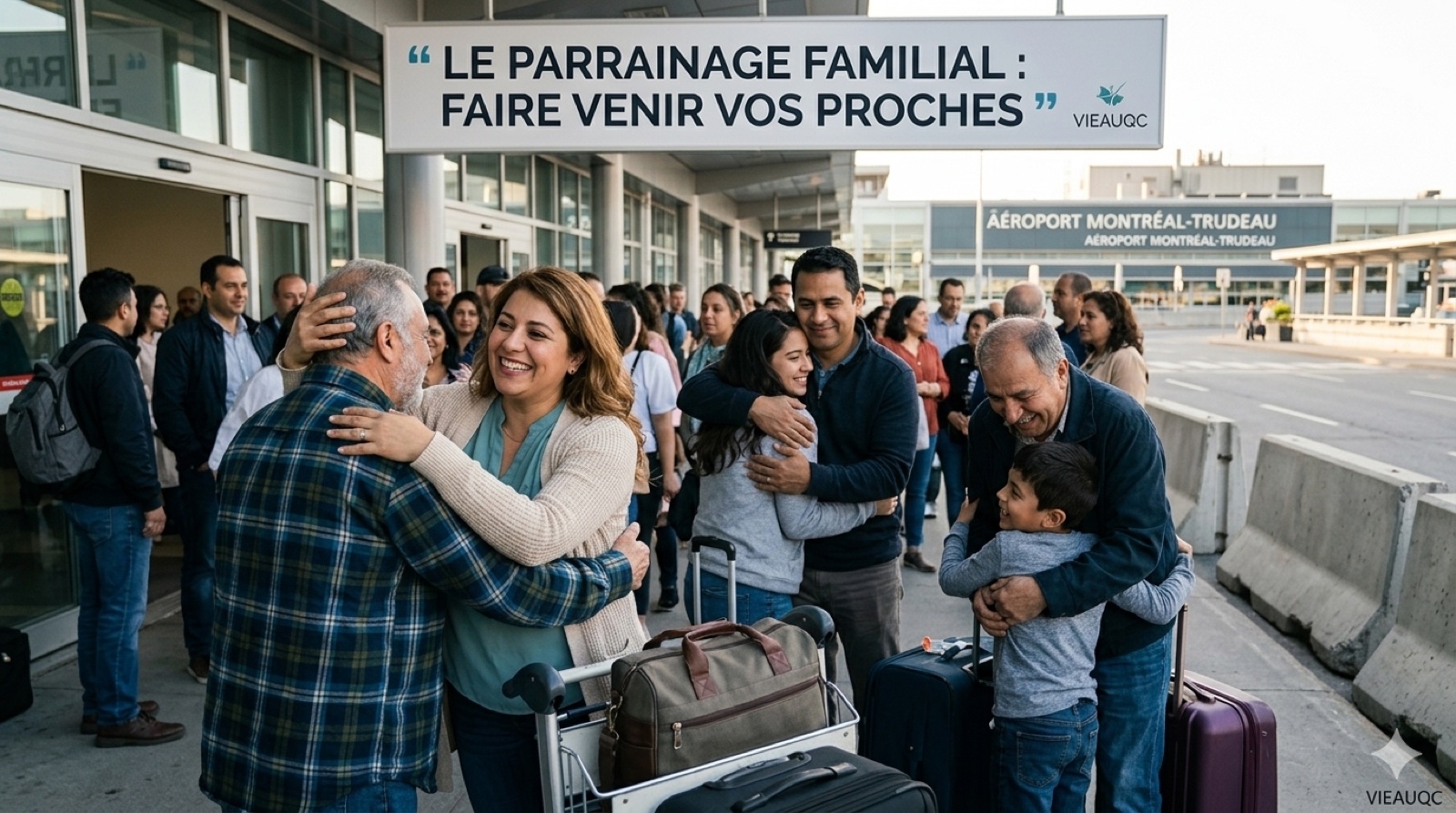
Le parrainage familial — réunir votre famille au Canada, étape par étape.
To sponsor a family member, you must be a Canadian citizen or permanent resident, at least 18, and residing in Canada. In Quebec, every file needs dual approval — both federal AND provincial. Eligible categories include a spouse, dependent children (generally under 22), and parents/grandparents through a limited program with an annual lottery.
1. Who can sponsor?
Conditions to sponsor:
- Canadian citizen or permanent resident
- At least 18 years old
- Residing in Canada (except citizens sponsoring a spouse)
- In Quebec: dual federal + provincial approval
2. Who can be sponsored?
Categories of people who can be sponsored:
- Spouse, common-law partner, conjugal partner
- Dependent children (generally under 22)
- Parents and grandparents (limited program with annual lottery)
- Brother / sister / nephew / niece orphan (specific cases)
3. Financial undertaking
The financial undertaking in Quebec (these durations are set by the *Règlement sur l'immigration au Québec* — distinct from the federal rules that apply outside Quebec):
- Spouse: 3 years
- Dependent child under 16: 10 years or until age 18, whichever is longer
- Dependent child 16 or older: 3 years or until age 25, whichever is longer
- Parents / grandparents: 10 years in Quebec — half of the 20 years often cited for the rest of Canada
If the person receives social assistance, you must reimburse the government.
4. Spouse sponsorship in Quebec
In Quebec, two approvals are required:
- Federal: IRCC (Immigration, Refugees and Citizenship Canada)
- Provincial: CSQ from MIFI
Relationship proof: photos, emails, joint travel, testimonials.
5. The three main categories at a glance
The three main categories — spouse, children, parents/grandparents — differ sharply in length of undertaking, fees and processing times.
On top of these fees, add: medical exams, criminal checks from every country lived in, and certified translations.
For parents and grandparents, IRCC uses the MNI (Minimum Necessary Income) — the published 2024 federal table required over $70,000 in proven income over each of the last 3 years to sponsor 2 parents into a family already of 2, and Quebec adds its own income test on top of IRCC's.
The timelines below reflect Quebec as of mid-2026 and shift often — always check IRCC's live processing-times tool before relying on a number.
| Category | Undertaking (Quebec) | Fees (CAD) | Quebec timeline (mid-2026) |
|---|---|---|---|
| Spouse (in Canada) | 3 years | ~$1,260 | ~30 months |
| Spouse abroad | 3 years | ~$1,260 | ~32-33 months |
| Dependent child | 3 to 10 years, depending on age (see section 3) | Variable | With spouse/parent application |
| Parents / grandparents | 10 years (Quebec) | ~$1,260 | ~65 months — paused for new applications since July 15, 2026 |
6. Your action list
Sponsoring a loved one in Quebec takes 8 steps. Check each box below as you go: your progress is saved if you're signed in:
7. Frequently asked questions
The most common questions on family sponsorship: non-married partners, what happens on separation, minimum income required, real timelines, and eligibility after bankruptcy.
Can I sponsor my partner if we're not married?
Yes — Canada recognizes three relationship types:
- Spouse (legally married)
- Common-law partner (continuous cohabitation of at least 12 months)
- Conjugal partner (committed relationship of at least 1 year, unable to live together due to immigration barriers)
All three are eligible under the same rules of the family class. You'll need to prove the relationship is genuine and continuing — joint bills, photos, letters from family, etc.
What happens if the relationship ends during the sponsorship undertaking?
Your financial obligation continues. The undertaking — 3 years for a spouse, 10 years for parents/grandparents in Quebec — is to the government, not to your partner — separation or divorce does not cancel it.
If your former partner receives social assistance during the undertaking period, the government will recover those amounts from you. This is a major reason to be certain before sponsoring.
What's the minimum income required to sponsor?
For a spouse or dependent child: no minimum income required.
For parents, grandparents or siblings: IRCC uses the MNI (Minimum Necessary Income), published annually by family size. The published 2024 federal table required over $70,000 proven income (family of 4: sponsor + spouse + 2 sponsored parents) over each of the last 3 tax years — this rises somewhat every year, so check IRCC's current table before relying on a figure.
Quebec adds its own income test on top of IRCC's, via MIFI.
How long does a sponsorship application take in 2026?
Timelines for Quebec applicants, from IRCC's live processing-times tool, as of mid-2026 (they shift often — check the current tool before relying on a figure):
- Spouse sponsorship, in Canada: about 30 months
- Spouse sponsorship, abroad: about 32 to 33 months
- Parents and grandparents (PGP): applies to files already in the system — about 65 months in Quebec, heavily backlogged (outside Quebec, closer to 33 months). No new PGP applications are being accepted since July 15, 2026 (see the update in section 5).
Quebec runs slower than the rest of Canada mostly because of the extra CSQ step (Certificat de sélection du Québec) on top of the federal review, and its own intake is capped for the 2026-2028 period (see section 5).
Can I sponsor if I've received social assistance or declared bankruptcy?
Currently receiving social assistance generally disqualifies you, with exceptions for disability. A past bankruptcy is accepted if it's been discharged.
Past sponsorship defaults (where the government had to support your sponsored relative) must be fully repaid before you can submit a new application.
Be transparent — this information is verifiable in government databases, and an undeclared item leads to refusal.
8. See also
These related guides may be useful:
- Renew or replace your PR card — the status the sponsored person obtains on arrival.
- Canadian citizenship application in Quebec — the long-term pathway after several years of permanent residence.
- Get your Social Insurance Number (SIN) — the first admin step for the sponsored person on arrival.
9. Official sources
For official information:
- Family sponsorship (IRCC)
- Sponsorship in Quebec (MIFI)
- Rules governing intake of applications in Quebec — where the 2026-2028 caps are set
Phone: IRCC at 1-888-242-2100.
Author's note: Long, complex, emotionally difficult — but one of the most beautiful possibilities Canada offers. Patience, organization, and don't hesitate to consult a lawyer or accredited consultant if needed.