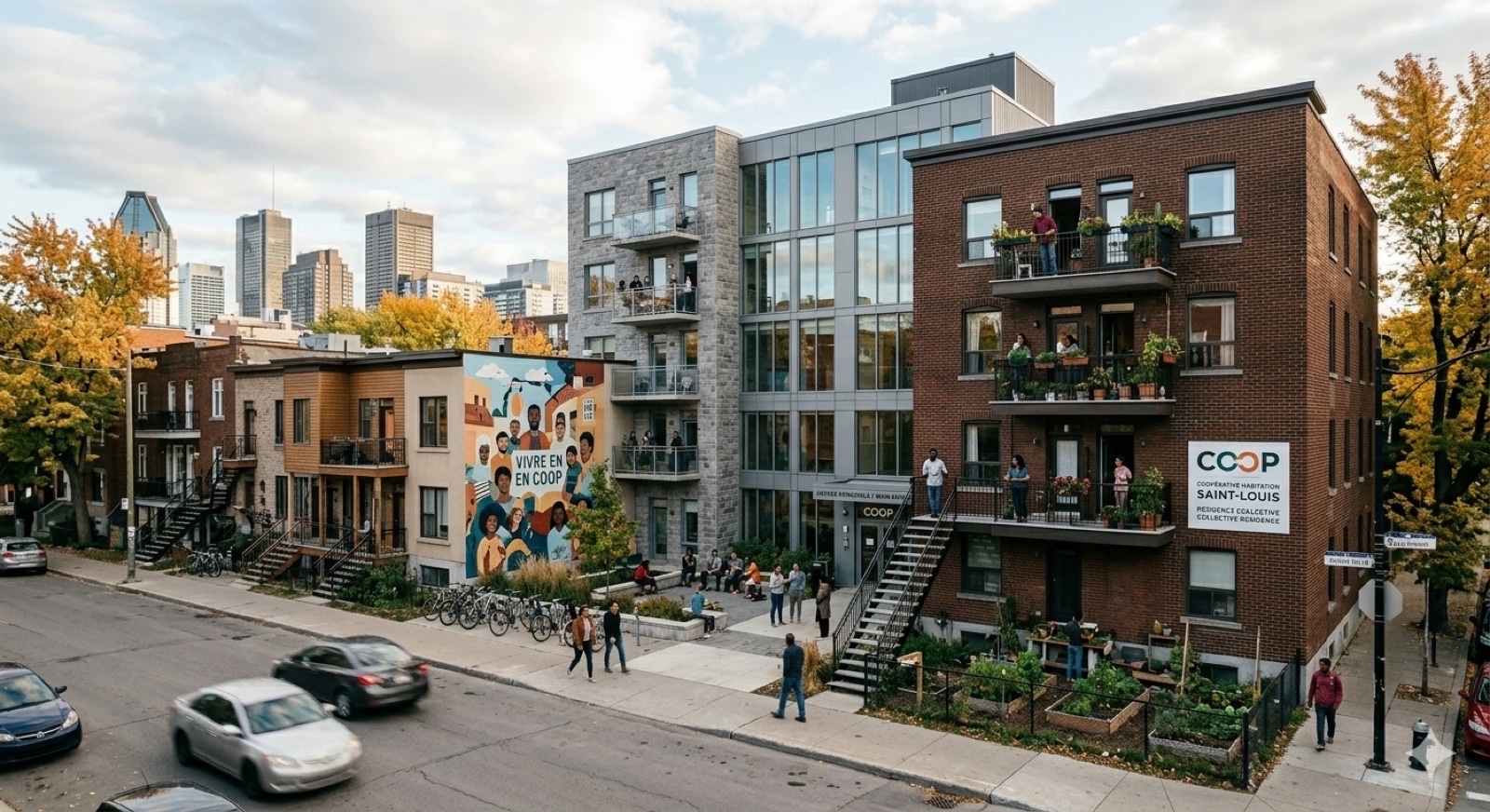
1. A housing co-op isn't an ordinary rental
Housing cooperatives in Montréal — also called coops d'habitation — work very differently from private rentals or public housing like the HLM. In a co-op, residents are not merely tenants: they collectively own and manage the building.
Because members handle administration, maintenance, and finances themselves, operating costs stay low — which lets co-ops offer quality housing at below market average prices.
If you live in a co-op, you are a member-tenant. You are expected to take part in decisions and to join a committee: you contribute time and skills to the building's life. It's not a detail: it's what makes the model viable.
The trade-off: lower rent, strong community feeling, great stability — in exchange for an active commitment of several hours per month.
2. The committee system: what's expected of you concretely
A co-op's governance is democratic. Each member can vote at the General Assembly, held at least once a year, regardless of apartment size. The assembly elects a board of directors that oversees major decisions.
To keep the building running without outsourcing expensive labour, tasks are divided into specialized committees. Members are invited to join one based on their interests and skills:
- Selection Committee — recruits and evaluates new applicants.
- Maintenance Committee — small repairs, painting, snow removal, landscaping.
- Finance Committee — rent collection, budget, bookkeeping.
- Secretariat or Social Committee — official records or community activities.
How often committees meet and the workload expected from each member vary by co-op. Ask this question at the first information session.
3. Two types of units: market and subsidized
Not all co-op units are alike. There are two main categories:
- Market-rate units — open to anyone, no income condition. Rent is held noticeably below the private market thanks to collective volunteer labour, but it's not indexed to your income. If your income goes up, the rent doesn't change.
- Subsidized units — depending on the program under which the co-op was created, it reserves a percentage of its units for low-income households; with the rent supplement (PSL), rent is set at 25% of family income. In PSBL-P co-ops, all tenants receive a subsidy and rent is calculated as in HLM.
The proportion of subsidized vs market units varies from one co-op to another. When you apply, you can specify that you're targeting a subsidized unit — but eligibility is judged separately, against the program's income thresholds.
| Housing co-op | HLM | Private rental | |
|---|---|---|---|
| Owner | The co-op (members) | Municipal housing office | Private landlord |
| Rent | Below market | Based on income (25%) | Market rate |
| Participation required | Yes (volunteering + meetings) | No | No |
| Waiting list | Yes (variable) | A few months to several years | Immediate if available |
| Housing security | High (member = rights) | High | Depends on the lease |
4. Two paths to apply: central registries or direct to co-ops
Unlike public housing, there is no single centralized application for all co-ops. Each co-op is independent, manages its own waiting list, and runs its own selection process.
There are two strategies — you can (and should) do both in parallel.
Path A — the central registry. The Fédération de l'habitation coopérative du Québec (FHCQ, formerly FECHIMM) groups some 480 co-ops (page in French; the English page still shows an older count). Getting into its bank of candidates takes three steps:
- Attend an information session by videoconference, for $15 per person, to understand the commitment of co-op life.
- Fill out the form indicating your preferred neighbourhoods, which committees you could join and other relevant information.
- FHCQ makes the list of participants available to its member co-ops, which consult it when recruiting — but they are not required to use it.
For PSBL-P co-ops, the application goes through Central-Logement-Coop:
- download the form;
- attach the requested documents;
- mail everything to 7000, avenue du Parc, suite 206, in Montréal.
You must notably be a Canadian citizen or permanent resident and stay under an income ceiling.
Path B — applying directly to individual co-ops. Each co-op has its own selection committee and waiting list, and you apply by writing directly to the co-ops. It's more work, but it's what works. The method is detailed in the next section.
5. The cover letter and the interview
For Path B (direct), your application looks more like a job application than a rental request. You mail or email a file to the selection committee of the co-op that interests you.
The file should contain a clear letter specifying:
- The size of unit you need and the composition of your household.
- Your approximate annual income (useful to evaluate your eligibility for a subsidized unit).
- Crucial: your concrete skills — volunteer, professional, or community. For example: « I have bookkeeping experience », « I'm handy », « I'm very organized and can manage archives ». That's what sets you apart.
- Your real motivations for living in a cooperative, democratic community.
- Your contact information (phone number and mailing address).
How to find co-op addresses: FHCQ maintains an online search tool and publishes the full list of its co-ops; a paper copy costs $2 at its offices or $6 by mail. Identify co-ops in the neighbourhoods that interest you and send your file to each.
If a unit opens up and your letter stands out, you'll be invited to a formal interview with the selection committee. They'll evaluate your availability and your fit for community life far more than your financial wealth.
6. How long before you get in
Be realistic about timelines. Because co-op rents are stable and the communities are tight-knit, turnover is very low — people rarely leave.
- Market-rate unit: finding a spot can take from several months to several years of persistent prospecting. Keeping an up-to-date list of co-ops you've applied to, and following up periodically, makes a difference.
- Subsidized unit: these units are rare and harder to find, so waitlists are significantly longer. Register early, but don't count on it as a first-line solution.
While you wait, two useful things:
- Check the FHCQ co-op search regularly: it can filter by availability — a good way to spot co-ops that are recruiting.
- Stay active in community volunteering — co-ops appreciate candidates who already show civic engagement.
Frequently asked questions
Here are the most common questions about housing co-ops in Montreal: whether a co-op is subsidized housing, and how long the wait is.
Is a housing co-op subsidized housing?
Not automatically. A co-op offers member-managed housing at generally fair rents, but only some units are subsidized (for example with the rent supplement, which sets rent at 25% of family income). The other units are at market rent, simply more stable and democratic. Ask each co-op which type it offers.
How long does it take to get a spot?
There's no fixed delay — it depends on the co-op, the unit type and turnover, and the subsidized units in particular can have long waits. Apply to several co-ops at once and stay reachable: a co-op contacts people on its list when a unit opens, and being responsive and involved improves your chances.
See also
These related guides may be useful:
- Social housing in Quebec — low-rent and subsidized housing.
- Shelter allowance (Revenu Québec) — financial help with rent.
- Signing a lease in Quebec — understand and sign your lease.
Official sources
- Fédération de l'habitation coopérative du Québec (FHCQ)
- Société d'habitation du Québec (SHQ, French only)
- 211 Greater Montréal
Information-session fees, form codes (particularly PSBL-P), the income percentage applied to subsidized units, and the postal address of the FHCQ central office may change — verify each before sending.
Author's note: getting into a co-op is not finding a cheap apartment. It's joining a community. The people who succeed are those who see volunteer commitment as part of the value, not as a constraint. If you're only looking for low rent without wanting to participate, the model won't suit you — and selection committees will detect it. If you're looking for a stable, democratic living environment, it's one of the best options on the Montréal market. Patience and persistence.