Voter — un droit qui s'ouvre avec la citoyenneté canadienne.
1. Who can vote?
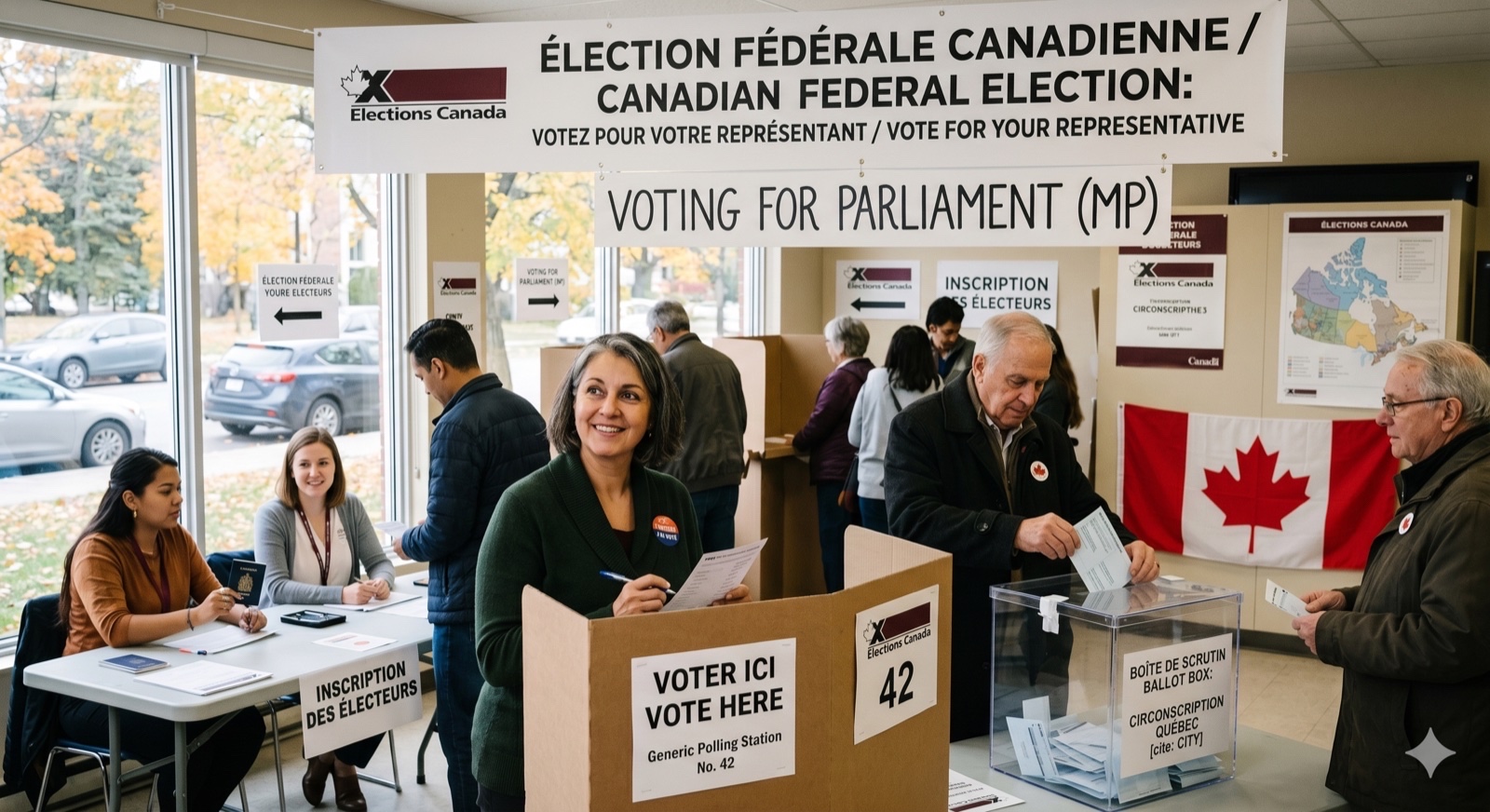
The right to vote in general elections is reserved for Canadian citizens aged at least 18 years old.
Permanent residents cannot vote in elections, even after many years in Canada: this is one of the rare differences between permanent-resident status and citizenship. The right to vote opens when you become a Canadian citizen, after the oath ceremony.
2. Three levels of government, three elections
In Canada, you vote at three levels of government, in separate elections:
- Federal elections — for the Government of Canada, run by Elections Canada
- Provincial elections — for Quebec's National Assembly, run by Élections Québec
- Municipal elections — for your city
Each vote has its own date and its own voters list.
| Provincial elections (Quebec) | Federal elections (Canada) | |
|---|---|---|
| Responsible body | Élections Québec | Elections Canada |
| Government elected | National Assembly (119 seats) | House of Commons (343 seats) |
| Frequency | Every 4 years (fixed date) | Every 4 years (possible fixed date) |
| Automatic registration | No — via electoral register | Yes, if already registered for federal tax |
| Canadian citizens only | Yes | Yes |
3. Municipal elections: who can vote
General municipal elections take place across Quebec on a regular cycle, every four years, to elect your city's mayor and councillors. To vote, you generally must be a Canadian citizen, 18, and domiciled in the municipality for a certain period.
Important for newcomers: permanent residency alone generally does NOT give the right to vote in Quebec municipal elections — citizenship is required. There are, however, particular categories, for example for property owners who don't live there. Check your exact eligibility with Élections Québec or your city.
4. School elections
The school side is more particular and has changed a lot in recent years. In Quebec, English-language school boards still hold elections every four years to elect their members (the last were held in November 2024), while the French-language network was reorganized into school service centres, without general elections of the same form. The rules are evolving and have been the subject of legal debate. If you want to know whether there's a school election in your situation, and whether you're eligible, the safest is to check directly with Élections Québec and your school service centre or board.
| Municipal elections | School elections | |
|---|---|---|
| Who can vote? | Canadian citizens residing in the municipality, 18+ | Canadian citizens, parents of students or taxpayers, 18+ |
| Electoral card required | Yes (or proof of identity + address) | Yes |
| Frequency | Every 4 years, first Sunday of November (next: Nov 2029) | Every 4 years, English-language boards only (last Nov 2024, next Nov 2028) — a separate cycle from municipal |
| Permanent residents | Not eligible | Not eligible |

5. Registering on the voters lists
To vote, your name must appear on the voters list.
Registration is often updated automatically from government sources — notably a checkbox on your tax return. But automatic registration is not guaranteed. The safe habit: check yourself that you are registered with Elections Canada and Élections Québec, and update your address after every move.
For the municipal level: in the weeks before an election, you normally receive a notice saying whether you're registered and where to vote; if not, you can request registration or a correction during the set period — the deadlines are strict.
6. On voting day
Before a vote, you generally receive an information card showing where and when to vote.
- To vote, you must prove your identity and address — bring an accepted piece of ID
- Several options exist if you do not have the expected document — check the list of accepted documents
- Advance voting, before the official day, is also available
7. Your action list
Follow these steps so you can exercise your right to vote. Check each box as you go: your progress is saved if you are signed in.
8. Frequently asked questions
The most common questions on voting: whether permanent residents can vote, how to check your registration, voting at several levels of government, and dual voting rights.
Can I vote if I am a permanent resident?
No. Voting in elections is reserved for Canadian citizens. A permanent resident has access to almost all public services and most social rights, but not the right to vote — that right opens only with citizenship.
If voting matters to you, that is one more reason to consider the citizenship application once the physical-presence requirement is met.
How do I know if I am registered to vote?
Check directly with the election authorities — do not assume. Elections Canada lets you verify and update your federal registration online; Élections Québec does the same for provincial and municipal voting.
Each maintains its own list — check both. A recent move or a recent change to citizenship can leave you off the list.
Do I register separately for each type of election?
There are two main lists: a federal one (Elections Canada) and a Quebec one (Élections Québec), which also serves the municipal elections. These are separate systems — confirm you appear on both.
Good news: registration largely carries over from one election to the next. Your job is mainly to keep your address current and to verify before each vote.
Can I vote in Canada if I hold another nationality?
Yes. What matters for voting in Canada is being a Canadian citizen — holding another nationality at the same time does not remove that right. Canada generally allows dual citizenship.
Whether your country of origin lets you keep its nationality, and vote there, depends on that country's rules. For voting in Canada, the only condition is Canadian citizenship and registration.
How often are municipal elections held?
General municipal elections in Quebec follow a regular four-year cycle, on a fixed date province-wide. Between general elections, by-elections can be held to fill a vacant seat. Élections Québec publishes the calendar; your city announces local details as the vote nears.
Why does municipal voting matter?
Because the municipal level decides the things closest to daily life: snow removal, parks, libraries, public transit, zoning, water, local taxes. Once you're a citizen, your municipal vote is one of the most direct ways to shape your neighbourhood. It's local power, often decided by very few votes.
9. See also
These related resources may be useful:
- Parcours — Canadian citizen — your rights and steps after citizenship.
- The Canadian citizenship application — the step that opens the right to vote.
10. Official sources
For official, up-to-date information:
- Elections Canada
- The site of your municipality (elections / voters-list section)
- For the school side: your school service centre or board
The Élections Québec link is given directly in section 3.
Author's Note: voting is the most visible right that citizenship adds. But it only works if your name is on the list. Make it a reflex: after every move, and before every election, check your registration.