1. L'assurance médicaments est obligatoire
Au Québec, l' est obligatoire.
Deux options :
- Assurance privée via employeur (si offerte) → obligatoire de l'utiliser
- Régime public de la (par défaut sinon)
2. Le régime public de la RAMQ
Le régime public RAMQ :
- Franchise mensuelle : environ 21 $
- Coassurance : 30 % du coût restant
- Maximum mensuel : environ 105 $ (variable selon revenu)
- Enfants et personnes âgées : couverture améliorée
À cela s'ajoute une cotisation annuelle, payée via votre déclaration de revenus du Québec. Certaines personnes (prestataires de l'aide sociale, aînés à faible revenu) paient moins ou rien. Les montants changent chaque année : vérifiez le site de la RAMQ.
3. Le privé d'abord, le public sinon
| Critère | Régime public (RAMQ) | Régime privé (collectif) |
|---|---|---|
| Pour qui | Les personnes sans accès à un régime privé | Les personnes ayant accès par l'emploi, le conjoint ou un ordre professionnel |
| Adhésion | Vous devez vous inscrire vous-même | Souvent automatique par l'employeur |
| Est-ce obligatoire ? | Oui, si vous n'avez aucune option privée | Oui, vous devez y adhérer si vous y avez accès |
| Couvre conjoint/enfants | Chacun selon sa propre situation | Habituellement oui, comme personnes à charge |
| Coût | Une cotisation annuelle via votre déclaration de revenus | Une prime, souvent partagée avec l'employeur |

4. Les pharmacies au Québec
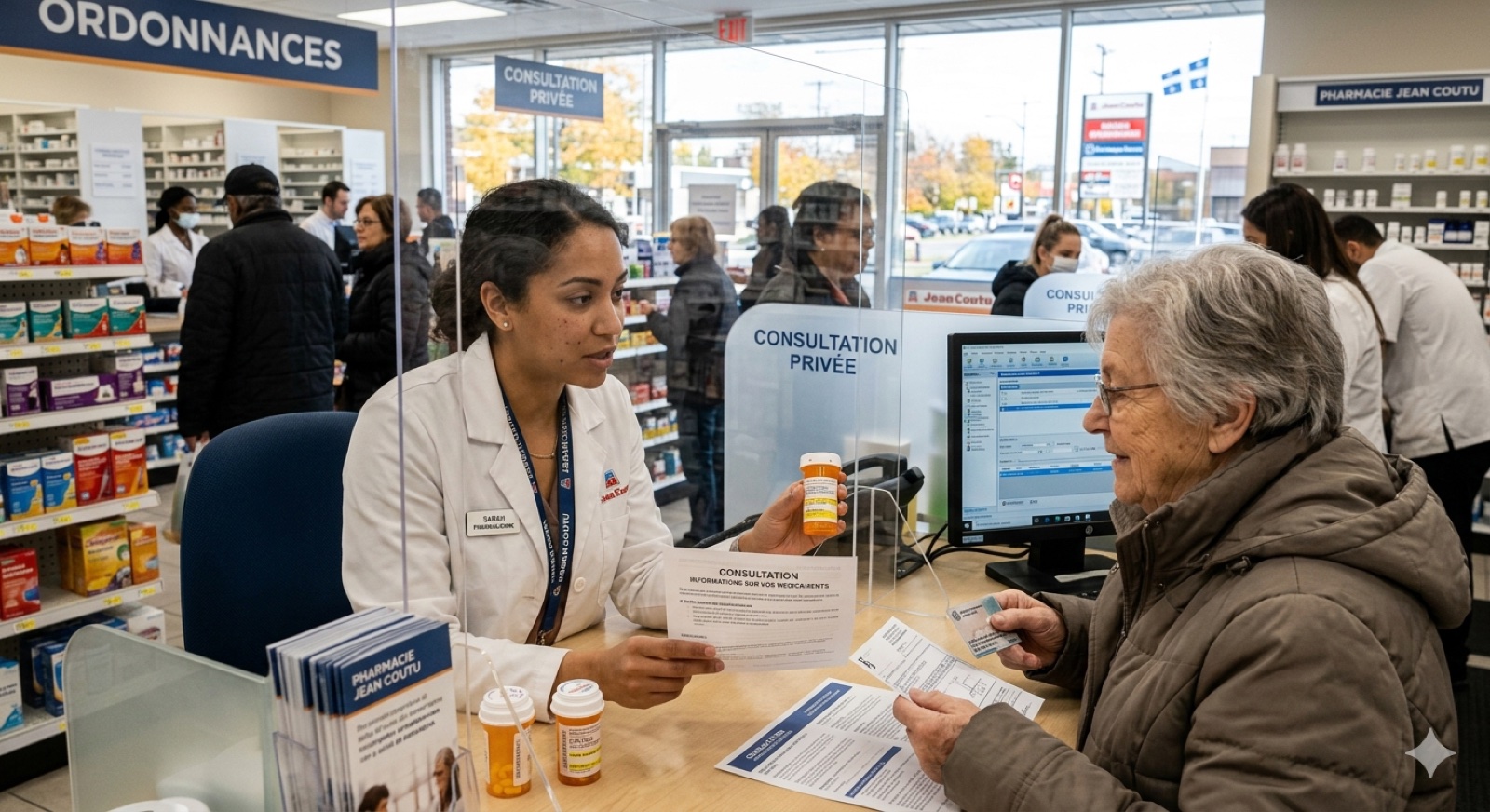
Au Québec, le réseau des pharmacies de quartier est dense. Quatre chaînes dominent le paysage :
- Jean Coutu — la plus grande chaîne au Québec, présente aussi en Ontario et au Nouveau-Brunswick.
- Pharmaprix — la bannière québécoise du groupe Shoppers Drug Mart (hors Québec).
- Uniprix — réseau de pharmaciens-propriétaires québécois.
- Familiprix — autre grand réseau québécois, souvent en région.
- Brunet — chaîne québécoise avec une forte présence en régions.
5. Comparer les chaînes en un coup d'œil
Les quatre grandes chaînes se ressemblent sur l'essentiel. Voici les écarts pratiques.
Aucune chaîne n'a d'avantage de prix structurel sur les médicaments d'ordonnance — le tarif maximum facturable au régime public est encadré. Les promotions visent surtout les produits en vente libre et les cosmétiques.
| Chaîne | Présence | Particularités | Idéale si |
|---|---|---|---|
| Jean Coutu | Tout le Québec, Ontario, Nouveau-Brunswick | Plus grand réseau ; appli mobile mature | Vous voulez la même chaîne partout |
| Pharmaprix | Tout le Québec ; lié à Shoppers (Canada) | Souvent ouvert tard ; gamme cosmétique large | Vous habitez en milieu urbain |
| Uniprix | Surtout au Québec | Pharmaciens-propriétaires indépendants | Vous voulez une relation de proximité |
| Familiprix | Tout le Québec, dont régions | Très présente en région et banlieue | Vous habitez hors grand centre |
6. Le rôle élargi du pharmacien
Au Québec, le pharmacien fait bien plus que remettre des médicaments. Il peut notamment :
- Prescrire pour plusieurs conditions mineures : infections urinaires non compliquées chez la femme adulte, infections oculaires bénignes (conjonctivite), eczéma léger et dermatites, certaines infections fongiques, rhume des foins, herpès labial, aphtes, hémorroïdes légères, verrues, et contraception d'urgence.
- Prolonger une ordonnance existante quand vous attendez un rendez-vous médical.
- Ajuster les doses au besoin.
- Administrer des injections (vaccin antigrippal, vaccins de voyage, etc.).
- Évaluer un état mineur et vous diriger vers un médecin si nécessaire.
Certains de ces actes sont couverts par la RAMQ quand vous êtes inscrit au régime public ; d'autres entraînent des honoraires facturés à votre régime privé ou à vous-même. Demandez toujours le tarif avant la consultation pour éviter les surprises.
7. Médicaments en vente libre
Les médicaments en vente libre sont accessibles directement dans les rayons :
- Analgésiques : Tylenol (acétaminophène), Advil (ibuprofène).
- Sirops contre la toux et le rhume.
- Antihistaminiques pour les allergies (Reactine, Claritin, Aerius).
- Gouttes nasales, crèmes de base, vitamines.
Ces produits sont presque jamais couverts par l'assurance, sauf rares exceptions sous ordonnance d'un professionnel. Le pharmacien donne des conseils gratuits sans rendez-vous : n'hésitez pas à le solliciter avant d'acheter, surtout si vous prenez déjà d'autres médicaments. Certaines combinaisons posent un risque réel d'interaction.
8. Questions fréquentes
Les questions les plus posées par les nouveaux arrivants : assurance obligatoire, qui paie quoi, écarts entre chaînes, consultation sans rendez-vous, et transfert d'une ordonnance.
Pourquoi l'assurance médicaments est-elle obligatoire au Québec ?
Le Québec est la seule province canadienne avec une assurance médicaments universelle. Le principe : chaque résident doit être couvert, soit par un régime collectif d'employeur incluant les médicaments, soit par le régime public de la RAMQ. L'objectif est de s'assurer que personne ne renonce à une ordonnance nécessaire pour des raisons financières.
Si votre employeur offre une couverture collective admissible, vous devez l'utiliser — vous ne pouvez pas opter pour le régime public à la place. Ne pas s'inscrire vous expose à une cotisation annuelle au moment de produire votre déclaration de revenus.
Qui paie quoi entre moi et la RAMQ pour un médicament ?
9. Voir aussi
Ces guides apparentés peuvent vous être utiles :
- Obtenir votre carte d'assurance maladie (RAMQ) — la base de votre couverture santé, y compris pour les médicaments.
- Consulter un médecin au Québec — comment obtenir une prescription en première ligne.
- Aller chez le dentiste au Québec — un autre service de santé en grande partie hors RAMQ.
10. Sources officielles
Pour des informations officielles :
La page officielle du régime public d'assurance médicaments (RAMQ) est liée directement dans la section 2.
Note de l'auteure : Le pharmacien peut résoudre la moitié des petits maux du quotidien sans rendez-vous médical. Apprenez à utiliser cette ressource.