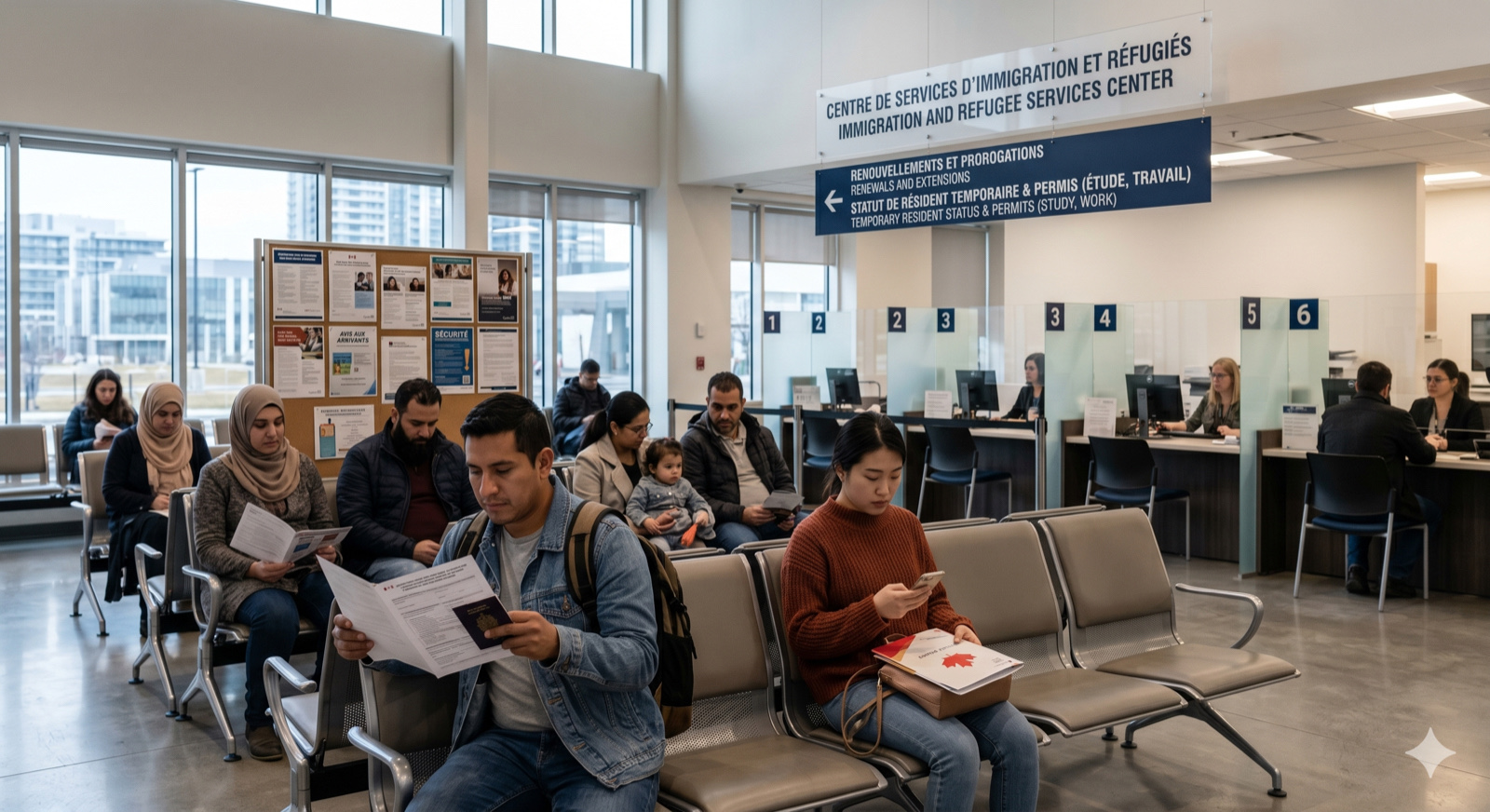
Permis fermé ou ouvert — connaître la différence avant de signer un contrat.
1. Closed permit or open permit
There are two broad categories of work permit:
- The closed permit — tied to a specific employer
- The open permit — tied to no employer
The open permit is intended, for example, for certain spouses of workers or students, and for graduates holding a post-graduation work permit.
| Closed permit | Open permit | |
|---|---|---|
| Authorized employer | One only, named on the permit | Any employer (with restrictions) |
| Changing jobs | New permit required | Possible without a new permit |
| Who gets it? | Workers recruited via LMIA | Spouses of workers/students, graduates (PGWP), some temporary residents |
| LMIA required? | Generally yes | No |
| CAQ required? | Generally yes (in Quebec) | Sometimes |

2. The closed permit: LMIA and CAQ
Most closed permits require two prior authorizations:
- An LMIA — your employer requests it from Service Canada
- A CAQ for work — issued by the Quebec government
Once the LMIA and the CAQ are obtained, you apply for the work permit from the federal government. The physical permit is handed to you at the border. Check immediately the conditions printed on it: employer, occupation, location, dates. Any error must be reported promptly.
3. When an LMIA is not required
Some work permits are exempt from the LMIA:
- Several international-mobility programs
- Open permits
- People who already hold a CSQ toward permanent residence
The exact programs change: confirm your situation with your employer or a regulated immigration consultant before leaving, and check the official Quebec government page on working in Quebec.
4. Respecting your permit conditions
With a closed permit, you can only work for the listed employer, in the listed occupation, at the listed location. Any change requires a new permit application.
Working outside the conditions of your permit is a violation that can lead to loss of status. If your situation changes, or if you face mistreatment, seek information: there are remedies, including an open work permit for vulnerable workers.
5. The rights you have, whatever your permit
Your rights as an employee are protected by the CNESST, the Quebec body that enforces labour standards. They do not depend on your immigration status. In practice:
- The minimum wage, and pay for every hour actually worked
- Overtime premium pay beyond the standard work week
- Paid statutory holidays and paid annual vacation
- A safe workplace, and compensation if you're injured at work
- The right to refuse dangerous work
- The right to be treated without harassment or discrimination
No one may pay you «under the table», below minimum wage, or withhold your wages because you're new or because your permit is tied to them.
6. Closed or open permit: the real-life difference
The difference between the two permit types is not administrative — it changes your balance of power day-to-day.
A closed permit ties you to a single employer, a single occupation, a single work location. You cannot change jobs without a new permit application. It's this link that makes a worker vulnerable: if the employer abuses you, leaving appears to mean losing your right to work.
An open permit is tied to no specific employer. You can leave a job and look for another freely.
Check which category your permit belongs to: it's printed on it. And even with a closed permit, you're never truly trapped — the next section explains why.
7. Recognizing exploitation and abuse
Certain signs should alert you. At the time of writing, federal regulations describe several forms of abuse in connection with employment: physical abuse, sexual abuse, psychological abuse such as threats and intimidation, financial abuse such as fraud and extortion, and reprisals against a worker who defends their rights.
In practice, situations to never accept:
- An employer or agency that keeps your passport, work permit or phone — this is prohibited in Quebec
- Anyone who makes you pay to get the job itself — prohibited
- Hours worked but unpaid, or wages below the minimum
- Threats to have you removed from the country if you complain
- Dangerous work with no equipment or training
If you recognize your situation: it is not your fault, and you are not alone.
8. The open work permit for vulnerable workers
The federal government offers a recourse designed exactly for closed-permit workers facing abuse: the open work permit for vulnerable workers. Its purpose is to let you leave an abusive employer and look for another job, without staying trapped.
At the time of writing, this permit has important features:
- It is free: no permit fee and no biometrics fee
- It's an open permit, so you can then work for almost any employer
- The application is made online, not at the border
- The application is processed confidentially with respect to the employer
The eligibility conditions and the exact procedure can change — check the rule in force on the Government of Canada's official site, and get support from a community organization or legal aid: you do not have to build this file alone.
9. Changing employers on a closed permit
Leaving an abusive situation is one thing; changing employers simply by choice is another, and it is also possible.
With a closed permit, you generally cannot start a new job without a new authorization: the permit names a specific employer. The procedure, at the time of writing, looks like this:
- You find a new job, and the employer completes the required authorizations on their side.
- You file an application for a new work permit with the federal government.
- The federal government also applies a policy that may, in some cases, let you start the new job sooner — after submitting your application, without waiting for the permit to be printed.
These rules and timelines evolve. Check the procedure and eligibility in force on the Government of Canada's site before acting, and never leave one job to start another without confirming you are authorized to do so.
10. Where to get help
You never have to solve a problem with an employer alone. Several resources, free of charge, can support you. The table below summarizes who to turn to depending on your problem.
One important point: the CNESST can take action on behalf of a temporary foreign worker even without a formal complaint from them, when it has grounds to believe their rights are not being respected.
You can reach the CNESST by phone, anywhere in Quebec, at a toll-free number: 1 844 838-0808. For status questions and immigration recourse, our guide on free legal aid details how to get support without paying a private lawyer.
| Your problem | Who to turn to |
|---|---|
| Unpaid wages, unpaid hours | CNESST — complaint service |
| Illegal working conditions | CNESST — labour standards |
| Workplace injury or accident | CNESST — health and safety |
| Abuse, exploitation, abusive employer | Vulnerable-worker permit + community organization |
| Status document, immigration recourse | Free legal aid |
| Need to be heard and guided | Community organization for immigrants |
11. Your action list
Understanding and securing your work permit takes 6 steps. Check each box below as you go: your progress is saved if you're signed in:
12. Frequently asked questions
The most common questions on the work permit: the difference between closed and open, who pays for the LMIA, changing employer, and remedies in case of abuse.
What is the difference between a closed and an open permit?
A closed permit ties you to one employer, occupation and work location in particular: you cannot work elsewhere without applying for a new permit.
An open permit is not tied to any specific employer: you can work for almost any employer, subject to the restrictions printed on the permit.
The type you get depends on the immigration program through which you came.
Who pays for the LMIA — the employer or me?
The employer. The LMIA is the employer's process and cost: they must demonstrate to Service Canada that no local worker was available.
It is not legal for an employer or recruiter to bill you for the LMIA or the job. If anyone asks you to pay for a job, an LMIA or a « guaranteed » permit, treat it as fraud.
Can I change employer with a closed permit?
Not automatically. A closed permit authorizes you to work only for the named employer. To change, you generally need a new permit, and the new employer may have to complete the authorizations first.
If you're stuck with an abusive employer, do not switch to illegal work — there are remedies, including an open work permit for vulnerable workers. Consult free legal aid quickly.
My permit is approaching expiry — what should I do?
Act early. Launch any renewal several months before expiry. If you file your application before expiry, you generally keep the right to continue working while awaiting the decision — this is maintained status.
If you let the permit expire without filing, you lose the right to work immediately. See our guide on renewing and extending a permit.
If I file a complaint against my employer, will I lose my permit?
Filing a complaint does not, by itself, cancel your work permit. Your permit and your labour-standards complaint are two separate things. The CNESST enforces your rights regardless of immigration status, and the law forbids an employer from punishing a worker for asserting their rights — reprisals are themselves a form of abuse.
The real risk is the opposite: staying silent in an illegal situation, or sliding into unauthorized work. If you're afraid, do not act alone — a community organization or free legal aid can guide you.
Who can apply for the open work permit for vulnerable workers?
At the time of writing, this federal permit is aimed at temporary foreign workers who hold a work permit tied to an employer (i.e., closed) and who are experiencing abuse, or are at risk of abuse, in connection with their job in Canada.
The exact eligibility conditions and application steps are set by the federal government and can change. Don't rely on a figure seen on a forum: check the criteria in force on the Government of Canada's official site, and ask an organization or legal aid to help you assemble the file.
My employer is keeping my passport — is that allowed?
No. In Quebec, an employer or a recruitment agency cannot require you to hand over your personal documents or belongings — passport, work permit, phone. These documents are yours and must stay in your possession.
If an employer or agency keeps them, it's an illegal practice you can report to the CNESST, online or by phone at 1 844 838-0808. Keep your own copies — paper and digital photos — of your passport and permit in a safe place, separate from the originals.
Am I entitled to Employment Insurance if I lose my job?
It's possible. Employment Insurance is a federal program, and if you've worked and contributed through payroll deductions, you may be eligible — your immigration status is one factor among several, including the reason the job ended and the number of insurable hours worked.
The eligibility rules are set by the federal government and change. Don't assume yes or no: check your situation on the Government of Canada's official site, and see our guide on Employment Insurance. Whatever the answer, it never replaces your right to be paid for hours already worked.
13. See also
These related resources may be useful:
- Parcours — Temporary worker — all your steps, from LMIA to permanent residence.
- Renew or extend your permit — before expiry, to keep your status.
- The CSQ — Quebec Selection Certificate — the selection step toward permanent residence.
- Free legal aid in Quebec — how to get support for a recourse without paying a private lawyer.
14. Official sources
Author's note: a closed permit creates an imbalance — your status depends on a single employer. Know your rights from day one: the CNESST protects you whatever your status, and no good job is paid for in advance.