To apply for Canadian citizenship, you must be a permanent resident, have lived in Canada at least 1,095 days (3 years) over the past 5 years, have filed your tax returns, and — if you're between 18 and 54 — prove your knowledge of French or English and pass a test on Canada. You keep your original citizenship unless your country forbids it.
1. Why apply for citizenship?
Canadian citizenship offers:
- The right to vote in federal, provincial, and municipal elections
- A Canadian passport — one of the most powerful in the world
- The unconditional right to remain in Canada
- Access to certain public-sector jobs reserved for citizens
You also keep your original citizenship unless your country forbids dual nationality.

2. Conditions to meet
To apply for citizenship, you must:
- Be a permanent resident
- Have lived in Canada at least 1,095 days within the last 5 years (3 years)
- Have filed your tax returns for at least 3 years
- Prove your knowledge of French or English if you are between 18 and 54
- Pass a knowledge test about Canada
3. Calculate your days of presence
The 1,095-day calculation is strict: you need at least 1,095 days of physical presence in Canada in the 5 years before you sign your application, including at least 730 days as a permanent resident. Time spent in Canada as a temporary resident or protected person counts as half a day per day, up to 365 days of credit (IRCC). Keep all your boarding passes and passport stamps.
Use IRCC's official calculator to check your eligibility before submitting your application — if you apply online, you must use the one in your online account (IRCC).
Before using Immigration Canada's official calculator, quickly check where you stand with our residency-days calculator — it shows whether you're approaching the 1,095-day threshold.
4. The citizenship test
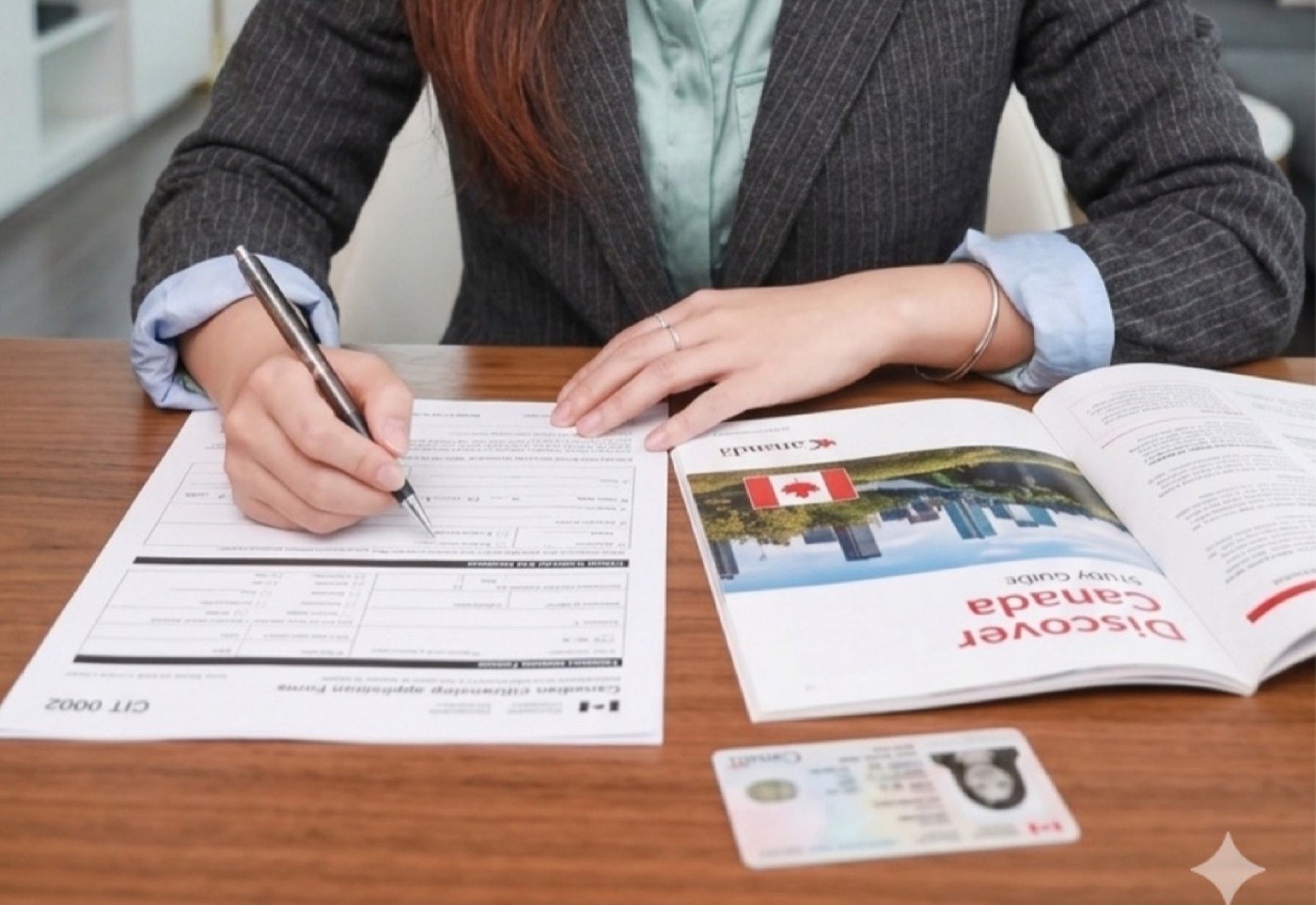
If you are between 18 and 54, you must take a 45-minute citizenship test, most often taken online. To prepare, read the free official guide Discover Canada.
5. What the test covers
The test covers what a future citizen is expected to know about Canada:
- The rights and responsibilities of citizenship
- Canada's history and institutions
- The geography and regions of the country
- The political system: elections, levels of government, justice system
- Canadian symbols
All questions are drawn from the official study guide. The test has no trick questions and does not assess your French or English — it only checks your knowledge of Canada.
6. The test format
The test has 20 questions, multiple choice or true-or-false, and lasts 45 minutes; you need at least 15 correct answers (75%). You have 3 chances to pass within the 30-day period given in your invitation. These values are set by IRCC and may change — check them on the official citizenship test page.
The online test is now the default for most applicants (taken from home, monitored by webcam); IRCC offers an in-person or Microsoft Teams test only if you need an accommodation. Whatever the format, you get the same 3 chances, and you choose to answer in French or English.
The stable rule, whatever the format: it's a closed-book test, based on a single official study document.
| Element | Detail |
|---|---|
| Format | 20 multiple-choice or true-or-false questions, 45 minutes, at least 15 correct |
| Type | Closed-book, based on the official Discover Canada guide |
| Language | French or English of your choice |
| Attempts | 3 chances within the 30-day period of your invitation |
| Official source | Discover Canada guide (IRCC) |
7. The official study guide
The official study guide is titled « Discover Canada: The Rights and Responsibilities of Citizenship ». It is free, published by IRCC, and is the single source of the test material.
You can download it from the IRCC site in several formats — PDF, large-print version, e-book and audio file — so you can study by reading or by listening.
IRCC revises this guide periodically. Always download the most recent version directly from canada.ca, rather than a copy found elsewhere: an old edition may contain outdated information.
8. How to prepare effectively
The strategy that works doesn't depend on any specific number — it stays valid even when the test changes:
- Read the guide all the way through, once, without trying to memorize everything
- Read it a second time, taking notes on dates, names and institutions
- Focus on the heavy chapters: history, government, elections and the justice system come up most often
- Answer the study questions at the end of the official guide
- Do several timed practice tests to get used to the pace
- Study a little each day over two to four weeks rather than everything the night before
9. The interview with an officer
After the test, IRCC may invite you to an interview with a citizenship officer, depending on your case — it is not automatic. This meeting serves to confirm your identity, check your original documents, and confirm that you meet the conditions of your application.
It is also when the officer informally observes your ability to communicate in French or English. Bring the original documents listed on your invitation: passport, permanent resident card, and any requested document.
Answer simply and honestly. The interview is not a surprise second test — it's an administrative verification.
10. If you fail the test
Failing the test is not the end of your application. IRCC gives you 3 chances within the 30-day period given in your invitation; check the rules in force on your invitation and on the official citizenship test page (linked in section 6).
If you fail all 3 attempts, you are invited to a hearing with a citizenship official, who asks you the questions out loud (20 questions, 15 to pass) and may assess your French or English. If you fail the hearing, the application is refused: you then have to apply again and pay the fees again (IRCC).
Most failures come from too-light preparation. Go back to the official guide, identify the chapters that let you down, and do more practice tests before the next attempt.
11. Your preparation checklist
Follow these steps to approach the test with confidence. Check each box as you go — your progress is saved if you're signed in.
Your action list
0 of 7 done
12. The ceremony and the oath
If your application is approved and you pass the test, you'll be invited to a citizenship ceremony. You'll take the citizenship oath and receive your Canadian citizenship certificate.
13. How long does it take?
Processing time: IRCC currently estimates it at about 12 months (estimate published in September 2026), but it changes often. Check up-to-date timelines on the Immigration, Refugees and Citizenship Canada (IRCC) website.
2026 fees (in effect since March 31, 2026). A family of 2 adults + 2 children pays $1,506 in government fees, plus translation of foreign documents. No legal representation needed for a standard application.
| Item | Cost (CAD) | Detail |
|---|---|---|
| Adult — total fees | $653 | $530 application + $123 right |
| Minor (under 18) | $100 | Application only |
| Family — 2 adults + 2 children | $1,506 | Combined total |
| Document translation | Depends on the translator | Per foreign document |
| Legal representation | ❌ Not required | Standard application |
| Test retake (up to 2 more) | Free | 3 attempts within 30 days, then a hearing |
14. Frequently asked questions
The most common questions about citizenship: dual citizenship, what happens if you fail the test, days outside Canada that count, ceremony delays, and the total cost.
Will I lose my original citizenship?
Canada allows dual citizenship — it won't ask you to renounce your original passport. But the answer also depends on your country of origin: some countries automatically withdraw their nationality from people who acquire another one, others accept it. Pakistan, for example, has dual-nationality arrangements with a list of 22 countries, including Canada (Pakistan's official list).
Check your country's rules with its embassy or consulate before applying — losing your original citizenship is often irreversible.
What happens if I fail the citizenship test?
You have 3 chances to pass within the 30-day period given in your invitation, at no additional cost. Only after failing all 3 are you invited to a hearing with a citizenship official, who asks you similar questions out loud; if you fail the hearing, the application is refused (IRCC).
Most failures come from not studying the Discover Canada guide thoroughly enough. Prepare seriously — 75% (15/20) is required.
Do days spent outside Canada count toward physical presence?
In general, no — only days physically spent in Canada count. Two situations are credited differently (IRCC):
- Time spent in Canada as a temporary resident or protected person before permanent residence: each day counts as half a day, up to 365 days of credit
- Time spent abroad as a Crown servant or a member of their family: each day counts as a full day
Vacations, business trips, and family emergencies outside Canada don't count. Use the official IRCC calculator — estimating leads to refusals.
How long between submitting my application and the ceremony?
IRCC currently estimates the processing time for a citizenship application at about 12 months (estimate published in September 2026). It changes often: check IRCC's processing-times tool before relying on a number.
It covers the steps after you apply: the test, a possible interview, then the invitation to the ceremony.
What's the total cost?
The official government fees (since March 31, 2026):
- Adult: $653 ($530 application + $123 right of citizenship)
- Minor (under 18): $100 only
A family of two adults and two children would therefore pay $1,506 total.
Add translation costs for foreign documents (the rate depends on the translator) and possibly photos for the certificate. No legal representation is needed for a standard application.
Is the citizenship test difficult?
It is not difficult for someone who has actually read the official guide. The questions are factual, not tricky, and they all come from one document.
The candidates who struggle are almost always those who did not prepare, relying on general knowledge or on unofficial sites. A few weeks of regular study, with two readings of the guide and a handful of practice tests, is enough for the large majority.
Can I take the test in French?
Yes. You choose to take the test in French or English — the two official languages of Canada — and the official study guide is published in both.
The test itself does not assess your language skills; it only checks your knowledge of Canada. Your language level is observed separately, informally, during the interview, and proof of language is a separate requirement of the application.
What should I bring on the day of the interview?
Bring the original documents listed on your invitation — usually your passport (including expired ones covering the relevant period), your permanent resident card, and any document IRCC specifically requests.
The exact list is on your invitation letter, so read it carefully and prepare each item in advance. Showing up without an original document can delay your file. When in doubt, bring more rather than less.
15. See also
These related guides may be useful:
- Apply for a Canadian passport — the natural first step after the citizenship ceremony.
- Renew or replace your permanent resident card — the status required before applying for citizenship.
- Family sponsorship in Quebec — a pathway to bring spouse, children or parents during the journey.
- Residence days calculator — verify whether you've reached the required 1,095 days.
- The path to citizenship — every step from permanent residence to the oath.
- Voting in elections in Quebec and Canada — the first right you gain as a new citizen.
16. Official sources
For official information:
- Become a Canadian Citizen (IRCC)
- Calculate your physical presence (IRCC)
- Eligibility for citizenship — adults and minor children
- Discover Canada study guide
- Notice: Right of citizenship fee increasing — the source for the current $653/$100 fees
- Citizenship test: Test results and next steps — the source for the 3-attempts rule
- Pakistan's dual-nationality country list (Directorate General of Immigration & Passports) — confirms Canada is covered (English-only, Pakistan has no French-language official site)
You can also call IRCC at 1-888-242-2100.
Author's Note: Citizenship isn't required to stay in Canada, but it deeply changes your relationship with your adopted country. Prepare early, keep your documents, and savor the moment when it comes.