1. Two authorizations, two governments
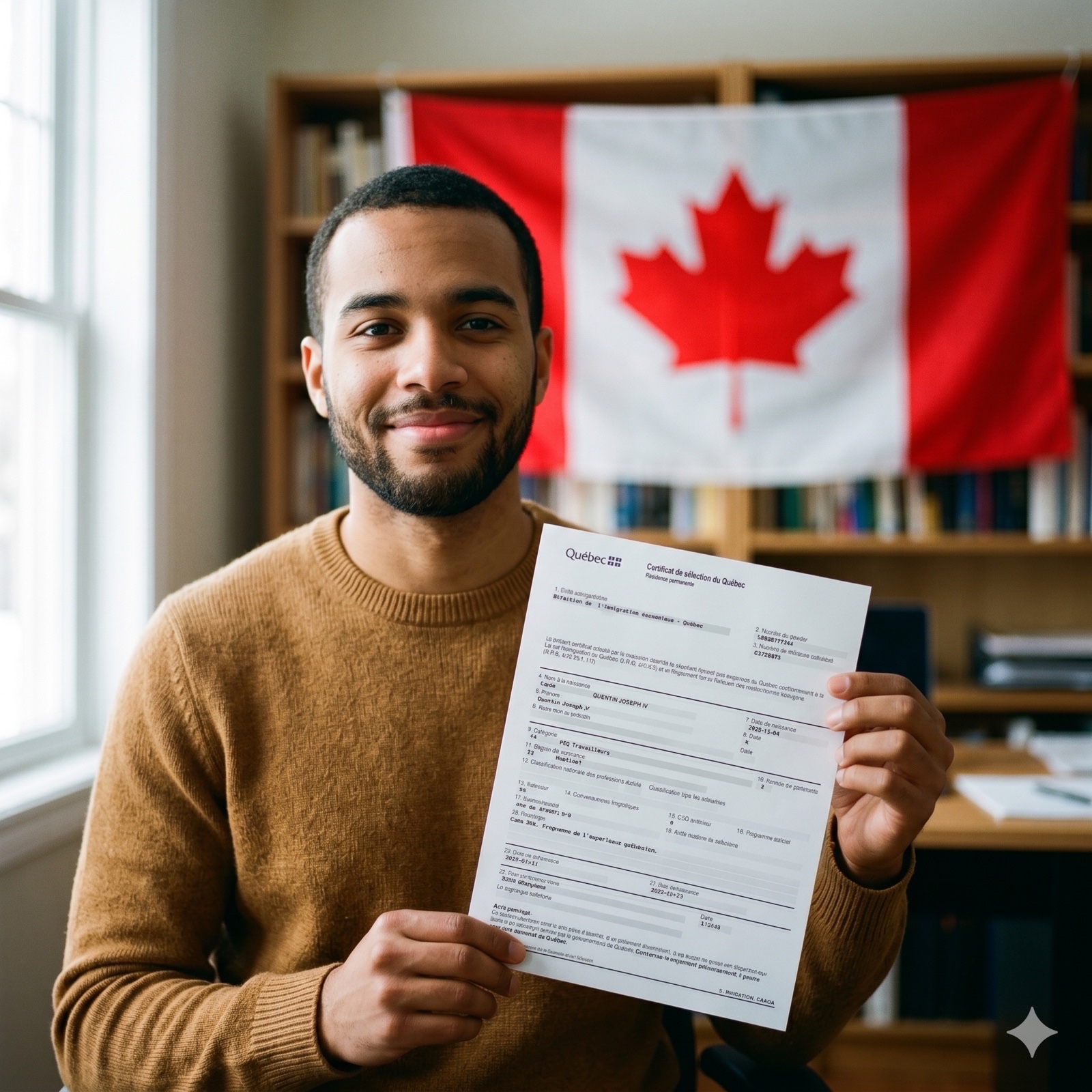
To study in Quebec you need two separate documents, issued by two governments:
- The CAQ for studies — issued by the Quebec government
- The study permit — issued by the federal government of Canada
The order is fixed: the CAQ first, then the study permit.
| CAQ for studies | Study permit | |
|---|---|---|
| Issued by | Quebec government (MIFI) | Government of Canada (IRCC) |
| Apply | First | Second |
| Prerequisite | Admission letter from an institution | CAQ obtained |
| Role | Provincial selection + attestation letter | Legal authorization to study in Canada |
| Renewal | First (if studies extended) | Second |

2. Step 1 — the CAQ for studies
The CAQ for studies is requested online from the MIFI, after receiving a letter of admission from a school.
Fees apply; check the amount and current processing time on the official Quebec page about the temporary selection application for studies. Also watch the cap: from December 17, 2025 to December 16, 2027, Quebec sets by decree a maximum number of CAQ applications for studies per institution (vocational, college and university levels). Once that number is reached, a non-exempt application is deemed inadmissible — check with your school before you apply.
Important advantage: the CAQ for studies also serves as a provincial attestation letter, the document the federal government now requires to process most study permit applications. You have no separate step to obtain it.
3. Step 2 — the federal study permit
Once you have the CAQ, you apply for the study permit from IRCC. You attach the CAQ attestation.
The physical study permit is generally handed to you on arrival in Canada by the border officer. Check the conditions printed on it as soon as you receive it.
4. A study permit is not a work permit
A study permit authorizes you to study first. The right to work off-campus is not automatic — it appears as a condition printed on the permit itself.
Your permit may carry a remark that authorizes off-campus work, or one that forbids it. Until you have read those conditions, you do not know whether you have the right to work.
5. Who is eligible for off-campus work
To work off-campus, several conditions must be met at the same time:
- You are a student full-time at a recognized institution
- Your program (post-secondary, or secondary-level vocational training in Quebec) lasts at least 6 months and leads to a diploma, certificate or degree
- Your courses have started — not just your admission accepted
- Your study permit carries a condition that authorizes off-campus work expressly
- You have a social insurance number (SIN)
These eligibility criteria are set by the federal government and have changed before. Check the conditions in force on the IRCC site before looking for a job.
6. The hour limit: study sessions versus breaks
Off-campus work is governed by an hour limit that depends on the time of year:
- During study sessions — you may work up to 24 hours per week
- During official breaks in the academic calendar — summer holidays, the winter break, reading week — you may work full-time, with no weekly limit
Important: the 24-hour limit is the figure in force today, but it is set by the federal government and has already changed. It was 20 hours in the past. Remote work for an employer outside Canada does not count toward these 24 hours, as long as you meet your permit's conditions. Always check the limit in force on the IRCC site before accepting a job or extra hours.
| Situation | Authorized working hours |
|---|---|
| During study sessions | 24 hours / week |
| Official school holidays | Full-time (no limit) |
| Graduate awaiting PGWP | Full-time, if you could work off campus and applied for the PGWP before your study permit expired |
| Without valid study permit | Prohibited |
7. On-campus work versus off-campus work
Two forms of work exist for an international student, and they do not follow the same rules:
- On-campus work takes place inside your institution — library, cafeteria, lab, student services
- Off-campus work is with any employer elsewhere in the city
The weekly hour limit discussed in this guide concerns off-campus work. Hours worked on campus follow their own rules. As always, the conditions printed on your permit prevail — read them to know what you may do. And for an internship or co-op placement: since April 1, 2026, a post-secondary student no longer needs a co-op work permit; a secondary-school student still does (IRCC).
8. The SIN: essential to work and be paid
To work legally in Canada and be paid correctly, you need a Social Insurance Number — the SIN.
It is a nine-digit number that every employer requires before paying you a salary. Without a SIN, you cannot be declared as an employee or receive your year-end tax slips.
Service Canada issues the SIN, usually on the spot during your visit, with your passport and your study permit. Apply for your SIN as soon as your courses have started and you are ready to look for work.
9. Tracking your hours — and why it matters
The responsibility for respecting the limit is yours, not your employer's. Keep a personal record of all your off-campus hours, week by week.
If you have two jobs, add up the hours from both: the limit applies to the total, not to a single employer. Note which weeks are study sessions and which weeks are official breaks, because the rule changes between them.
Keep your pay stubs and your schedule: they are your proof. If your status is ever verified, you are the one who must show that you respected the limit.
10. After graduation
After your studies, the Post-Graduation Work Permit (PGWP) can let you work in Canada and gain experience that opens a path to permanent residence.
Its eligibility conditions — program length and type, recognized institution, language level — change regularly. Check the rules in force well before your studies end.
11. Your action list
Follow these steps in order to obtain your study authorizations. Check each box as you go — your progress is saved if you're signed in.
Your action list
0 of 11 done
12. Frequently asked questions
The most common questions on the CAQ and study permit: why two documents, what the provincial attestation letter is, timelines, and working during studies.
Why do you need two documents to study in Quebec?
Because immigration is a shared responsibility in Canada. Quebec chooses who it accepts on its territory — that's the CAQ. The federal government issues the permit that legally authorizes you to be in Canada as a student — that's the study permit.
Other provinces issue a separate provincial attestation letter; in Quebec, the CAQ for studies plays that role itself. You complete the Quebec step first, then the federal step.
How long do these steps take?
The processing times of the CAQ and study permit vary, and they have changed often in recent years. Do not rely on a number you saw on a forum.
Check the current processing time for the CAQ on the Quebec government site, and for the study permit on the IRCC site, before planning.
The safe rule: start the CAQ application as soon as you have your letter of admission, and never assume the documents will arrive 'just in time'.
My CAQ or permit is expiring — what do I do?
Both the CAQ and the study permit have an expiry date. If you continue or extend your studies, you must renew them before expiry — and once again, the CAQ first, then the study permit.
Filing your renewal before expiry of the current document lets you keep your status while you wait for the decision. Never let a permit lapse.
Can I work as soon as I arrive as a student?
The right to work off-campus comes from the conditions printed on your study permit — read them. When allowed, a weekly hour limit applies during sessions, and full-time is permitted during breaks.
You also need a SIN (Social Insurance Number) to work and be paid correctly — Service Canada issues it on the spot with your passport and study permit.
Is the limit really 24 hours per week?
24 hours per week during study sessions is the figure in force at the time this guide was written. But this limit is a federal IRCC rule and has changed before: it was 20 hours per week in the past.
Never treat this number as permanent. Before accepting a job or extra hours, check the limit currently in force on the IRCC site. A figure you saw on a forum or in an old guide may be out of date.
Can I work full-time during the summer?
During an official break in your academic calendar — summer holidays, the winter break, reading week — you may generally work full-time, with no weekly hour limit, provided you were a full-time student before the break and will return to full-time studies after it.
The break must be a real scheduled break in your program. The week between a job offer and your first class is not a break. When the break ends, the weekly limit applies again immediately.
What happens to my permit if I go over the limit?
Working more hours than permitted is a breach of the conditions of your study permit. The consequences are serious: you can lose your student status, see a future post-graduation work permit refused, and in serious cases be ordered to leave Canada.
The limit applies to the total of all your jobs combined. If you are close to the limit, stop. Track your hours every week so you never have to guess.
13. See also
These related resources may be useful:
- Parcours — International student — all your steps from the CAQ to permanent residence.
- The SIN — Social Insurance Number — needed to work off-campus.
- Learn French for free — free classes open to many students.
- The PGWP and the path to permanent residence — what comes after graduation, toward permanent residence.
- Renewing or Extending Your Permit in Quebec — how to extend your study permit before it expires, and avoid losing status.
14. Official sources
Author's Note: the only truly costly mistake here is mismanaging time. The CAQ first, the permit next, each with its own processing time. Get the machine moving the moment you have your letter of admission.