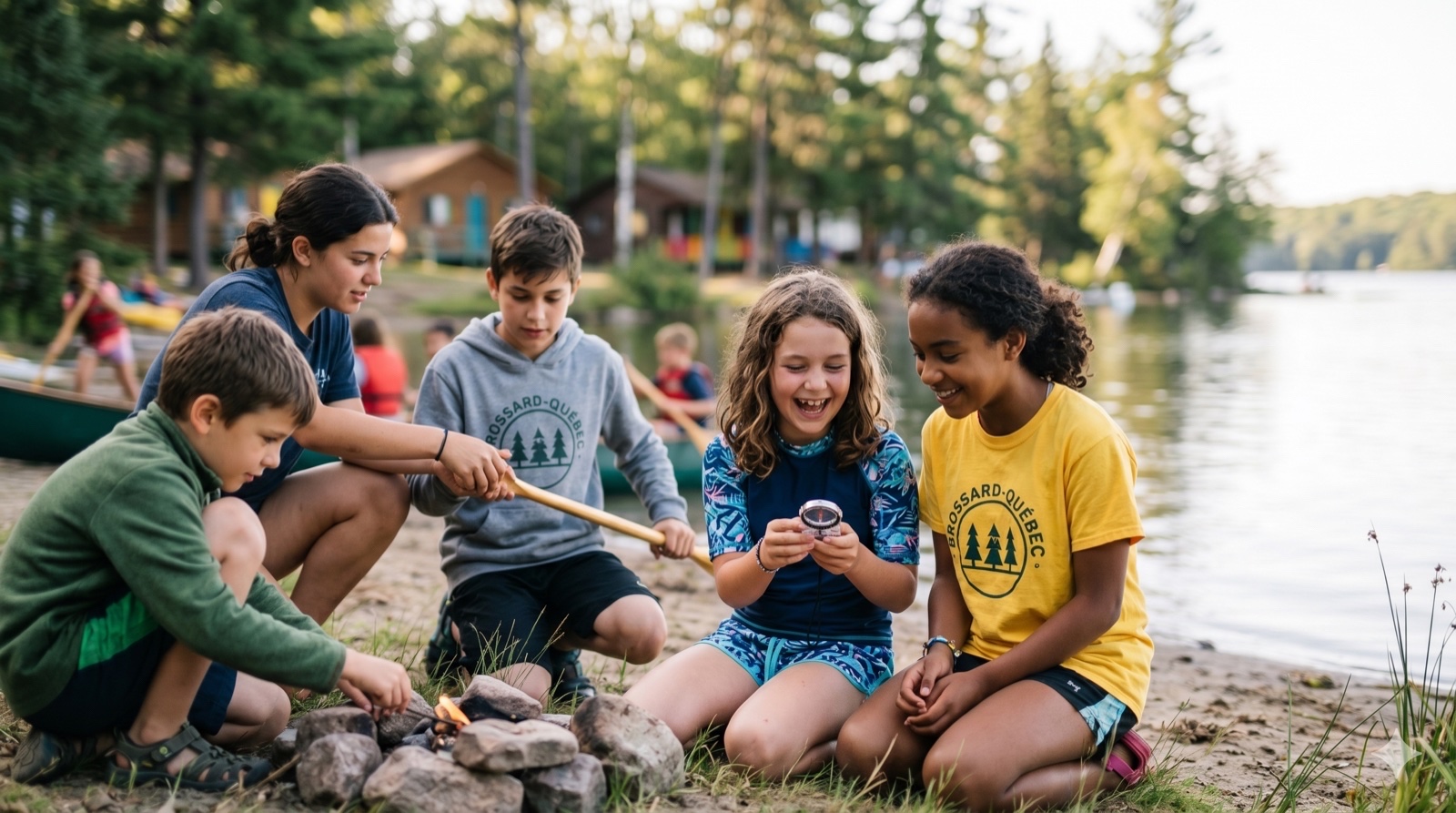
Les camps d'été offrent des expériences enrichissantes pour les enfants de 5 à 17 ans.
1. Types of summer camps in Quebec
There are two main types of summer camps for children in Quebec:
Day camps (camp de jour): the child returns home each evening — similar to a summer daycare. Organized by cities, community organizations, sports centres or private companies. Generally Monday–Friday, 9 am–4 or 5 pm, with extended care available. Children do sports, arts, aquatic activities and outdoor activities.
Overnight camps (camp de vacances / camp de nuit): residential camp where the child lives at camp for one or two weeks. Often in forests or by lakes. Generally for children aged 8–17.
2. Costs and financial aid
Summer camp costs vary by type and organizer:
| Type | Weekly cost |
|---|---|
| Municipal / community day camp (Montréal) | $150–350 |
| Private or specialized day camp (sports, music, arts, science) | $300–600+ |
| Overnight residential camp | $800–2,000/week |
Financial aid available:
- Municipal subsidies — Montréal boroughs offer grants for municipal camps, on request
- Québec en Forme and other provincial organizations: camp bursaries
- Federal and provincial tax credits for children's physical and artistic activities
- Community organizations (local Centraide) can help fund camp participation for families in need
- Some residential camps have their own bursary funds — ask directly
3. How to register your child
Registrations for popular summer camps — whether municipal or residential — often begin as early as January or February for the summer season.
For Montréal municipal camps: each borough has its own registration forms and deadlines — the Ville de Montréal website centralizes information by borough.
For residential overnight camps: the Association des camps du Québec organizes a Camp Fair (Salon des camps) in January or February where you can meet representatives from dozens of residential camps in one place.
For private camps outside the municipal circuit, sites like Jasmin Roy or LocalSurf aggregate private camp offers in your region.
Most camps accept children from age 5–6 for day camps and age 7–8 for residential camps.
4. Frequently asked questions
Common questions from immigrant families about summer camps in Quebec.
When do summer camp registrations open?
Registrations for the most popular camps — especially municipal borough camps — often open in January or February, several months before summer. Private camps and specialized programs sometimes open registrations in the fall of the previous year. It is important to check the website or social media pages of each camp you are interested in as early as possible, as spots fill up very quickly.
Are municipal day camps cheaper than private ones?
Yes, generally. Municipal camps organized by city boroughs are often significantly less expensive than private or specialized camps. They also offer subsidies or reduced rates for families with lower incomes, upon request. Private or specialized camps (sports academies, language camps, arts camps) offer more specific programming but at a higher cost. For a family on a tight budget, starting with a municipal camp is often the most accessible option.
My child doesn't speak French well yet — can they still go to camp?
Yes. Most day camps and residential camps in Quebec welcome children at all French levels. Children learn the language very quickly in an immersive environment — through play, teamwork and daily interactions with counsellors and other children. Many camps have counsellors who speak other languages (English, Spanish, Arabic) and can support new arrivals. A residential camp, in particular, is often described by immigrant families as one of the most effective environments for a child to gain confidence in French in just a few weeks.
Are there half-day options for younger children?
Some day camps offer half-day programs, especially for the youngest children (ages 4–6). These shorter formats are useful for children who are not yet ready for a full day away from home. Municipal camps and community organizations sometimes offer this option — it is best to ask directly when contacting each camp. Full-day camps generally also offer extended care (before 9 am and after 4 or 5 pm) for families who need it.
5. See also
These related guides may be useful:
- Hockey and organized sports for children in Quebec — after-school sports activities.
- Activities for babies and toddlers in Quebec — for younger children.
- Immigrant family budget — planning camp costs in your budget.
6. Official sources
- For Montréal municipal camps and subsidies: montreal.ca
- For residential camps: Association des camps du Québec — campquebec.qc.ca
- For camp bursaries: Québec en Forme and local Centraide organizations
Author's Note: Quebec residential overnight camps have a very strong tradition — Quebecers remember their camp summers as formative experiences. For an immigrant child looking for friends and beginning to learn French, a residential camp is often one of the most effective linguistic and social immersions. One or two weeks at a forest camp can do more for a child's social integration than an entire school year.