1. Rio Tinto in Jonquière
Rio Tinto is the largest private employer in Saguenay-Lac-Saint-Jean.
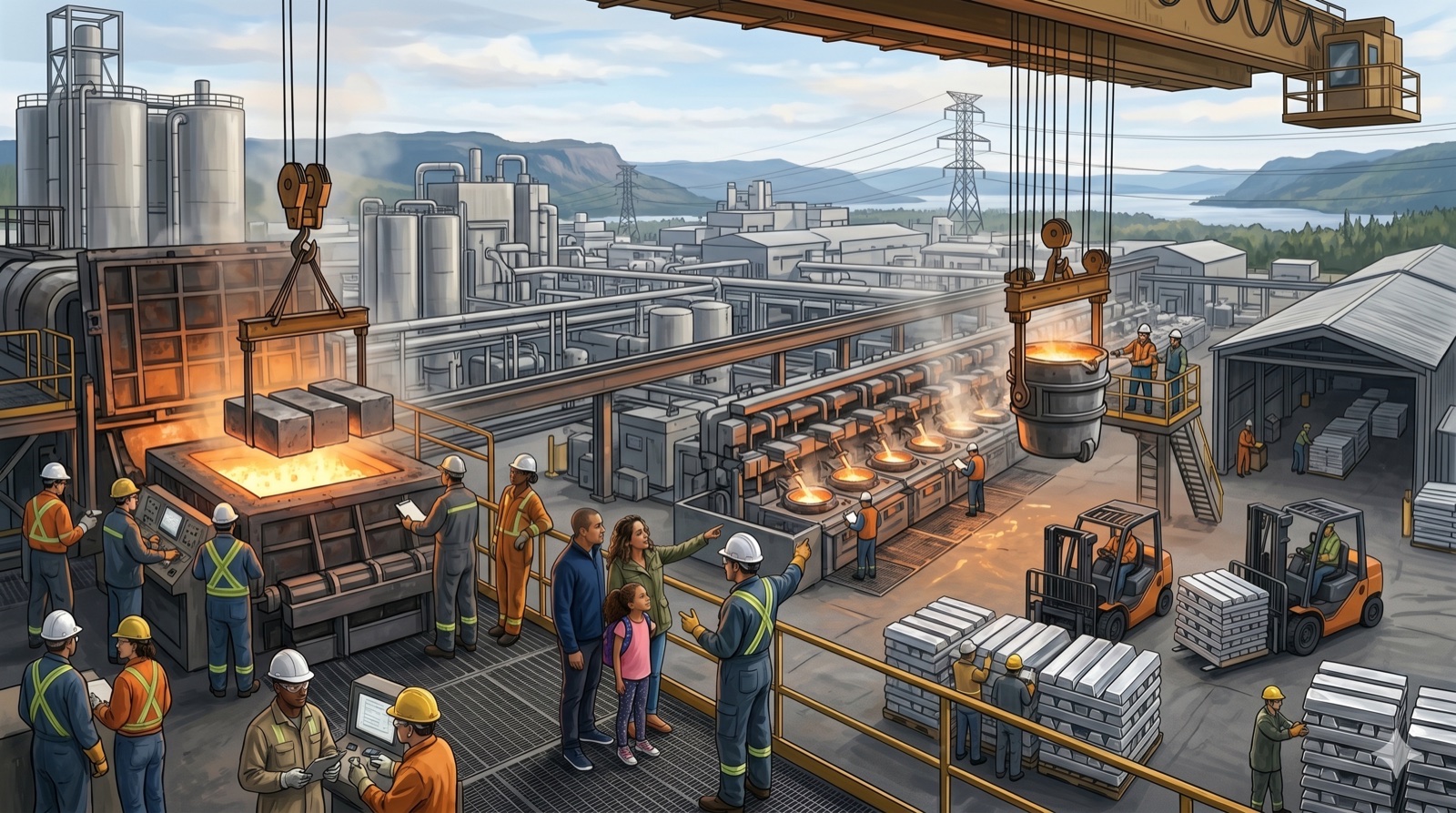
Two facilities in Jonquière: the Arvida smelter and the Vaudreuil complex — ~3,000 jobs. Rio Tinto acquired Alcan in 2007.
2. Types of positions
Position categories:
- Operators / production workers — DES or DEP often sufficient
- Technicians / industrial mechanics — technical DEC
- Engineers / chemists — university bachelor's
- Management
Many manual positions are unionized with very competitive salaries.
3. Salaries and conditions by position
Rio Tinto salaries are among the highest in Quebec for regions. Shift schedules are industry norm and earn 15 to 25 % premiums above the base salary.
Typical 2026 salaries, shift premiums included. Industrial jobs at Rio Tinto are almost always unionized — the collective agreement protects conditions, pays shift premiums, and guarantees employment security. Comprehensive benefits and generous pension plan are the norm. In return, the work can be physically demanding and often includes night and weekend shifts.
| Position | Annual salary (CAD) | Training required |
|---|---|---|
| Smelter operator | $70,000 to $95,000 | DES or DEP |
| Industrial mechanic | $75,000 to $105,000 | DEP + certifications |
| Industrial electrician | $80,000 to $110,000 | DEP + certifications |
| Chemistry technician | $60,000 to $85,000 | Technical DEC |
| Process engineer | $75,000 to $130,000 | Bachelor's + OIQ |
| Apprentice operator (training) | ~$50,000 to $60,000 | DES — paid training |
4. Conditions and benefits
- High salaries: ~$80,000 to $120,000/year for unionized workers (with premiums and overtime)
- Comprehensive benefits package
- Generous pension plan
- Employment security guaranteed by collective agreement
In return: physically demanding work, night and weekend shifts.
5. How to apply
All openings on the Rio Tinto career site.
Typical process: online application → aptitude tests → interview → (sometimes) medical exam → decision.
Allow on average 2 to 4 months between application and hiring for an operational role.
6. Frequently asked questions
The most common questions from newcomers interested in Rio Tinto: French level required, possibility of entering without industrial experience, and hiring-process duration.
What French level do I need to work at Rio Tinto?
Intermediate (Level 6-7) is the minimum for most operational roles. For management or supervisory positions: Level 8+ expected.
The Saguenay accent is particularly pronounced — even French speakers from France or Africa take 3 to 6 months to adjust.
Practical tip: practice listening via local radio (CKRS, Énergie Saguenay) before arrival. Rio Tinto and other major employers often offer French classes paid by the employer — ask at hiring.
Safety procedures are entirely in French and your ability to follow them clearly is essential.
Can I apply to Rio Tinto without industrial experience?
Yes — Rio Tinto offers an « Apprentice operator » program of about 6 to 12 months:
- Paid training path
- Requires only a high-school diploma
Industrial mechanic and electrician roles still require a Quebec DEP + technical certifications.
But operator entry roles are accessible to newcomers without industrial experience.
Traits Rio Tinto looks for: reliability, safety awareness, ability to follow procedures in French, physical fitness for shift schedules.
The most important qualification is often less the diploma than the willingness to commit to shift work and learn on site.
How long does the hiring process take?
Allow 2 to 4 months on average for an operational role, from application to start date.
The process unfolds in four steps:
- Online application
- Aptitude tests (mathematical reasoning, French comprehension, sometimes mechanical)
- Interview — often a panel of 2 to 3 people (supervisor + HR)
- Medical exam + drug test for physical roles
For technical and engineering roles, allow 3 to 6 months because foreign-credential verification with OIQ or other professional orders adds time.
Apply early — Rio Tinto often hires in cohorts tied to training calendars.
Is it better to live in Jonquière or elsewhere in Saguenay if I work at Rio Tinto?
Jonquière is the optimal location. The Arvida and Vaudreuil plants are in Jonquière itself, so most sectors put you 5 to 15 minutes from work by car.
- Downtown Jonquière: ~5 minutes
- Kénogami: ~10 minutes
- Shipshaw: 15 to 20 minutes
- Chicoutimi: 25 to 35 minutes
- Saint-Honoré: ~40 minutes
Winter snowstorms can double these times, so a short commute matters more here than in Montreal.
One caveat for Jonquière: housing is still relatively affordable for Saguenay, but the market has tightened — the vacancy rate fell to 1.6% in 2025, so don't expect to have your pick of apartments. The heritage Arvida sector — designed in 1926 as a model smelter town — is particularly walkable.
7. See also
To go further on working in Jonquière:
- Read industries and work in Saguenay for the full economic context of the region.
- See first steps in Jonquière for francisation and services that support workplace integration.
- Prepare your move-in with finding housing in Jonquière to target a sector near the Arvida or Vaudreuil plants.
8. Official sources
Author's Note: Verify credential recognition with MIFI before applying.