1. Market overview
Watch out: Jonquière's rental market is no longer loose. The vacancy rate fell to 1.6% in 2025 — a very tight market, like the rest of the City of Saguenay.
Average prices (CMHC, fall 2025):
- 2-bedroom (4½): ~$985/month (up 12% year over year)
- 3-bedroom (5½): ~$1,054/month (up 7%)
The majority of residents are owners — particularly in Arvida and Kénogami.
The total cost (rent + heating) still stays lower than Montréal — electricity remains relatively affordable thanks to regional hydroelectricity, even though the rate is the same across Quebec.
2. Main neighbourhoods
Profiles by sector:
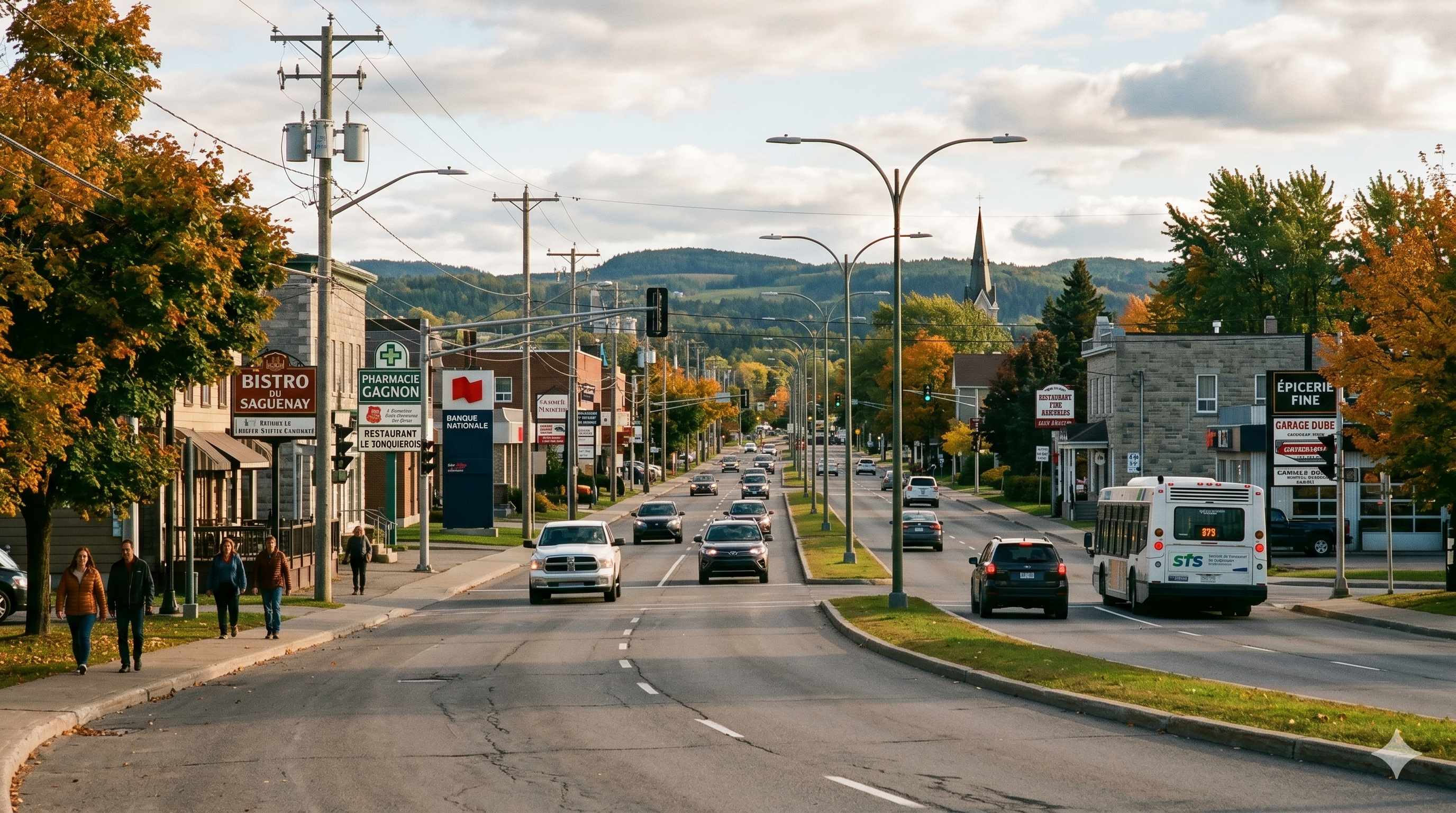
- Downtown (rue Saint-Dominique): apartments near shops, bars, restaurants. Young professionals and students.
- Arvida: heritage homes planned in the 1920s by the aluminum smelter. Middle-income families.
- Kénogami: large affordable homes, often with generous lots.
- Near the Cégep: student apartments and shared rentals.
- Saint-Cœur-de-Marie and Shipshaw: more rural sectors — for those who like space.
Arvida and Kénogami remain the most sought-after sectors for families. The downtown area and the Cégep area dominate student rentals. Shipshaw and Saint-Cœur-de-Marie offer a rural setting.
| Sector | Profile | For whom |
|---|---|---|
| Downtown (Saint-Dominique) | Apartments near shops | Young professionals, students |
| Arvida | 1920s heritage homes | Middle-income families |
| Kénogami | Large homes, generous lots | Families seeking space |
| Near the Cégep | Student apartments | Students, shared rentals |
| Saint-Cœur-de-Marie / Shipshaw | Rural sectors | Those who like space |
3. The standard lease and quirks
All leases must use the official form from the Tribunal administratif du logement — it's mandatory.
Standard period: July 1 to June 30 — creates the famous moving day on July 1.
Never sign without an in-person visit.
Saguenay-specific checks (harsh winters):
- Insulation: quality of walls, windows, doors
- Heating type: electric (most common), wood (rare), natural gas (very rare in Saguenay)
- Energy performance: a poorly-insulated apartment can double the Hydro bill in winter
- Ask for the Hydro-Québec average of the past 12 months — the landlord can provide it
4. Buying in Arvida — a unique heritage
In Arvida, homes from the 1920s-1940s are renowned for their build quality:
- Thick walls
- Well-oriented windows for natural light
- Generous lots
Heritage distinction:
- The Quebec government declared Arvida a heritage site in 2018 under the Cultural Heritage Act — the highest level of heritage protection available provincially
- A UNESCO World Heritage bid is ongoing but has not succeeded yet — a first attempt in 2017 was not retained, and the campaign has been relaunched aiming for Arvida's 2026 centennial. Arvida is not currently a UNESCO World Heritage Site
Several homes are protected by this provincial heritage-site status.
Check the rules BEFORE any renovation:
- Exterior modifications: strictly regulated
- Window replacement: materials and style imposed
- Additions: can be prohibited depending on the street
5. Where to look and practical tips
Main channels:
- Kijiji and Facebook Marketplace
- Local Facebook groups: Logement Saguenay-Lac-Saint-Jean — very active
- Student board at Cégep de Jonquière
- Local realtors: Royal LePage Saguenay, Re/Max Saguenay — free service for buyers
Jonquière-specific tip:
Before signing, ask a neighbour if the area is quiet — the proximity of Rio Tinto Arvida plants can cause noise or odours depending on wind.
6. Frequently asked questions
The most common questions on Jonquière housing: typical winter Hydro bill, commute to Rio Tinto, and best family neighbourhoods.
What's the typical winter Hydro bill for a 4½ in Jonquière?
For a well-insulated 4½ heated entirely by electricity:
- Winter (December to March): $150-$250/month
- Summer: $50-$80/month
- Annual average: ~$120/month
For poorly-insulated older buildings: expect 50-100% more.
Saguenay's electricity is at the same Hydro-Québec rate as the rest of Quebec (~$0.08-$0.10/kWh) — there's no regional discount despite the local hydroelectric production.
Always ask for the consumption history of the previous tenant before signing.
How many minutes to commute to Rio Tinto from Jonquière?
From most Jonquière sectors: 5-15 minutes by car.
The Arvida and Vaudreuil plants are within Jonquière itself — that's one of Jonquière's reasons for being.
Travel time by sector:
- Kénogami: ~10 minutes
- Downtown: ~5 minutes
- Shipshaw: ~15-20 minutes
Comparison:
- Chicoutimi: 25-35 minutes
- Saint-Honoré: 40 minutes
For Rio Tinto workers, Jonquière is the optimal location: short commute, predictable winter driving, ample free parking at all plant sites.
What are the best family neighbourhoods in Jonquière?
Arvida is the gold standard:
- Quiet streets, mature trees
- Walkable to schools
- Strong community spirit
- Ranked among Quebec's best neighbourhoods for family life
Kénogami: similar but with larger lots and slightly cheaper homes — ideal for those who want space.
Downtown (Saint-Dominique): more urban, less quiet but extremely walkable.
Shipshaw: on the outskirts, offers a semi-rural family life.
Most Jonquière elementary schools rank above the provincial average.
7. See also
To go further on settling in Jonquière:
- Read signing a lease in Quebec to break down each clause of the official form before signing.
- See working at Rio Tinto in Jonquière to aim for a sector near the Arvida or Vaudreuil plants.
- Prepare your move with first steps in Jonquière for the service point and Place du Royaume.
- Compare cities with housing in Quebec: comparing cities — CMHC average rents and vacancy rates.
8. Official sources
Author's Note: If you work at Rio Tinto, living in Jonquière puts you minutes from the plants.