1. New or used: the right choice for you
A new car costs more and loses value fast in its first years. Its real advantages:
- Full warranty from the manufacturer
- No unknown history: no hidden accident, no debt
- Reliability and recent technology
For a first vehicle on arrival, many newcomers choose used. New makes sense if you plan to keep the car for many years.

2. Private seller or dealer?
- Private seller: lower price, but no warranty and more risk
- Dealer: higher price, legal protections, limited warranty
A private seller is cheaper but with no warranty: the rule is « as is », and QST is still owed at the SAAQ on transfer. A dealer costs more but offers the legal warranty of fitness under the Quebec Consumer Protection Act, plus financing. For a first purchase without experience, the dealer remains safer.
| Criterion | Private seller | Dealer |
|---|---|---|
| Price | Lower | Higher |
| Legal warranty of fitness | ❌ (« as is ») | ✅ |
| GST (5 %) | ❌ | ✅ |
| QST (9.975 %) | ✅ | ✅ |
| Financing offered | ❌ | ✅ |
| Risk | Higher | Lower |
3. Check the vehicle history
Always request a vehicle history report before buying:
- CarFax Canada — about 50 $
- Reveals: accidents, previous owners, mileage, liens
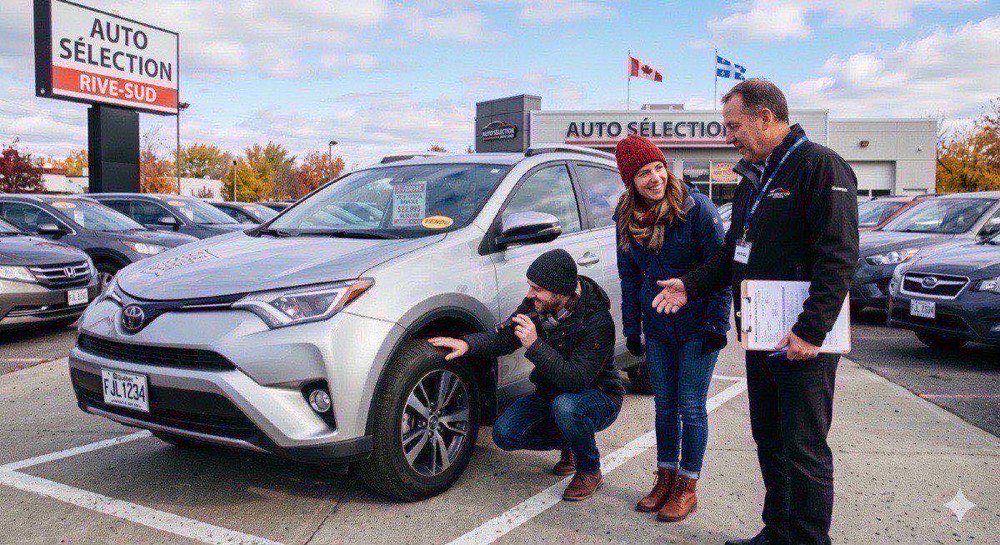
4. Mechanical inspection
Get an independent mechanical inspection:
- Mechanic of your choice (not the seller's)
- Cost: 100 to 200 $
- Leverage to negotiate or walk away from the purchase
5. Negotiating the price
Price is almost always negotiable:
- Compare on AutoHebdo, Kijiji, Marketplace
- Typical margin: 5 to 15 % negotiable
- Use defects found as arguments
6. Transfer and registration
The transfer happens at the SAAQ:
- Seller + buyer together (or power of attorney)
- You pay: QST 9.975 % on the price + registration fees
- Car insurance before taking the car (mandatory)
7. Buy or lease?
Two ways to get a new car:
- Buy (often on credit): you become the owner, payments end, you keep the car
- Lease a car: lower monthly payments, but you do not own the car
A lease imposes an annual mileage cap, often around 20,000 km; every kilometre over is billed. Wear judged excessive is also billed on return. Leasing costs less per month but, over the long term, buying and keeping the car after the loan is usually cheaper.
| Criterion | Buying | Leasing |
|---|---|---|
| Ownership | ✅ You own the car | ❌ You return it at the end |
| Monthly payment | Higher | Lower |
| Mileage limit | None | ⚠️ Annual cap, extra km billed |
| Wear and tear | Your call | ⚠️ Excess wear billed on return |
| Long-term cost | Usually cheaper if you keep it | More expensive over many years |
| Best if | You keep cars a long time | You like a new car every few years |
8. Understanding the real price
The advertised price is not the final price you pay — but in Quebec, the law protects you more than in most other provinces. Since 2010, the Consumer Protection Act requires every dealer's advertised price to already include freight and preparation fees (usually around $1,300 to $2,000, depending on the model) plus administrative fees like RDPRM registration. The dealer cannot legally add these afterward.
What's still added legally on top of the advertised price:
- GST (5%) and QST (9.975%) — about 15% more
- Registration duties and fees from the SAAQ
- A specific duty on new tires, about $4.50 each
The car's price is negotiable almost always; the taxes, never. If you give your old car as a trade-in, its value reduces the amount on which taxes are calculated. If a salesperson tries to add freight or prep fees on top of the price you were already quoted, that's illegal — ask for them to be removed.
9. Financing
Three financing sources:
- The dealer — often through the manufacturer, sometimes at a promotional rate (0% on some models)
- Your bank or caisse — compare their rate
- Paying cash — no interest, no debt
10. The warranty
A new car is covered by the manufacturer's warranty. Its length varies by maker — typically:
- Basic warranty: about 3 years / 60,000 km
- Powertrain: about 5 years / 100,000 km
On top, the legal warranty applies under Quebec's consumer protection law.
11. Electric vehicles
An electric vehicle costs more to buy but is cheaper to use (energy, maintenance).
Government incentives have existed to lower the purchase price. But these programs, their amounts and their availability change frequently and can be reduced or paused. Never assume a rebate: check the program's current status on the official sites before signing.
12. Your action list
Follow these complete steps to safely buy a used car. Check each box as you go — your progress is saved if you're signed in.
Your action list
0 of 12 done
13. Frequently asked questions
The most common questions on used-car purchases: paying QST even between private sellers, inspection at an independent mechanic, buying without Canadian credit, used-car warranty, and required road test.
Do I pay QST if I buy from a private seller?
Yes — QST (9.975 %) is owed on every used-vehicle transfer in Quebec, including private sales.
It's calculated on the higher of:
- The sale price
- The vehicle's value per the Guide d'évaluation Hebdo (the official valuation guide used by Revenu Québec and the SAAQ)
You pay it at the SAAQ during the ownership transfer. GST (5 %) only applies to sales by a dealer.
Tip: be honest about the price — SAAQ compares it to the reference value, and undervaluation is fraud.
Is the independent mechanical inspection really worth it?
Yes — non-negotiable. Costs 100 to 200 $ and reveals problems the seller won't disclose: rust under the body, brake wear, transmission issues, hidden accident damage.
On average, the inspection report saves you 500 to 3,000 $ through negotiation or by avoiding a problem vehicle.
Never accept « the seller already had it inspected » — ALWAYS use your own mechanic (not the one recommended by the seller). CAA-Québec offers a verification service if you don't have a trusted mechanic.
Can I finance a used car without Canadian credit?
Yes, but the rates are punishing. Specialty « subprime » lenders accept newcomers with no Canadian credit at rates of 12 to 25 % (vs 5 to 8 % for good credit).
Better strategies:
- Save and buy outright a reliable 3,000 to 7,000 $ vehicle as your first car
- Wait 12 to 18 months while building Canadian credit with a secured credit card
- Ask a Canadian relative to co-sign
Avoid « no credit, no problem » dealers — their markups are huge.
Is there a warranty on a used car?
The Quebec Consumer Protection Act requires a « proper-functioning warranty » on vehicles bought from a dealer — its length depends on the vehicle's age and mileage at the time of sale (table in effect since April 2024): 6 months for a vehicle 4 years old or less with under 80,000 km, down to 1 month for a vehicle up to 7 years old or 120,000 km; beyond that, this specific warranty no longer applies.
A 3-year-old car with 80,000 km falls in the middle band: 3 months or 5,000 km (whichever comes first) of parts-and-labour coverage. If a proper-functioning issue appears during that period, the dealer must repair the vehicle, exchange it, or refund you.
Separately, the Act also requires goods to serve for « a reasonable time » given their price — but that broader rule has no fixed number of days; it's assessed case by case based on price, age and mileage.
Private sales carry no warranty of this kind — the rule is « as is ». An active manufacturer warranty (powertrain, electrical) may still apply, whether bought privately or from a dealer.
Is a road test required before buying?
Not legally required, but absolutely essential. Drive the vehicle for at least 30 minutes on highway AND city streets. Check for:
- Smooth gear shifts
- No shaking at high speed
- Brakes that don't pull to one side
- Air conditioning AND heating working (critical for Quebec winters!)
- No warning lights on the dashboard
- All windows and locks functional
- No unusual noises at low or high speed
Don't be intimidated — sellers who refuse a real road test usually have something to hide.
Is the price of a new car really negotiable?
Yes. The PDSF (manufacturer's suggested retail price) is a starting point, not a fixed price. The vehicle price, and sometimes the financing rate, are negotiable. The taxes (GST and QST), are not.
The freight and preparation fees are essentially not something to negotiate separately — under the Consumer Protection Act, they must already be included in the dealer's advertised price, and the dealer cannot legally charge them on top. If someone tries to add them afterward, that's illegal.
Get written quotes from two or three dealers for the same model and compare the « all-in » price — not the monthly payment, which can hide a longer contract.
Is it better to buy or to lease?
It depends on your use.
- Leasing suits those who want a lower monthly payment, change cars every few years, and drive modest, predictable distances
- Buying suits those who keep a car for years: once the loan ends, you own the vehicle and have no more payment
Over a long period, buying is usually cheaper overall. Watch the lease mileage cap (often ~20,000 km/year): exceeding it, or returning the car with excess wear, brings extra charges.
Can I cancel the purchase after signing?
Mostly no, with one narrow exception. If you pay cash or with a personal loan from your own bank, once the contract is signed at the dealer, you are legally committed: unlike door-to-door sales, this kind of purchase has no automatic right to cancel.
The exception: if you finance through an installment sale contract signed on the spot at the dealer (the dealer arranges the loan), the law gives you 2 business days to cancel — as long as you haven't taken possession of the vehicle. The clock starts once both you and the dealer hold a copy of the contract.
Never count on this exception — it's narrow, and you must still never sign under pressure. If a salesperson rushes you, that's a reason to leave, not to sign. Take the contract home, read every line, and come back to sign only when you are certain.
14. See also
Related guides that may be useful:
- Exchange your driver's licence at the SAAQ in Quebec — prerequisite to take ownership of the vehicle and sign the registration.
- Car insurance in Quebec — mandatory before driving the car, to be taken out before signing at the SAAQ.
- Build your Canadian credit in Quebec — to get a good auto-financing rate if you plan to borrow.
15. Official sources
For official information:
Author's Note: Take your time. Poorly chosen = thousands in repairs. Well chosen = often the smartest purchase you'll make on arrival.