Aller au contenu

Everyday Life

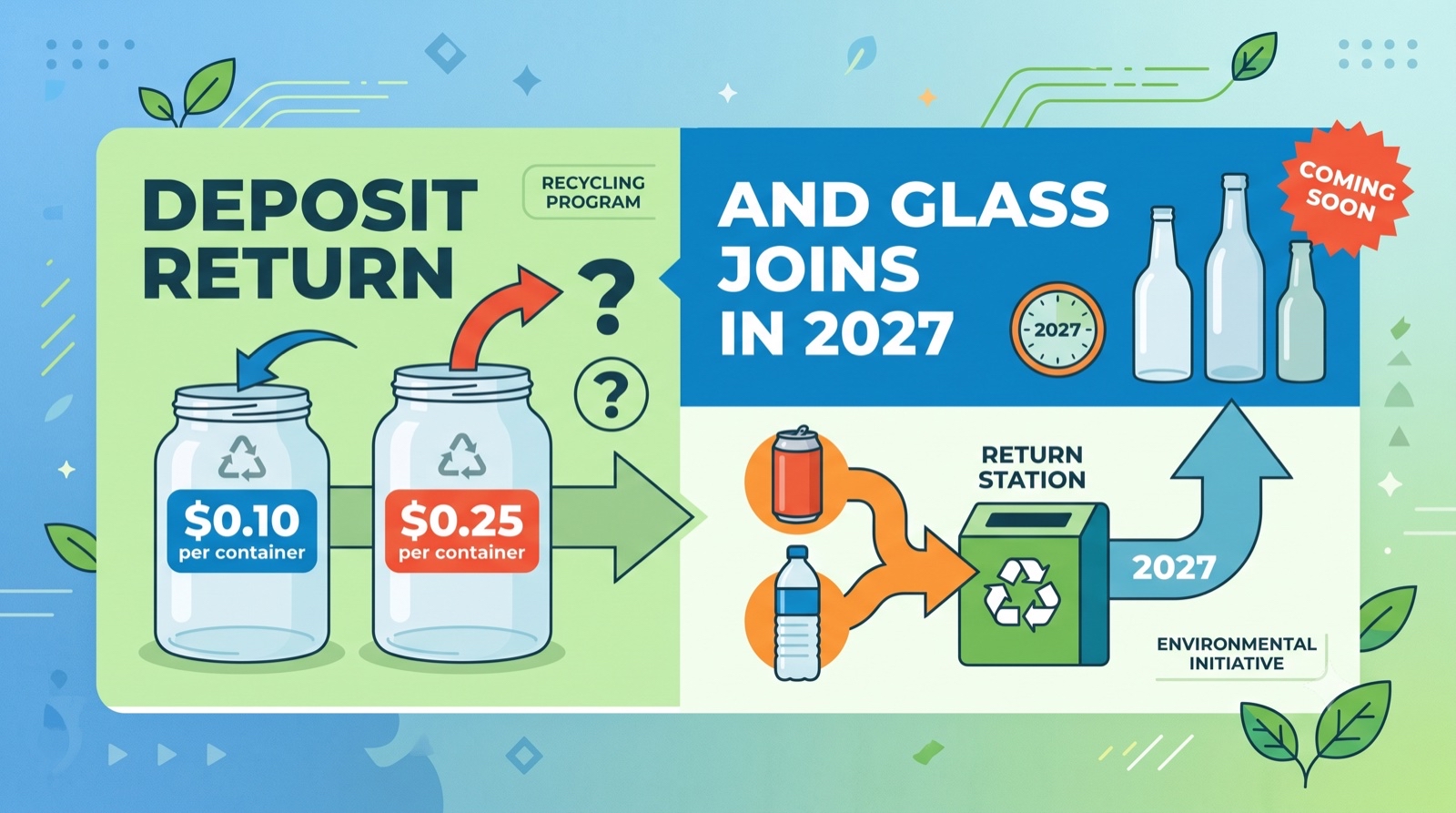
Deposit return: $0.10 or $0.25 per container — and glass joins in 2027

Quebec's deposit system is expanding in three phases. What you're already paying without realizing it, and how to get it back.

Vieauqc TeamJuly 17, 2026
Listen to the articleParagraph 1 / 9

You've already paid a deposit — probably without noticing. In Quebec, an amount is added to the price of most beverage containers at purchase, and you get it back when you return the empty. That system is expanding, and the next step has a date on it.

How much, exactly. Two amounts: $0.10 for most covered containers, and $0.25 for glass containers of at least 500 ml and no more than 2 litres, according to Consignaction. It isn't a tax: it's a deposit that comes back to you in full when the container is returned. Not returning your containers means leaving that money on the table.

Three phases, one still ahead. The expansion happens in stages:

  • November 1, 2023 — aluminum containers that weren't previously covered (juice cans, sparkling water, and so on) join the beer and soft drink containers already in the system.
  • March 1, 2025 — all other plastic beverage containers, from 100 ml to 2 litres.
  • March 1, 2027glass, other breakable materials, ferrous metal, multilayer and bio-based containers. This is the phase still to come.

In other words: your wine bottle or multilayer juice carton is not yet covered by the deposit. It will be in March 2027.

Where to return them. The system calls for a minimum of 1,200 return points spread across Quebec: retailers (stores with a sales area over 375 m², so most supermarkets) and dedicated return centres run by the designated management organization. By March 1, 2027, at least 400 dedicated return sites must be up and running.

The rollout has repeatedly slipped, and it shows. To be honest about the state of things: this reform has been pushed back more than once — the glass and multi-layer phase itself was delayed to 2027, as CBC reported, and the network of dedicated return points has lagged behind its targets. In practice, depending on your neighbourhood, returning containers may still mean queuing at a machine inside a grocery store rather than dropping by a dedicated centre.

Good to know for newcomers. The deposit often catches people out: the shelf price includes neither taxes nor the deposit, so the total climbs twice. The local habit is simple — keep a dedicated bag for deposit containers and empty it during your weekly grocery run rather than making a special trip. Check the deposit logo on the container: that's what decides, not what the material looks like. And don't toss a deposit container into the recycling bin: the gesture is still environmentally sound, but you forfeit your deposit. For return points near you and the current list of covered containers, go to the official sources rather than the summaries making the rounds.
Go deeper

Our full guides on this topic

More in Everyday Life

Our other articles in this category

Vieauqc TeamYesterday

Everyday Life

Moving: change your address with 7 agencies at once

Moving: change your address with 7 agencies at once

The Service québécois de changement d'adresse notifies seven departments and agencies in a single free step.

Moving in Quebec also means a long list of people to notify. Good news: for the government side, a single service does the job with several agencies at once. What it is. The Service québécois de changement d'adresse (SQCA) lets you send your new address to seven departments and agencies in a single step, as the Government of Quebec explains. It's free. The seven bodies covered. The SQCA notifies, all at once: Revenu Québec, the Régie de l'assurance maladie du Québec (RAMQ), the Société de l'assurance automobile du Québec (SAAQ), Retraite Québec, the Ministère de l'Emploi et de la Solidarité sociale, the CNESST, and Élections Québec. How to use it. The process is done online, anytime, on the official portal adresse.gouv.qc.ca. Have some identifying information ready (date of birth, social insurance number and, depending on the agency, a file number). Do it as soon as possible after moving — the SAAQ, in particular, must be notified within 30 days. What it does NOT cover. The SQCA…

Vieauqc TeamYesterday

Everyday Life

Mandatory winter tires: what to know before December 1

In Quebec, winter tires are mandatory from December 1 to March 15. Here's the rule and how to comply.

If you drive in Quebec, a rule unique in North America awaits you this winter: winter tires are mandatory. It's still early in July, but it's worth knowing well before the first snow. The dates. According to the Government of Quebec, your vehicle must be fitted with four winter tires from December 1 to March 15. The tires must be installed by December 1 at the latest — book your garage appointment in November, as shops fill up fast. Which tires qualify. A tire designed for winter must carry the official pictogram (a mountain with a snowflake) or be studded. Since 2014, the "M+S" marking alone is no longer enough. The rule applies to all passenger vehicles registered in Quebec, including rental vehicles. The fine. Driving without compliant winter tires during the mandatory period exposes you to a fine of $200 to $300, on top of the very real risk on the road. Preparing the rest of the vehicle. The SAAQ reminds drivers that beyond tires, a Quebec winter means checking the battery,…

Vieauqc TeamYesterday

Everyday Life

Back-to-school 2026: enrolling your child in Quebec

The 2026-2027 year starts in late August. Here's how to enrol a child in public school as a newcomer.

The new 2026-2027 school year is coming up. For elementary and secondary students, classes usually resume in late August, but the exact date varies from one school service centre (centre de services scolaire, or CSS) to another — check your CSS's calendar for the precise date in your area. Who has to attend. In Quebec, school attendance is compulsory, as the Government of Quebec explains, from the year a child turns 6 until the school year in which they turn 16 (or until they earn a diploma). Kindergarten at age 4 exists but is optional. Where to enrol. Registration is done through the school service centre that serves your neighbourhood, not directly at the school. Each CSS has its own online process and dates. Identify the CSS for your address, then follow its admission steps. Documents to prepare. You'll typically need proof of residence, the child's birth certificate (with an official French or English translation if it's in another language), and the immigration documents of…