1. Overall structure
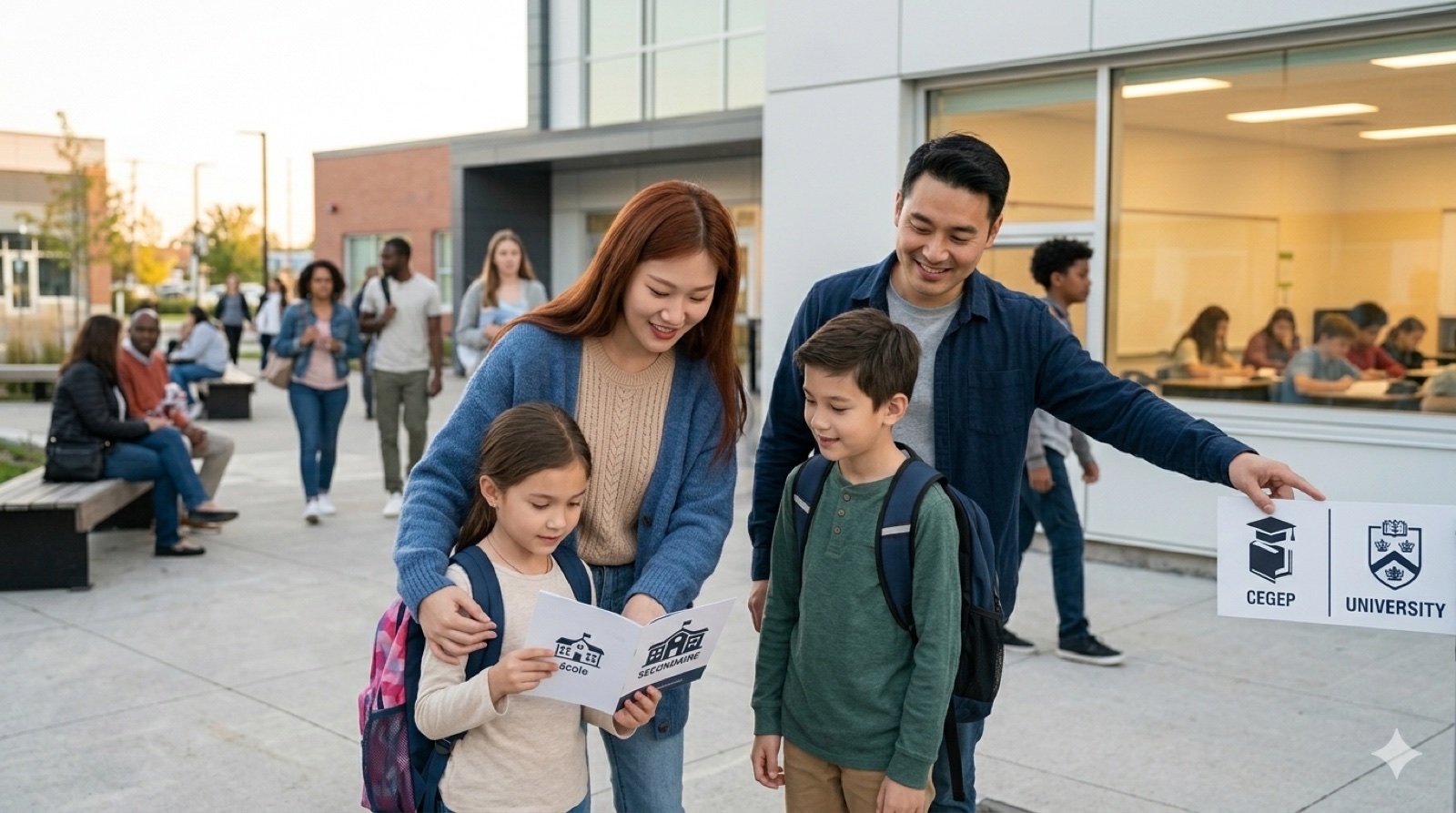
Structure from primary to university:
- Primary: 6 years (Grades 1 to 6, ~6 to 12 years old)
- Secondary: 5 years (Sec. 1 to 5, ~12 to 17 years old)
- CEGEP: 2 or 3 years (~17 to 19 years old)
- University: bachelor's ~3 years, master's ~2 years, doctorate ~3-5 years
The diagram below shows these pathways, plus the entry points for adults.

2. Mandatory and free schooling
- Mandatory and free until age 16
- Public school: free (only material and field-trip fees)
- Private school: typically $3,000 to $15,000/year, depending on the school and region
3. Bill 101 and French schooling
Bill 101:
- Children of immigrants: mandatory French-language school at primary and secondary
- Free choice at CEGEP and university
- A few very specific exceptions (Canadian English-speaking parent educated in English)
4. CEGEP: between high school and university
The CEGEP:
- 2 years: pre-university programs (sciences, humanities...)
- 3 years: technical programs (toward direct employment)
- Free at public CEGEP for Quebec residents
5. University: cheaper for Quebecers
University fees:
- Quebec residents: ~$3,000/year (among the lowest in the Americas)
- Other Canadian provinces: ~$9,000/year at most universities, but significantly more at the English-language universities McGill and Concordia, where fees now exceed $12,000/year
- International: $18,000 to $50,000/year depending on the program
The chart below compares these orders of magnitude. That amount isn't fixed: the AFE loans and bursaries program can reduce it, and permanent residents, refugees and protected persons have exactly the same rights to it as a citizen — see who actually qualifies for Quebec's student financial aid.

6. The levels at a glance
Summary of the main levels of the Quebec school system: typical duration, approximate age and cost for a Quebec resident. Figures are indicative.
The school year at primary and secondary starts in late August or early September and ends in late June. At CEGEP and university, two main sessions structure the year: fall (late August to December) and winter (January to May). An optional summer session is added to catch up on courses. The timeline below places each level by age.
| Level | Duration | Approximate age | Cost (QC resident) |
|---|---|---|---|
| Primary (public) | 6 years | 6 to 12 years | Free (materials separate) |
| Secondary (public) | 5 years | 12 to 17 years | Free (materials separate) |
| Secondary (private) | 5 years | 12 to 17 years | $3,000 to $15,000 per year |
| Pre-university CEGEP | 2 years | 17 to 19 years | Free at public |
| Technical CEGEP | 3 years | 17 to 20 years | Free at public |
| University — bachelor's | about 3 years | 19 and up | about $3,000 per year |
| University — master's | about 2 years | 22 and up | about $3,000 per year |

7. The welcome class for non-French-speaking children
For children arriving without French, the public network offers the welcome class. The child spends one or two years of intensive immersion in French, then joins the regular class at their age level.
The service is free and organized by your school services centre. Ask for it explicitly at enrollment: it is not always proposed automatically.
8. Studying as an adult: DEP, FGA, AEC and RAC
The system doesn't stop at 16: Quebec has entry points designed for adults, widely used by newcomers who want to requalify.
- Vocational training (DEP): learn a trade in a 615-to-1,800-hour program — a few weeks to two years — leading to a diploma issued by the Ministry of Education.
- Adult general education (FGA): from age 16, finish secondary school or earn the prerequisites a program requires.
- Attestation of college studies (AEC): a college credential awarded after a program taken through cégep continuing education, without going through the full DEC.
- Recognition of prior learning (RAC): have your existing work or life experience assessed to obtain a DEC or an AEC, without relearning what you already master.
A diploma earned abroad goes through a different process: comparative evaluation and credential recognition. And for the French these programs require, see Francisation Québec.
9. Your action list
Follow these concrete actions to enroll your children in Quebec's school system. Check each box as you go: your progress is saved if you're signed in.
Your action list
0 of 5 done
10. Frequently asked questions
The most common questions from newcomers about Quebec schools: at what age to enroll a child, how the territory map works, whether public English school is accessible, arriving mid-year, a child who speaks no French, and going back to school as an adult.
At what age must my child start school in Quebec?
The first mandatory year is Grade 1 of primary, in September of the year your child turns 6.
Before that, two free public options exist: maternelle 4 ans (kindergarten 4) and maternelle 5 ans (kindergarten 5). They are not mandatory but very common — maternelle 5 ans is attended by nearly every child. School is mandatory until age 16 or until obtaining a diploma.
Can you pick any public school?
No. Each address belongs to a school services centre and to a specific school catchment. Your child has a guaranteed spot at the school of your address. Requesting another school in the same centre is possible but conditional on availability.
Private schools, by contrast, are open to all Quebecers — admission criteria are set by the school, often via an entrance test in the autumn before enrollment.
Is there really no way to attend public English school?
In the vast majority of immigration cases, no — Bill 101 closes the door at primary and secondary. The narrow exceptions exist only when at least one parent attended an English-language school in Canada (not abroad).
After secondary, the choice is free: an immigrant student can enroll in an English-language CEGEP (Dawson, Vanier, John Abbott) or an English-language university (McGill, Concordia, Bishop's).
We're arriving mid-school-year: can my child start school right away?
Yes. As soon as you have an address in Quebec, your school services centre will place your child in school, even in January or April. Come with the usual documents: birth certificate, vaccination record, most recent report card.
Mid-year, spots at a specific school can be limited: the child is then directed to another school in the same centre. If your child doesn't speak French, request the welcome class at the same time as you enroll.
My child doesn't speak a word of French: will they lose a year?
No. The public network plans for exactly this situation: the welcome class offers one or two years of intensive French immersion, after which the child joins the regular class for their age. The service is free, but ask for it explicitly — it is not always proposed.
Children learn fast; it's often the parent who needs more time. For yourself, the free classes from Francisation Québec can run in parallel.
I'm an adult without a Quebec diploma: where do I start to requalify?
Pick the door that matches your situation: a DEP to learn a trade (a few months to two years), an AEC through cégep continuing education for a college credential, or RAC to turn the experience you already have into a diploma — the details are in section 8 of this guide.
A diploma earned abroad goes through a comparative evaluation first: see the guide on credential recognition.
11. See also
These related guides may be useful:
- Family allowance in Quebec — the financial aid for families with school-age children, to apply for at enrollment.
- New baby paperwork — the first registrations that lead to the school path.
- Learn French free with Francisation Québec — for parents accompanying children in welcome classes who want to learn in parallel.
- Choosing an elementary school in Quebec — how to compare and pick a primary school once you understand the system.
- Enrolling Your Child in a Welcome Class in Quebec — how the classe d'accueil helps a non-French-speaking child integrate into the school system.
12. Official sources
For official information:
Author's note: Quebec's system is different and excellent. Your children will learn French fast, and free CEGEP opens many doors.