Why this guide
If a single outing were to make you understand Quebec, this would be it.
At the end of winter, when the snow is still there but the sun is starting to warm things up, thousands of Quebec families head for the cabane à sucre. You eat far too much, you sometimes sing, and you leave with syrup filling the trunk.
This is not a tourist attraction invented for visitors: it is a family ritual that cuts across every social class, and the Government of Quebec officially designated it as an element of intangible heritage in 2021.
This guide explains when to go, what you will eat, how much to budget, how to dress, and what to do if you don't have a car.
1. When exactly? Two calendars not to confuse
This is the first source of misunderstanding, so let's settle it right away: there are two different calendars.
The temps des sucres, in the biological sense, is the period when sap rises in the maples. The Office québécois de la langue française defines it as the spring period when maple groves are put into operation. It runs roughly from mid-March to late April and lasts four to five weeks.
The sugar-shack season is wider: Bonjour Québec, the official tourism board, places shack openings between late February and late April. Many shacks therefore open before the sap really flows, serving syrup from the previous harvest.
In other words: if you simply want to eat at a shack, aim for March or April. If you want to see the sap running and the evaporator working, aim for the second half of March.
Why spring and not winter? Because what draws the sap up is the freeze-thaw alternation. The ministry responsible for forests explains it this way: freeze and thaw cycles draw a sweet water called eau d'érable up into the trunk of sugar maples. Nights must freeze and days must thaw. A winter that hangs on, or a spring that turns warm all at once, and the run is poor. That is also why the dates shift from year to year.
2. An Indigenous legacy, recognized as heritage in 2021
There is something many people do not know, including Quebecers: processing maple sap is not a French colonial invention.
Quebec's cultural heritage register is explicit about it: the knowledge and know-how associated with transforming maple water are a legacy of Indigenous peoples.
Indigenous peoples already knew the properties of the maple and drank eau d'érable as a remedy or a source of energy. Before European metal cauldrons arrived, they concentrated the sugar using bark containers, clay, heated stones, or freezing. It was they who then showed the colonists how to tap the trees.
On April 11, 2021, the traditions of the temps des sucres were designated as an element of Quebec's intangible heritage.
So when you go to the cabane, you take part in something officially recognized as living heritage.
3. What you eat — and why it's so hearty
The shack meal draws on the meals served to those who « faisaient les érables » — the workers who spent whole days outdoors in the cold. Hence the principle: fatty, salty, sweet, and plenty of it. This is not light cuisine, and it does not pretend to be.
The cultural heritage register describes the traditional meal as: soupe aux pois, eggs, ham, beans, pancakes, grands-pères dans le sirop, omelette and oreilles de crisse. The tourism board adds sausages, bacon, creton, potatoes, bread and tarte au sucre.
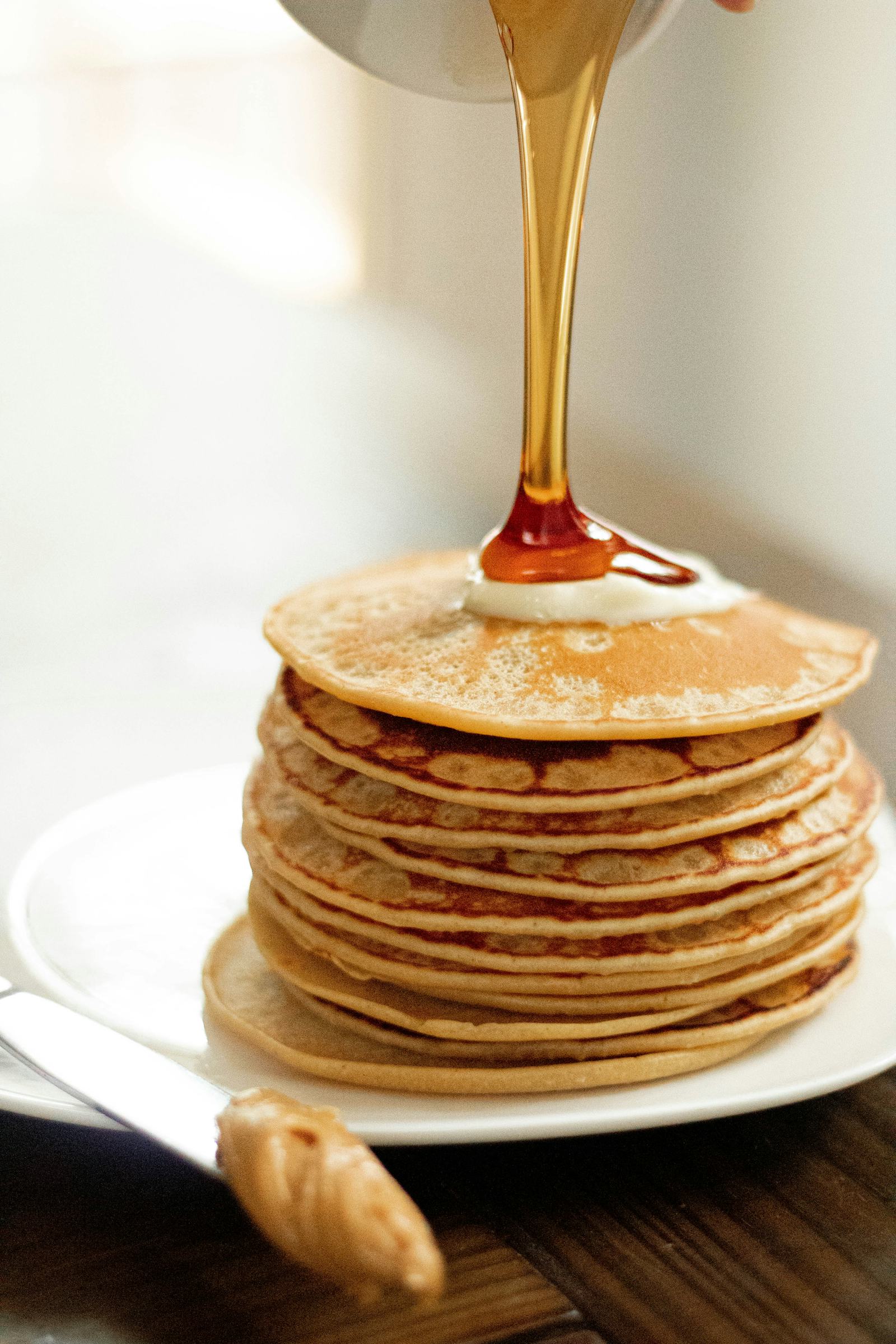
Almost everything is eaten drenched in maple syrup — including the savoury items. Yes, including the ham and the beans.
A word about oreilles de crisse, because the name always intrigues. They are not ears: they are slices of salt pork grilled until crisp, which curl up as they cook — hence the name.
An amusing linguistic detail: the government register spells them « oreilles-de-Christ », while the tourism board and virtually everyone else writes « oreilles de crisse ». Crisse is a distortion of Christ used as a swear word in Quebec; the official spelling is, in a sense, the polite version.
| Dish | What it is |
|---|---|
| Soupe aux pois | Thick yellow-pea soup, often with ham — the classic starter |
| Oreilles de crisse | Slices of salt pork grilled until crisp |
| Fèves au lard | White beans slow-simmered with pork and syrup |
| Omelette soufflée | A very puffy oven-baked omelette |
| Jambon | Served in thick slices, drenched in syrup |
| Creton | Cold pork pâté, spread on bread |
| Grands-pères dans le sirop | Dough balls poached directly in maple syrup |
| Tarte au sucre | Brown-sugar or maple pie — the typical dessert |
| Tire sur la neige | Hot syrup poured on snow, rolled onto a stick |
4. Tire sur la neige: the moment everyone waits for
If you were to remember only one image from the sugar shack, this would be it.
The process, as described by the cultural heritage register: maple syrup, previously boiled and thickened, is poured onto the snow. The cooled tire is then rolled around a wooden stick or paddle.
In practice: someone comes out with a pot of scalding syrup, pours it in strips along a long trough of clean snow, waits a few seconds, and you roll your strip of tire around a stick like a lollipop. It is hot, it is sticky, it is excellent.
Two practical tips. First, eat the tire right away: once cold it hardens and sticks to your teeth. Second, it is extremely sweet — one or two sticks are plenty, especially after the meal.
It is also the most photographed moment of the day, and the activity children enjoy most.
5. Which type of shack to choose?
Not all shacks are alike, and the choice completely changes the experience. The official tourism board distinguishes six types:
- Rustique — a wooden lodge in the middle of the forest, traditional menu, authentic atmosphere. The classic image
- Gastronomique — a chef reinterprets the classics. Pricier, more refined, very popular
- Familiale — with sleigh rides, a small farm, activities for children. The best choice with young kids
- Urbaine — an event in the city rather than a place in the forest. Reachable without a car
- Intime — small and quiet, away from the big noisy halls
- Végétarienne — yes, this is an official category
For a first time, rustique or familiale give the most representative experience.
If you are several families or a large group, check the size of the hall: some shacks seat hundreds of people at long communal tables, which is very festive but very loud.
6. What does it cost, and do you need to book?
On price, the official tourism board gives a clear order of magnitude: between $30 and $50 per adult for the traditional meal. Gastronomic establishments cost more, and children usually get a reduced rate.
Treat that figure as a benchmark, not a guarantee: each shack sets its own prices, and you should always check the establishment's own website before setting out. The urban shack often works differently: free entry, and you pay per portion.
On booking, the answer is yes. March weekends are peak season, and popular shacks fill up well in advance. Some accept reservations by phone only. Official tourism bodies mark booking as recommended or required for most of the establishments they list.
We cannot tell you how many weeks ahead to book: no official source gives that figure, and it depends enormously on how popular the establishment is. The prudent rule: as soon as you know you want to go, call.
7. What to wear, and how to get there
The official tourism board gives very concrete clothing advice, and it is worth following:
- Waterproof boots — in March the ground is a mix of slush and mud
- Layered clothing — it is hot in the hall and cold outside, and you will be going back and forth all day
- Loose, comfortable clothes — you are going to eat a lot
- A moisture-resistant coat, plus hat and mittens for the tire outside
On transport, let's be honest about what official sources do and do not say. Tourism bodies systematically describe shack locations in driving time — 40 minutes south of Montreal, an hour from downtown — and never mention public-transit service. We found no official source stating that shacks are or are not reachable by bus.
What can be said safely: most traditional shacks are in rural areas, and a car is by far the simplest way to get there.
Where to look? Bonjour Québec maintains an official sugar-shack directory, filterable by region, with a map view. It is the best starting point.
Geographically, Quebec's maple industry is concentrated in Chaudière-Appalaches, Estrie, Centre-du-Québec, Montérégie and Bas-Saint-Laurent.
8. Vegetarian, allergies, dietary restrictions
The traditional menu is overwhelmingly pork-based, which is a real problem for many newcomers. Here is what can be said with certainty, and what cannot.
What is certain: vegetarian is an official category. The tourism board lists vegetarian shacks among its six types, and confirms that many establishments now offer vegetarian options. You can filter on that criterion.
What is uncertain: we found no official or industry source on halal, gluten-free or allergy-adapted options. Some shacks advertise them on their own websites, but that commits only them and can change from season to season.
Good practice in every case: state your restrictions when you book, not on arrival. The shack meal is often served table d'hôte at a fixed time for the whole hall — improvising a replacement dish on the spot is far harder than at a restaurant.
9. An industry, not just a tradition
A useful detour to grasp the scale of the thing.
According to the Government of Quebec, Quebec is the world's leading producer of maple syrup and supplies on average 73% of world production. In 2024, there were 7,838 operations holding a quota, 54 million taps in operation, and a production of 239 million pounds for a market revenue of $750 million.
The word « contingent » (quota) deserves an explanation: Quebec maple production is governed by a quota system. A producer cannot simply produce and sell whatever they want: production is capped, and marketing is collective. It is one of the few agricultural sectors organized this way, and it explains the remarkable stability of maple syrup prices year after year.
In other words, when you buy a can of syrup at the shack, you are taking part in a three-quarters-of-a-billion-dollar industry that also happens to be a family party.
10. Frequently asked questions
The most common questions about the sugar shack: the best time to go, the budget to plan for, what you can do without a car, and whether the experience suits young children.
What's the best time for a first visit?
March, and ideally the second half of the month. There will still be snow on the ground for the tire, the maples will be running, and most shacks will be open. February is too early to see sap flowing, and by late April the snow may be gone.
How much should I budget per person?
The official tourism board places the traditional meal between $30 and $50 per adult, with a usual reduced rate for children. Gastronomic shacks cost more. Always check the chosen shack's own website: each establishment sets its own prices.
Can I go without a car?
Hard for a traditional shack: official tourism sources always describe their location in driving time and do not mention public transit. The realistic solution is the urban shack, an official category: a sugar-shack event held in the city, reachable by metro. Check the current year's dates with your city's tourism body.
Is it suitable for young children?
Very well, provided you choose a familiale shack: one of the six official categories, with sleigh rides, a small farm and activities. The tire sur la neige is almost always children's favourite moment. Just watch out for noise: some large halls seat hundreds of people at communal tables, which can be trying for a toddler.
11. See also
These related guides may be useful:
- Winter outdoor activities in Quebec — what to do during the months before the maple season starts
- Public holidays in Quebec — the rest of the Quebec seasonal calendar, and which days shops close
- Eating out in Quebec — restaurant codes, ordering and tipping, useful before any group meal here
- Politeness and cultural codes — the unwritten rules of a Quebec social gathering, communal tables included
12. Official sources
All the information in this guide comes from the official sources below. Several Quebec government heritage pages exist in French only — they are linked as-is.
- Sugar shacks — Bonjour Québec (official tourism board)
- A first visit to the sugar shack — Bonjour Québec
- Best sugar shacks in Montreal — Tourisme Montréal
- Les traditions du temps des sucres — Répertoire du patrimoine culturel du Québec (French only)
- Désignation au patrimoine immatériel — Conseil du patrimoine culturel du Québec (French only)
- Le temps des sucres — Ministère des Forêts (French only)
- Production de sirop d'érable — Gouvernement du Québec (French only)
- « Temps des sucres » — Vitrine linguistique de l'OQLF (French only)
Author's note: of all Quebec traditions, the sugar shack is the one that tells worst and lives best. On paper it sounds like a pork buffet in a barn. In practice it is a loud hall where three generations eat too much, where strangers share your table, and where everyone goes outside at the same time to eat hot sugar off a stick.
One tip for a first visit: don't go as a couple, go as a group. The cabane is designed for long tables. And save room for the tire — plenty of people discover it too full to enjoy it.
Finally, take a minute to remember where this comes from. The Government of Quebec says it plainly: this know-how is a legacy of Indigenous peoples. It is rare for such a joyful tradition to have so clearly documented an origin, and it is worth knowing.