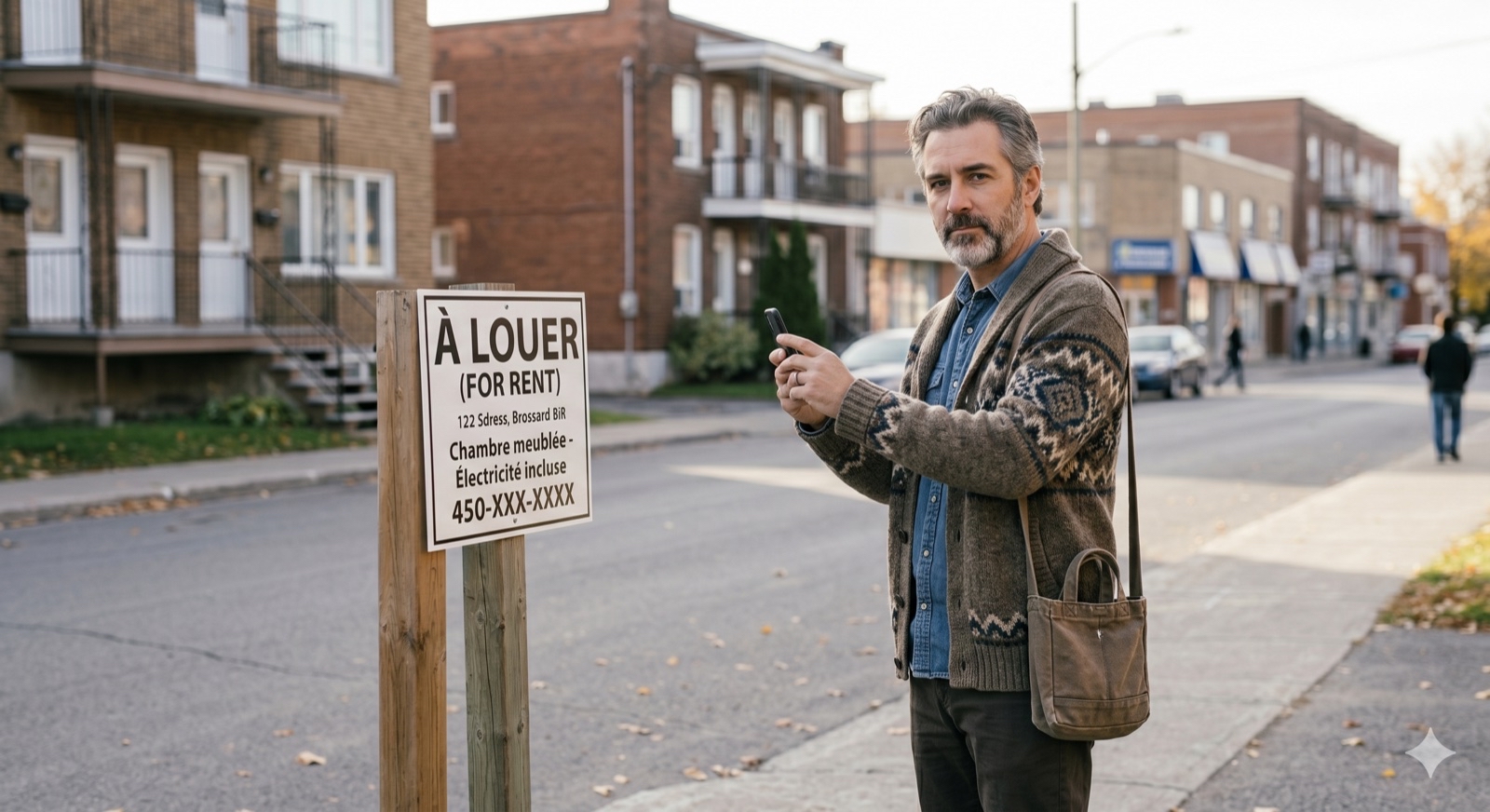
Rents vary a lot across Quebec: in October 2025, an average two-bedroom cost $1,460 in Gatineau and $1,346 in Montréal, but $985 in Saguenay. Pick 2 or 3 candidate cities by weighing rent, jobs and lifestyle, then use each city's own housing guide to search on the ground.
1. Quebec's rental market at a glance
Every fall, the Canada Mortgage and Housing Corporation (CMHC) surveys rents and available apartments in every Quebec centre. It is the most reliable reference for comparing cities. The October 2025 survey puts the average two-bedroom at $1,460 in Gatineau, $1,346 in Montréal, $1,277 in Québec City, $1,062 in Sherbrooke, $1,045 in Drummondville, $1,016 in Trois-Rivières and $985 in Saguenay. The chart below shows the full picture.

2. Three families of cities
To compare usefully, group cities into three families: the big centres, the suburbs around Montréal, and the regional cities. Each has a very different profile for rent, jobs and daily life. In the suburbs, note that average rents are not always lower than in the city: newer buildings dominate the market there, which pushes averages up. The chart shows the rent ranges; the table sums up the strengths and what to watch out for:
| Family | Cities | Strengths | Watch out for |
|---|---|---|---|
| Big centres | Montréal, Québec City, Gatineau | Jobs, services, transit, newcomer support | Higher rents, strong competition |
| Montréal's suburbs | Laval, Longueuil, Brossard, Terrebonne, Repentigny | Space, family neighbourhoods, schools | A car is often needed; not always cheaper |
| Regional cities | Sherbrooke, Trois-Rivières, Drummondville, Saguenay, Magog, Bécancour | Lowest rents, short commutes, quality of life | Smaller job pools, fewer transit options |

3. Reading the numbers: rents and available apartments
The average rent doesn't tell the whole story. The vacancy rate — the share of apartments sitting empty — shows how hard your search will actually be. The lower it is, the fiercer the competition between tenants. In October 2025, two-bedroom vacancy stood at 2.9% in Montréal, 3.0% in Sherbrooke, 2.6% in Gatineau, 2.5% in Québec City and Trois-Rivières — but only 0.6% in Saguenay, one of the tightest markets in the province: rents are the lowest there, yet finding a unit takes longer. In Drummondville, the CMHC estimate (1.5%) comes from a small sample, so treat it with caution. The chart below compares the cities.

4. Choosing by profile
The right choice depends less on the ideal city than on your situation: studies, family, a work contract or permanent settlement.
- Students: Sherbrooke and Trois-Rivières combine universities with some of the lowest rents; in Montréal, look at student housing and renting a room to stay on budget.
- Families: the suburbs (Laval, Longueuil, Terrebonne, Repentigny) and regional cities offer space and schools; check commute times before signing.
- Temporary workers: settle near the employer — Saguenay, Bécancour and Drummondville have strong industrial job pools and short commutes.
- New permanent residents: the big centres offer the widest job markets and newcomer services; regional cities offer lower costs and often a faster path to francophone daily life.
5. Your city in brief, from Montréal to Saguenay
Every city on this portal has its own housing guide, written for the local market. Here is the one-line portrait, with the CMHC sector average where measured:
- Montréal — the province's biggest market ($1,346); neighbourhood choice matters as much as price.
- Québec City — capital-region stability, average $1,277.
- Gatineau — Ottawa jobs, Quebec rents ($1,460, the province's highest average).
- Laval — family suburb on the island's doorstep ($1,362).
- Longueuil — metro-connected South Shore ($1,194).
- Terrebonne — growing north-shore corridor (sector average $1,610, mostly newer builds).
- Repentigny — quieter east gateway (L'Assomption corridor, $1,189).
- Lévis — south shore of Québec City, ferry and bridges.
- Sherbrooke — university city, $1,062.
- Magog — lakeside living near Sherbrooke ($940).
- Trois-Rivières — mid-way city, $1,016.
- Bécancour — industrial south shore of Trois-Rivières ($1,122).
- Drummondville — logistics hub between Montréal and Québec ($1,045).
- Saguenay — the region's anchor city ($985, but few vacant units).
- Chicoutimi — Saguenay's service and university borough ($1,033 sector).
- Jonquière — industry and cégep life ($962 sector).
- La Baie — fjord-side and most affordable ($838 sector).
6. The Quebec search calendar
In Quebec, most leases end on June 30, which makes July 1 the province's big moving day. The widest choice runs from February to May, when tenants give notice. Arriving off-season (fall, winter)? You will still find housing — the market just moves more slowly, and short-term options help bridge the gap. Whatever the city, prepare a small tenant file (ID, proof of income or employment, references): in tight markets, the prepared applicant signs first.
7. Your action list
Five steps to go from comparing to actually searching:
Your action list
0 of 5 done
8. Your rights and support programs, everywhere in Quebec
Whichever city you choose, the same provincial rules protect you and the same support programs exist. Before signing, read up on signing a lease and your tenant rights — rent increases are regulated, and the TAL comparison tool helps you judge whether an asked rent is abusive. On a tight budget, look at the housing allowance and social housing; and wherever you land, home insurance is inexpensive and worth having from day one.
9. Frequently asked questions
The questions that come up most often when choosing a city.
Which Quebec city has the cheapest housing?
Among the centres measured by CMHC, Saguenay had the lowest average in October 2025 — $985 for a two-bedroom, with its La Baie sector down at $838. Be aware, though: vacant units are rare there.
Should I visit before choosing a city?
Ideally, yes: spend a few days in your two or three candidate cities before committing. If that's impossible, lean on this portal's city guides, local groups and video visits, and favour a flexible first rental.
Do CMHC averages match the listings I see?
Not always. The CMHC average covers all occupied units, including older, cheaper leases. Units advertised today often rent above that average. Use the figures to compare cities with each other, not as a guaranteed price.
Can I start in one city and move to another later?
Yes, and it's a common strategy: a first one-year lease in a well-connected city while you validate the job and the neighbourhood, then a better-informed move. Quebec leases end on a fixed date, which makes planning easy.
Is living in the suburbs really cheaper than in the city?
Not automatically. In October 2025, the Mascouche-Terrebonne sector's average rent was higher than the Island of Montréal's, because the housing stock there is newer. Suburban savings mostly come from getting more space for the same price — once you add the cost of a car and the commute.
10. See also
These related guides may help you:
- Your first week in Quebec — the day-by-day arrival checklist, housing included.
- Buying a home in Quebec — when renting turns into owning.
- Housing co-ops in Montréal — below-market rent in exchange for involvement.
11. Official sources
For up-to-date information, consult these official sources:
Author's note: there is no single best city — only the one that fits your budget, your job and the way you want to live. The figures on this page give you the starting point; the city guides take over for the on-the-ground search.