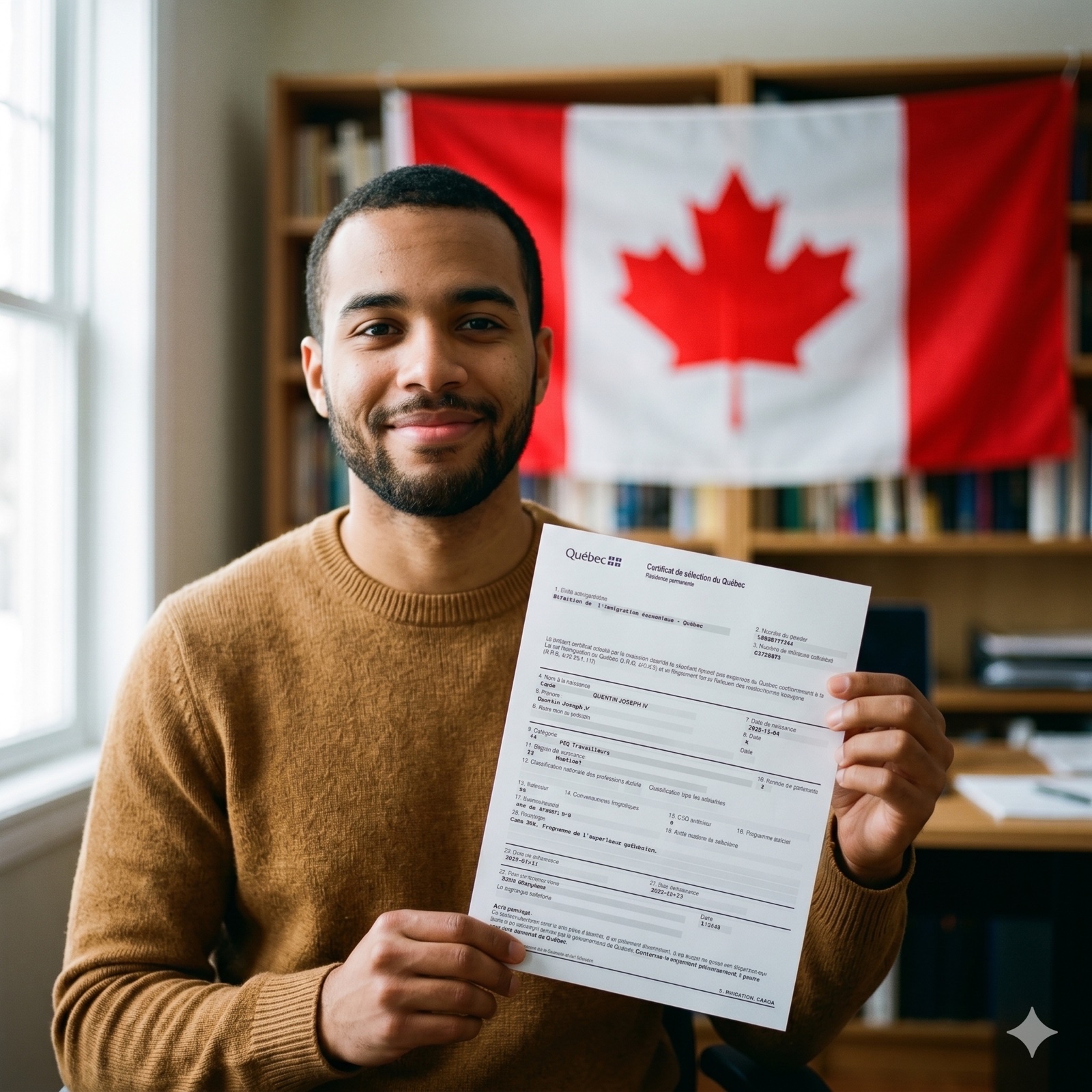
The PSTQ is the program through which Quebec selects skilled workers for permanent residence. You file a free expression of interest in Arrima, MIFI invites the strongest profiles stream by stream, and you then have 30 days to accept and 60 days (one year in stream 3 without the regulatory body's proof) to submit your application. If you are selected, you receive a CSQ, then you apply for permanent residence with the federal government.
1. The PSTQ at a glance
The Skilled Worker Selection Program (PSTQ) is for people who want to settle permanently in Quebec to work. It is run by the Ministère de l'Immigration, de la Francisation et de l'Intégration (MIFI) and, since November 29, 2024, it has replaced the former Regular Skilled Worker Program (PRTQ). You can take part while already in Quebec, for example on a temporary work permit, or from abroad.
The process always follows the same order:
- You file an expression of interest in the Arrima portal
- It goes into a bank where profiles are ranked with a points system
- MIFI invites some profiles to submit a permanent selection application
- You must then prove that you meet every condition
If you are selected, Quebec issues you a Quebec Selection Certificate (CSQ). That is not permanent residence yet: you will then have to apply for it with the Government of Canada (see section 8). To compare the PSTQ with the other main program, the PEQ, see our guide to the CSQ. The official overview of the program is on the About the PSTQ page.
2. The four streams
The PSTQ has four categories. Each stream covers a group of occupations, so every occupation in the labour market fits somewhere. You do not choose your stream: MIFI determines it from the main occupation you enter in your expression of interest.
To find out where you stand, look up your occupation's code in the National Occupational Classification (NOC, CNP in French). It is a 5-digit code, and the second digit gives the FEER category, which describes the training the job usually requires:
- FEER 0: management positions
- FEER 1: usually a university degree
- FEER 2: a college diploma or 2 years of vocational training, or a supervisory or safety-related job
- FEER 3: college or vocational training of less than 2 years, or more than 6 months of training
- FEER 4: a high school diploma or a few weeks of training
- FEER 5: a short demonstration
Example: code 21211 (data scientists) has a 1 in second position, so it belongs to FEER 1.
A few details on experience and diplomas. Mandatory internships count for up to 3 months of experience, whether they were paid or not. In stream 2, experience gained outside Quebec counts for one year at most. A Quebec diploma must represent at least 900 hours (secondary or college) or 30 credits (university) in stream 1; in stream 2, the minimum is 600 hours at the secondary level, 900 hours at the college level or 30 university credits. In streams 1 and 2, you do not need to request a comparative evaluation of studies done outside Quebec.
French levels refer to the Quebec scale of French proficiency levels (Échelle québécoise des niveaux de compétence en français). In streams 1, 2 and 3, the spouse who comes with you must reach level 4 in oral French. To find out which test to take and which score matches which level, see our guide to French tests. The full conditions are on the PSTQ requirements page.
| Stream | Occupations | Experience required | Schooling or document | French (you) |
|---|---|---|---|---|
| 1 — Highly qualified and specialized skills | FEER 0, 1 or 2, no authorization to practise needed | At least 1 year full time (or equivalent) in your main occupation, in Quebec or elsewhere, in the 5 years before applying | Diploma of at least 1 year full time leading to an occupation (from a DEP to a doctorate), obtained before applying | Oral 7 and written 5 |
| 2 — Intermediate and manual skills | FEER 3, 4 or 5, no authorization to practise needed | At least 2 years in your main occupation, including at least 1 year in Quebec, in the 5 years before applying | High school diploma or equivalent, or a DEP, ASP or AEC of at least 1 year | Oral 5 |
| 3 — Regulated professions | Occupation on MIFI's list of regulated professions | No length stated: what counts is the regulatory body's document | Authorization to practise, or proof of recognition no more than 5 years old | FEER 0 to 2: oral 7 and written 5; FEER 3 to 5: oral 5 |
| 4 — Exceptional talent | Clearly stand out in your main occupation through exceptional expertise | At least 3 years in your main occupation in the 5 years before applying | Achievement on MIFI's list, or an opinion from a partner (MEIE, FRQ, CALQ or INS Québec) | No level stated for this stream; French remains a scored criterion |
3. The requirements common to every stream
Whatever the stream, a few conditions apply to everyone. You must:
- Be 18 or older
- Intend to settle in Quebec to hold a job you are able to do
- That job must not be for a business you control, legally or in fact, nor in an excluded sector: payday loans, cheque cashing or pawnbroking, or the sex industry and pornographic products
- Meet the criteria that earned you the invitation
- Sign a financial self-sufficiency contract: you commit to supporting yourself, and the family coming with you, for the 3 months after you obtain permanent residence
- Obtain the attestation of learning about democratic values and Quebec values, for yourself and for each family member aged 18 or older who comes with you
- Respect, if it applies, the obligation to return to your country tied to a Quebec study scholarship
The amount of the financial self-sufficiency contract depends on your situation; MIFI publishes it in a scale. For the attestation, the Receiving the attestation of learning about values page explains the process. MIFI will ask you to obtain it after you submit your application (see section 8).
4. Stream 3 and professional orders
If your occupation is on MIFI's list of regulated professions, stream 3 is the one that applies to you. The list is updated every January 31. In Quebec, these professions fall under a regulatory body, a professional order for example, which decides whether you may practise them.
For this stream, you must hold one of these two documents, issued by the body that regulates your profession:
- An authorization to practise in Quebec
- Proof of partial or complete recognition of the equivalence of your training or diploma, no more than 5 years old on the date you apply
A simple acknowledgment of receipt of your file does not count as proof. And if the body refuses to recognize your skills, you will not be able to meet the conditions of stream 3.
Good to know: MIFI advises waiting for the invitation before starting the process with the order, because it then gives you one year to obtain the proof. Meanwhile, you can already look up the steps specific to your trade on the Qualifications Québec website (in French) and gather your documents. To understand the role of orders and diploma recognition, see our guides on regulatory bodies in Quebec and on recognizing foreign diplomas.
5. Filling out your expression of interest in Arrima
The expression of interest is your profile in MIFI's bank. You fill it out online, whenever you like, in the Arrima portal. It is free and you do not need anyone to do it for you; if you pay someone to represent you, that person must be authorized by the minister.
The deadlines to remember:
- You have 90 days after creating it to fill it out and submit it, otherwise it is deleted
- Once submitted, it stays valid for 12 months
- Without an invitation after 12 months, it becomes invalid: you cannot extend it, but you can create a new one, free of charge, and your information is carried over
- Updating it does not extend its validity; you can withdraw it at any time
In it, you describe your situation, your status, your studies and your background: every job and paid internship of the last 5 years, plus the mandatory internships from your studies, paid or not. You also declare your spouse and your children. Your spouse can file their own expression of interest; each of you then enters the other's expression-of-interest number. A child under 18 cannot file one.
Keep these documents within reach: passports, French test results or a diploma accepted by MIFI that are no more than 2 years old, a validated job offer if you have one, diplomas, employment attestations for the last 5 years and, in stream 3, the order's evaluation if you already have it, even though it is not mandatory at this stage. You can also choose to make your profile visible to Quebec employers.
Finally, MIFI writes to you through the Arrima message centre. An email alerts you, but it is up to you to check that message centre, as well as your spam folder. Watch out for fraudulent messages. The details are on the Expression of interest page.
6. How invitations work
MIFI invites candidates stream by stream, in three steps:
- First, it sets criteria specific to the stream: experience, French and schooling
- Next, it can add criteria that target a specific profile, for example holding a Quebec diploma
- Finally, it invites the highest scores, up to the number it has set
There is no lottery. The minimum score of a round is the score of the last person invited: it changes from round to round and cannot be compared from one stream to another.
Points reward three families of criteria:
- Your human capital: French, age, length of work experience and schooling
- Quebec's needs: an occupation in labour shortage combined with your experience, a Quebec diploma and Quebec work experience, length of stay outside the Communauté métropolitaine de Montréal (CMM), a validated job offer and, in stream 3, the order's document
- Your adaptation: length of your studies in Quebec, a family member in Quebec, and your spouse's profile (French, age, Quebec experience, schooling and Quebec diploma)
The full grid was published in the Gazette officielle du Québec on July 2, 2025, with an erratum on July 9, 2025. MIFI also offers a self-assessment tool in the form of a PDF form: its result is only indicative, and beating the minimum score of a past round does not guarantee an invitation. The Invitation to submit an application page details the criteria.
7. After the invitation: 30 days, then 60 days or one year
The invitation arrives in the Arrima message centre, with an email notice. From its date, you have 30 days to respond:
- Accept the invitation
- Or refuse it, asking for your expression of interest to be kept in the bank or withdrawn
With no answer within 30 days, your expression of interest becomes invalid and leaves the bank. You can only submit an application if you were invited and accepted within that deadline.
Once you accept the invitation, a second deadline starts:
- Streams 1, 2 and 4, or stream 3 with the order's proof already in hand: 60 days to submit the application, the documents and the fees
- Stream 3 without the proof: one year, to give you time to obtain it
The information from your expression of interest is carried over into the application; review it and complete it. False or misleading information leads to the rejection of the application, and of any new application for 5 years.
Your documents must be scanned in colour and combined into a single PDF file. They must be legible, complete and accurate, in French or English; otherwise, attach a translation by a recognized translator. Keep a copy of everything. If something is missing, you will receive a letter of intent to reject giving you 60 days to complete your file; after that, the application is rejected.
The examination fees are paid by credit card, in full and in Canadian dollars, by you or by another person. They are not refunded, even if the application is refused or rejected. Using a paid professional gives you no priority. Here are the fees in force since January 1, 2026 (they are adjusted every January 1), according to the Applying page:
| Person | Examination fee |
|---|---|
| Principal applicant | $940 |
| Spouse or common-law partner | $201 |
| Each dependent child | $201 |
8. The examination and the decision
After you submit, MIFI asks you to obtain the attestation of learning about values, for yourself and the family members aged 18 or older. You have 60 days from that message; if you already have it, you will not receive this request. MIFI can also call you to an interview: the notice arrives in Arrima, with the date, place, time and documents to bring.
The examination ends in one of three ways:
- You are selected: your CSQ, and those of your family, are posted in Arrima
- MIFI intends to refuse your application: answer within the stated deadline, otherwise it will be refused; an request for administrative review is then possible, under certain conditions
- MIFI intends to reject it, for example because of doubts about a document's authenticity, missing documents or a missed interview: here again, answer within the deadline, otherwise it will be rejected
As for timing, on October 13, 2026, the Ministère was examining applications received in February and March 2026. This time is counted from receipt of the application, not from the invitation, and it gets longer if the file is incomplete. Since May 13, 2026, MIFI has been giving priority to applications from temporary foreign workers whose work permit has expired or is about to. This does not guarantee a decision before it expires: if you can, still renew your permit with your employer and Immigration, Refugees and Citizenship Canada (IRCC). See our guide to the work permit in Quebec.
Once you have the CSQ, the next step is federal: see our guide to the permanent residence application after the CSQ. The official process is described on the Examination of the application page.
9. Your action list
Follow these steps in order. Check each box as you go — your progress is saved if you're signed in.
Your action list
0 of 8 done
10. Frequently asked questions
The most common questions on the PSTQ.
Do I need to already live in Quebec to take part in the PSTQ?
Not necessarily. In stream 1, the experience can have been gained in Quebec or elsewhere. Stream 2, however, requires at least one year of Quebec experience out of the two years asked for.
You also do not need to be working in your main occupation, or even to have a job, when you are invited or when you submit your application. A stay in Quebec outside the Montreal metropolitan area (CMM) can, however, earn you points.
How much does the PSTQ cost?
The expression of interest in Arrima is free. You only pay when you submit the selection application: since January 1, 2026, $940 for the principal applicant and $201 for the spouse and for each dependent child. These fees are not refundable.
Budget separately for the federal stage, the French test and any translations. You will also commit, through the financial self-sufficiency contract, to supporting yourself during your first 3 months of permanent residence.
What score do I need to be invited?
There is no fixed threshold. The minimum score of a round is the score of the last person invited; it varies from round to round and from stream to stream.
MIFI's self-assessment tool gives you an estimate, but even a score above that of a past round guarantees nothing. Improving your French is a concrete way to act on your score, since it counts both for you and for your spouse.
Does my spouse need to speak French?
In streams 1, 2 and 3, yes: the spouse who comes with you must reach at least level 4 in oral French on the Quebec scale. Their French, age, schooling and Quebec experience can also add points to your profile, and they can even file their own expression of interest.
Free French classes exist: see our guide to Francisation Québec.
Does the PSTQ go through Express Entry?
No. Express Entry is the federal government's selection system, and it is not used for workers settling in Quebec. Quebec chooses its own skilled workers through the PSTQ.
The federal government only comes in afterwards, to examine the permanent residence application of the person who obtained a CSQ.
11. See also
These related guides may be useful:
- The CSQ — Quebec Selection Certificate — what the PSTQ leads to, and how it compares with the PEQ.
- Applying for permanent residence after the CSQ — the federal step that follows selection.
- French tests for immigration — which test to take and which score matches which level.
- Immigration lawyer or consultant: which to choose? — if you decide to be represented.
12. Official sources
For official and up-to-date information:
- Ministère de l'Immigration, de la Francisation et de l'Intégration (MIFI)
Ministère de l'Immigration, de la Francisation et de l'Intégration: 514-864-9191 (Montreal area) or 1-877-864-9191 (elsewhere in Quebec, toll-free).
Author's Note: in the PSTQ, a lot comes down to deadlines — 90 days to submit the expression of interest, 30 days to respond to the invitation, 60 days to submit the application. Check the Arrima message centre every week, have your documents ready before you are even invited, and work on your French starting today: it is a criterion you can act on right away.