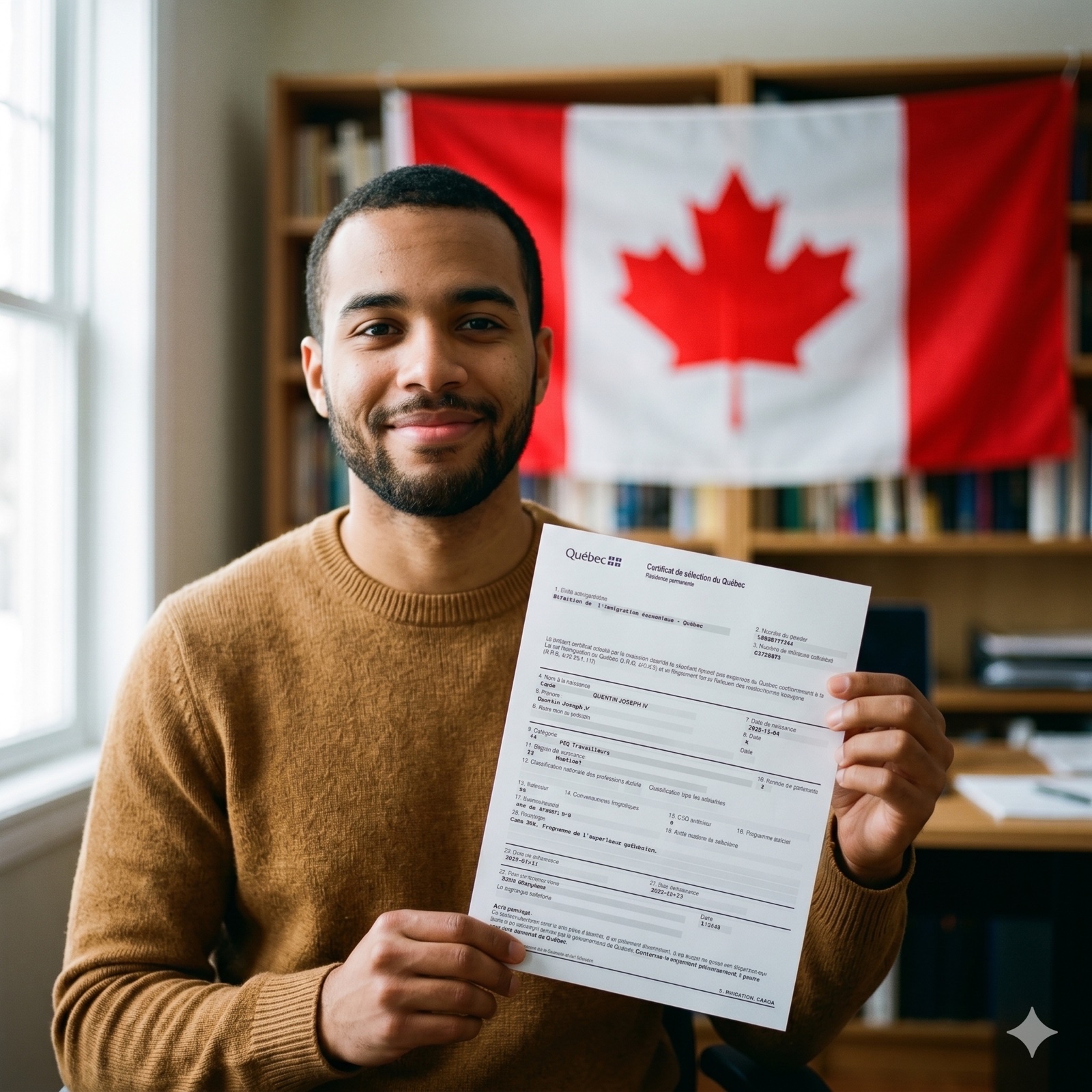
The CSQ means Quebec has selected you; it does not make you a permanent resident. You still have to file a complete permanent-residence application online with Immigration, Refugees and Citizenship Canada (IRCC), pay the fees ($1,590 for you, including the right-of-permanent-residence fee), give your biometrics, then do the medical exam once IRCC tells you to. Keep a valid work permit until the decision.
1. The CSQ is not permanent residence yet
Quebec and Canada share the decision. Quebec chooses the people it wants to welcome and issues them a Quebec Selection Certificate (CSQ). The Government of Canada decides whether or not to grant you permanent residence.
To be admitted, you and your family members must:
- hold a CSQ;
- file a permanent-residence application with Immigration, Refugees and Citizenship Canada (IRCC);
- pass the medical exam and the security and criminality checks.
The requirements of both governments must be met: the Quebec government explains this on its page Difference between admission and selection.
By obtaining a CSQ as a skilled worker, you also declared your intention to settle in Quebec to work there. That intention follows you into the federal application: one of the forms you attach is precisely about your intention to reside in Quebec.
2. Who can apply, and when
According to IRCC, you can apply if two conditions are met: you hold a CSQ, and you submit a complete permanent-residence application, police certificates included. The details are on the eligibility page for Quebec-selected skilled workers.
Whatever path led you to the CSQ — the PSTQ or the PEQ — the federal step is the same. It does not go through Express Entry, which does not apply to Quebec-selected workers. If you are still at the selection stage, start with the guide on the CSQ.
On timing, one reassuring rule: your CSQ stays valid until IRCC makes its decision, even if its expiry date has passed. The Ministère de l'Immigration, de la Francisation et de l'Intégration (MIFI) has in fact not renewed CSQs since 2018.
3. Forms and documents
Since September 23, 2022, the application must be filed online, in IRCC's Permanent Residence Portal. Paper, braille or large print are offered only as an accommodation, for example because of a disability. The official instruction guide is number Q7000, and IRCC's page on how to apply details each step.
A few rules to know before you start:
- The principal applicant signs electronically for the whole family, by typing their name exactly as it appears on their passport.
- A representative cannot sign for you, open the portal account for you, or use your password.
- You need one photo per person.
- An incomplete application is rejected: you have to fix it and submit it again.
Here are the forms IRCC lists. The digital forms are filled out online, for you and for each family member aged 18 or over; the others are PDFs to upload.
| Form | What it is | Who it concerns |
|---|---|---|
| IMM 0008 | Generic Application Form for Canada (digital) | You and each family member aged 18 or over |
| Schedule A, IMM 5669 | Background / Declaration (digital) | You and each family member aged 18 or over |
| IMM 5406 | Additional Family Information (digital) | You and each family member aged 18 or over |
| IMM 5562 | Supplementary Information – Your travels (digital) | You and each family member aged 18 or over |
| IMM 5690 | Document checklist (PDF) | Your application |
| IMM 0008, Schedule 5 | Economic Classes – Declaration of Intent to Reside in Quebec (PDF) | Your application |
| IMM 5604 | Separation Declaration for Minors Travelling to Canada (PDF) | Only if it applies to you |
| IMM 5409 | Statutory Declaration of Common-law Union (PDF) | Only if you live in a common-law union |
| IMM 5476 | Use of a Representative (PDF) | Only if you have a representative |
| IMM 5475 | Authority to Release Personal Information to a Designated Individual (PDF) | Only if it applies to you |
4. The fees
The fees are paid online. They generally include the processing fee for each person, the Right of Permanent Residence Fee (RPRF), biometrics, and fees paid to third parties: medical exam, police certificates and, if applicable, educational credential assessment. The amounts below are those of IRCC's fee list for Quebec-selected skilled workers.
The RPRF, $600, deserves an explanation. It is required when the application is approved: you must have paid it before becoming a permanent resident. You can, however, pay it when you file to avoid delays. It does not apply to dependent children. It is the only fee refundable once processing has started: you get it back if you withdraw your application or if it is refused.
The doctor's fees and the cost of police certificates are not set by IRCC: ask the medical clinic, or the authority that issues the certificate, directly.
| Item | Amount |
|---|---|
| Your application, with the RPRF | $1,590 |
| Your application, without the RPRF | $990 |
| Including your spouse or partner, with the RPRF | $1,590 |
| Including your spouse or partner, without the RPRF | $990 |
| Each dependent child | $270 |
| RPRF alone | $600 |
| Biometrics | $85 per person; maximum $170 for a family applying together |
5. After you apply: biometrics, medical exam, police certificates
Once the application is filed, IRCC first checks that it is complete: forms filled out and signed, fees paid, documents attached. If something is missing, the application is not processed and is returned to you. IRCC's page on the steps after you apply describes what comes next.
Three checks then await you.
Biometrics. If you are 14 to 79, you give your fingerprints and a photo for every permanent-residence application, even if you have done so before and they are still valid. You have 30 days from the date on the biometrics letter.
Medical exam. It is mandatory for you and your family members, even those who are not coming with you. For this application, wait for the instructions: IRCC sends you a letter after your file is transferred to the processing office, and you then have 30 days to do the exam. It must be done by a panel physician on IRCC's list; your own doctor cannot do it. That physician makes no decision: IRCC decides. You pay their fees, and the radiologist's if needed, at the appointment. Bring:
- an ID document (a passport is strongly recommended);
- your glasses or contact lenses;
- your previous medical reports and the list of your medications;
- the medical report form IRCC sent you;
- 4 recent photos if the physician does not use eMedical.
A temporary public policy, extended until October 5, 2029, exempts certain people already in Canada from a new exam. All of these conditions must be met: you are applying for permanent residence, you already live in Canada, you did an immigration medical exam in the last 5 years, and that exam showed a low or no risk. If you did such an exam in the last 5 years, enter its number — the unique medical identifier — in the new application. The details are on IRCC's page on the medical exam.
Police certificates. You and each family member aged 18 or over provide one, and IRCC may ask for more during processing. This document shows that you have no criminal record, or gives a copy of it; its name varies by country. If it is in neither French nor English, attach a copy of the original and a certified translation into French or English. See IRCC's page on police certificates.
Finally, always tell the truth. A false statement can lead to a refusal, inadmissibility, and a 5-year bar from applying to come to Canada.
6. Keeping a legal status while you wait
The CSQ gives you no status in Canada. If you already work in Quebec, you must keep a valid work permit throughout the federal process. MIFI describes three cases on its page After obtaining your CSQ:
- You have not yet filed your permanent-residence application: you can apply for an employer-specific, LMIA-exempt work permit. You do not need a CAQ, but your employer must take steps with IRCC and pay the compliance fee in the federal Employer Portal.
- You have filed your application and received an acknowledgment of receipt: you can apply for a bridging open work permit, with no CAQ.
- You have filed your application but do not yet have an acknowledgment of receipt: same solution as the first case, an employer-specific, LMIA-exempt permit.
If you live abroad and your CSQ is valid — it is 24 months old or less, or you are waiting for the decision on your permanent residence — you may be eligible for the International Mobility Program Plus (PMI+). It gives an open work permit so you can arrive in Quebec sooner.
For the renewal steps themselves, see the guide Renewing or extending your permit.
7. The decision: the Confirmation of Permanent Residence
IRCC bases its decision on four elements: your eligibility for the program, your funds to support yourself and your family on arrival, the results of the medical exam and your police certificate.
If the application is approved, you receive a Confirmation of Permanent Residence (COPR), along with a permanent-resident visa if you come from a country whose citizens need a visa. Check right away that the information matches your passport. IRCC cannot extend a COPR: use it before it expires.
What happens next depends on where you are.
If you are abroad, the COPR is issued to you before you travel. You must arrive in Canada and present it at a port of entry before its validity date; the border services officer signs and dates it. IRCC's page on the Confirmation of Permanent Residence details the document.
If you are already in Canada, everything happens in the PR confirmation portal. IRCC sends you two emails; check your spam folder. Do not create a new account: use the one from your application. The steps:
- Confirm that you are in Canada — this does not yet make you a permanent resident.
- Wait for the electronic confirmation (e-COPR) to be uploaded to your account, which can take up to a few weeks.
- Give your address in Canada.
- Upload a professional photo on a plain white background, taken in the last 12 months.
- Receive your permanent-resident card by mail.
Keep your COPR, even after the card arrives: it is your proof of status.
8. Your first steps as a permanent resident
Moving from a temporary status to a permanent one changes several of your documents. IRCC's page on preparing for your arrival covers them; here are the essentials.
- The SIN: you must get a permanent social insurance number. While you wait for the card, the signed COPR is enough to apply. See the guide on the SIN.
- Health insurance: file a new application with the RAMQ using the documents of your new status. You may not be covered for 3 months; without group insurance, private insurance is strongly advised. See the guide on the RAMQ.
- The driver's licence: if you were driving in Quebec with your home-country licence, you can use it for at most 6 months after the date you obtain permanent status. After that you need a Quebec licence. See the guide on exchanging your licence at the SAAQ.
- The permanent-resident card: the first one arrives by mail if you gave a Canadian address and a photo within 180 days of becoming a permanent resident. Otherwise, use IRCC's address notification tool within those 180 days, or the card is cancelled and you have to apply and pay again. For later steps, renewal or replacement, see the guide on the PR card.
9. Your action list
Check each step as you go: your progress is saved if you are signed in.
Your action list
0 of 8 done
10. Frequently asked questions
The questions that come up most often about the federal step after the CSQ.
Can my CSQ expire while I wait for IRCC's decision?
No. Your CSQ stays valid until IRCC makes its decision on your permanent-residence application, even if the expiry date printed on it has passed. That is also why MIFI has not renewed CSQs since 2018: you do not need to ask for a new one while your federal application is being processed.
Can I travel before I receive my Confirmation of Permanent Residence?
If you are already in Canada, be careful: IRCC cannot confirm your status while you are outside the country. If you plan to travel before receiving your e-COPR, contact IRCC at the email address given in the invitation it sent you.
If you are abroad, your COPR is issued before you travel. You must arrive in Canada and present it at a port of entry before its validity date, because IRCC cannot extend it.
Do I need to take a new French test for the federal application?
IRCC's page on how to apply mentions no language test at this step. Your French was assessed by Quebec during selection, before you received your CSQ; the federal application lists forms, police certificates, biometrics and the medical exam, not a new test.
Language comes back later if you apply for Canadian citizenship, which has its own proof rules. The guide on French tests for immigration explains which test is used for what.
My family situation changes while I wait: what should I do?
Tell both governments, each for its own part. With IRCC, report any important change — contact information, a birth, a death, a marriage, a divorce, an adoption — through its web form. With MIFI, adding or removing an accompanying spouse or dependent child after the CSQ is done with form ME-0133, sent by mail without any fees; MIFI then contacts you, and you should expect several weeks.
Do not wait: an unclear family situation, such as a divorce or an adoption that is not finalized or a custody question, is one of the causes of delay listed by IRCC.
How long does it take to get a decision?
We do not give a figure here, because it changes. The only reliable source is IRCC's processing-times tool. Keep in mind that the time it shows does not include the time Quebec took to issue your CSQ.
Some situations slow a file down: information that needs checking, a criminal or security issue, background checks, an unclear family situation, or a request for more documents or an interview.
Can I hand the whole process over to a representative?
Not entirely. A representative can help you, and you declare them with form IMM 5476, but IRCC sets limits: they cannot sign the application for you, open your portal account, use your password, or declare in the PR confirmation portal that you are in Canada. Those steps stay yours.
If you hire someone, check that they are authorized to represent you: the guide Immigration lawyer or consultant explains how.
11. See also
These related guides may be useful:
- The CSQ, Quebec Selection Certificate — the Quebec step that comes before this one.
- The PSTQ, Skilled Worker Selection Program — the main path to the CSQ for skilled workers.
- French tests for immigration — which test to take, and what it is used for.
- Canadian citizenship — the next step, once you have been a permanent resident long enough.
12. Official sources
For official and up-to-date information:
Author's Note: the CSQ is a real win, but it is only half of the journey. File a complete application the first time, wait for the instructions before the medical exam, and keep a close eye on your work permit's expiry date.