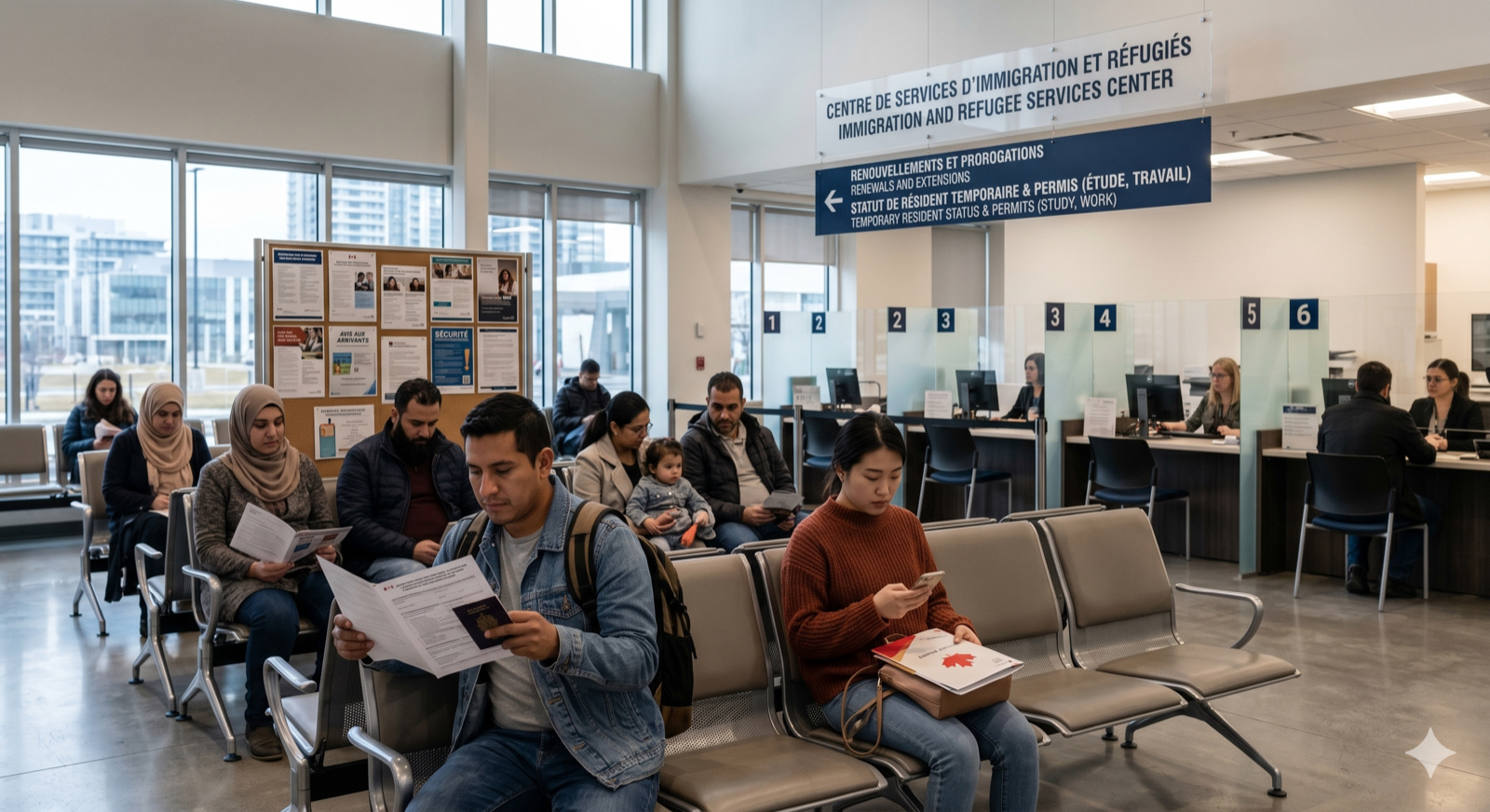
Renouveler à temps — la règle qui protège votre statut.
1. Renew early — the golden rule
A study or work permit has an expiry date. If you stay in Canada past that date, you must renew or extend it.
The golden rule: start early. Quebec asks you to start at least six months before a Temporary Foreign Worker Program (PTET) work permit expires, and recommends at least three months before a CAQ and study permit expire. For a Quebec-linked permit, the order matters: for a PTET worker, the employer first gets a new LMIA (EIMT), then you apply for a new CAQ, then the federal permit; for a student, the CAQ first, then the study permit.
| Permit type | CAQ to renew first? | Recommended lead time before expiry |
|---|---|---|
| Study permit (linked to CAQ) | Yes | At least 3 months (Quebec) |
| PTET work permit (linked to CAQ) | Yes — after a new LMIA obtained by the employer | At least 6 months (Quebec) |
| Work permit (without CAQ) | No | As early as possible — see IRCC processing times |
| Bridging open work permit (BOWP) | No — separate application | Once the PR application has passed the completeness check |
2. Maintained status
Here is the most important protection to know.
If you file your renewal application before your current permit expires, you keep your status while the government processes the application. This is maintained status (sometimes called implied status). You can generally continue to study or work under the same conditions, until a decision is made.
The essential condition is simple: file before expiry. A single day late makes all the difference. Two useful details for a work permit: it cannot be extended beyond your passport's expiry date; and if your permit expires in two weeks or less while your employer has already submitted a complete LMIA or CAQ application, you can apply for the extension without waiting for the decision; IRCC will not make a decision until it has received the LMIA or CAQ.
3. If your permit has already expired: restoring your status
If your work permit expired before you applied for an extension, you have lost your status and must stop working. To stay in Canada and work again, you must apply to restore your status together with a new work permit, within 90 days of losing your status.
The conditions: you met the requirements of your stay (for example, you did not work illegally) and the conditions of your expired permit, and you do not hold a temporary resident permit. After 90 days it is too late: you must leave Canada and apply again from outside the country if you want to work there again.
You apply with form IMM 5710: tick “Restore my status as a worker” and explain on a separate page why you stayed in Canada longer than allowed. Before you apply, your employer must have completed all the required steps on their side. While you wait, you may stay in Canada, but you normally cannot work until your status is restored and the new permit is issued. Approval is not guaranteed; if refused, you must leave Canada.
The fees: $246.25 for restoration, plus $155 for the work permit, so $401.25; $100 more for an open permit, and $85 for biometrics if you must provide them. Each family member who also lost their status applies separately and pays their own restoration fee.
For a study permit, the process is similar: an application for a new study permit and to restore your status, fees included ($396.25 in total). You may stay in Canada during processing, but you cannot study until your status is restored and you have received the new permit (IRCC).
4. The bridging open work permit (while awaiting PR)
If you have filed a permanent-residence application and your work permit is approaching expiry, you may be eligible for a bridging open work permit.
This open permit lets you continue working — for any employer — while your permanent-residence application is processed. It is a bridge between your current permit and permanent status. Mind the scope: this permit covers a closed list of programmes — Express Entry, the Provincial Nominee Program, Quebec skilled workers, caregivers (the former pilots open from 2019 to 2024, the caring for children class and the caring for people with high medical needs class; the pilots launched in 2025 do not qualify), Agri-Food, Quebec investors. Family or spousal sponsorship is NOT on it. And in Quebec the list shrinks further: Express Entry, the Provincial Nominee Program, the caregiver programs and Agri-Food require you to intend to live outside Quebec. If you live in Quebec, the possible routes are Quebec skilled workers (with a CSQ that was valid when you applied for PR) and Quebec investors.
5. Travelling during processing
Two traps almost nobody knows. First, on maintained status you generally cannot renew your provincial documents — in Quebec, that means your RAMQ card and your SAAQ driver's licence (IRCC): make sure they are valid before your permit expires. Second, if you file online, the deadline is midnight UTC, not midnight where you live — Quebec is several hours behind UTC, so filing in the evening of expiry day, Quebec time, can already be too late. Your SIN, for its part, expires on the same day as your permit: you can keep working with an expired SIN while on maintained status, and you update it once you receive the new permit.
Maintained status protects you inside Canada — IRCC specifies that the authorization to keep working holds as long as you stay in Canada.
If you leave Canada while your renewal is being processed, you may not be able to re-enter with the same rights: if the application has not yet been approved, you may be allowed back as a visitor, without the right to work until the renewal is approved. Before any travel outside Canada during a renewal period, check the current rules or consult a professional.
6. Your action list
Follow these steps to renew your permit without interrupting your status. Check each box as you go — your progress is saved if you're signed in.
7. Frequently asked questions
The most common questions on renewing a permit: maintained status, what happens if the permit expires, working during processing, and the bridging open work permit.
Can I keep working or studying during processing?
Yes — if you filed your application before expiry of your current permit. That is maintained status: while you wait, you generally keep the right to continue under the same conditions as before.
But if you did NOT file before expiry, you have no such right, and continuing would be unauthorized. The whole protection hinges on filing on time.
One important exception: if you applied for a study permit or to extend your stay as a visitor (visitor record), you can work only until your work permit expires, not while you wait for the decision (IRCC).
What happens if my permit expires before I file?
You lose your temporary-resident status and the right to study or work, immediately, on the expiry date.
There is sometimes a restoration of status in a limited window after expiry (see section 3) — but it is uncertain, paid, and with no right to work in the meantime. It is a safety net to never plan to use.
What is the bridging open work permit (BOWP)?
It is an open work permit for people who have already filed a permanent-residence application and whose current permit is running out.
Without it, a worker on a closed permit could be forced to stop working while waiting for permanent residence. The bridging permit lets them keep working, for any employer. Mind the scope: the bridging permit covers a closed list of programs — Express Entry, the Provincial Nominee Program, Quebec skilled workers, caregivers (the former pilots open from 2019 to 2024, the caring for children class and the caring for people with high medical needs class; the pilots launched in 2025 do not qualify), Agri-Food, Quebec investors. Family or spousal sponsorship is NOT on it: if that is your route, do not plan on this permit. And in Quebec the list shrinks further: Express Entry, the Provincial Nominee Program, the caregiver programs and Agri-Food require you to intend to live outside Quebec. If you live in Quebec, the possible routes are Quebec skilled workers (with a CSQ that was valid when you applied for PR) and Quebec investors.
Do I renew the CAQ too, or only the federal permit?
If your permit is tied to a CAQ — typically a study permit, and many work permits in Quebec — you renew the CAQ as well, and you do it first. The order is the same as for the first application: Quebec before federal.
For a PTET worker there is even a step before that: the employer must obtain a new LMIA (EIMT). Because two levels of government are involved, each with its own processing time, Quebec asks you to start at least six months ahead for a PTET work permit, and recommends at least three months for studies.
8. See also
These related resources may be useful:
- The Quebec work permit — closed permit, open permit, and conditions.
- The CAQ and study permit — for international students.
- The CSQ — Quebec Selection Certificate — toward permanent residence.
9. Official sources
For official and up-to-date information:
Author's Note: this entire guide comes down to one habit — file before expiry. Maintained status protects those who are on time; it does not exist for latecomers. Put the expiry date in your calendar, and count back six months.