Aller au contenu

Cost of Living

QPIP 2026: your premium drops — and here's what it pays for

The parental-insurance premium taken off your paycheque drops in 2026, while the covered income rises to $103,000.

Vieauqc TeamJuly 19, 2026
Listen to the articleParagraph 1 / 8

Look closely at your next pay stub. A small line labelled "QPIP" shows up every time you get paid. QPIP is the Québec Parental Insurance Plan — a public program that pays income to parents during maternity, paternity, parental, or adoption leave. In 2026, the premium (the amount taken off your wages to fund the plan) goes down.

By how much? The government cut the premium rates by roughly 13% as of January 1, 2026, according to the official Québec government announcement. For a salaried worker, the rate drops to 0.430% of your work income, with a maximum annual contribution of $442.90, as shown on the QPIP premium page. In practice: a few more dollars in your pocket each year, with nothing to do on your end.

The "maximum insurable earnings" goes up, though. That's the salary ceiling used to calculate your premiums and, later, your benefits. It rises from $98,000 to $103,000 for 2026, per the QPIP news release. A higher ceiling means a future leave can be calculated on a larger share of your salary.

Self-employed? You pay in too, but at a different rate: 0.764% of your net business income, up to the same $103,000 ceiling, for a maximum contribution of $786.92. You won't see it on a pay stub — you pay it when you file your Québec income tax return.

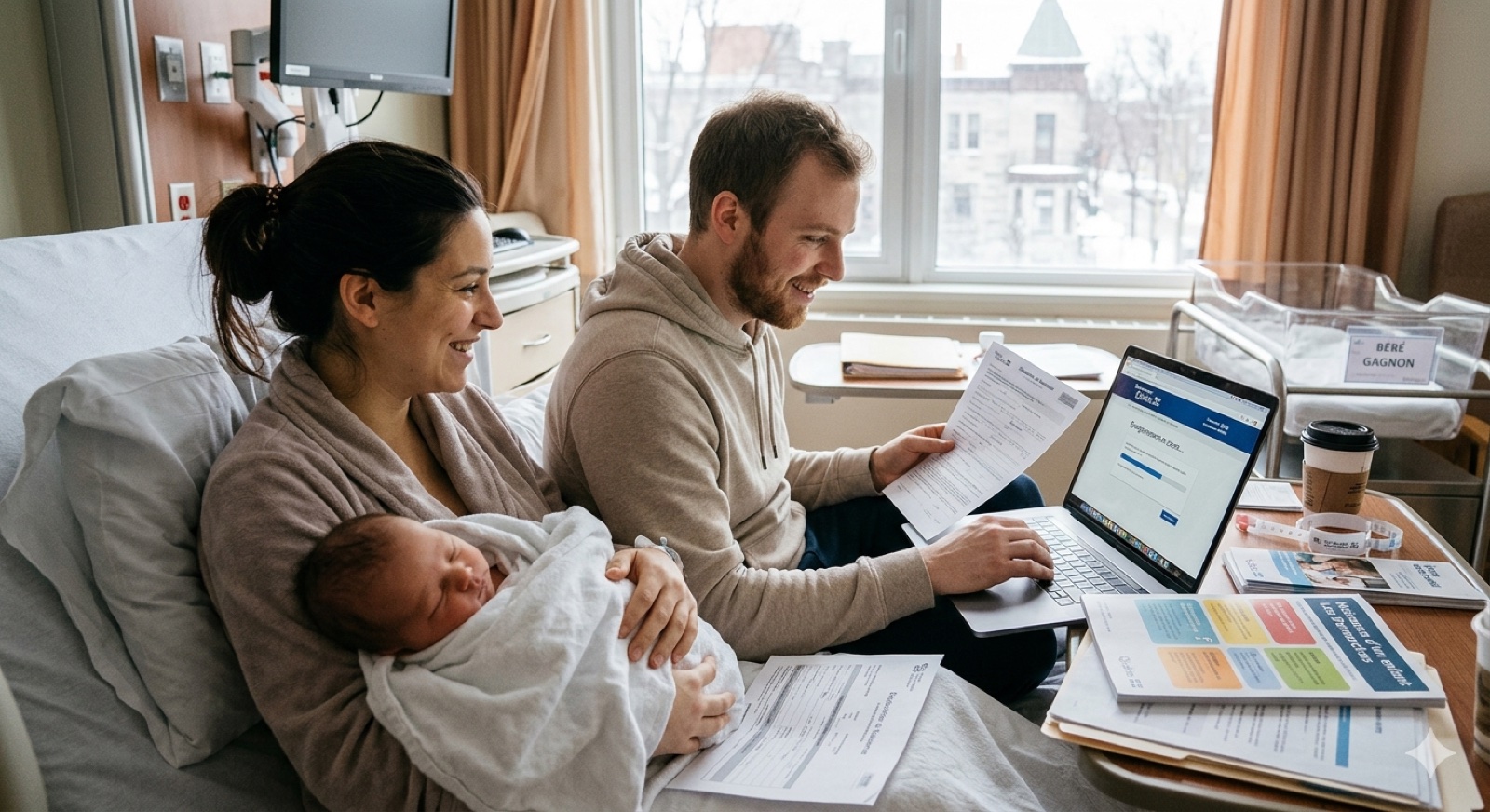
Why it matters if you're thinking about starting a family. Because that small deduction is what gives you access to benefits (replacement income) when you have a child. QPIP offers two plans to choose from, explained on the Québec government site: the basic plan, which spreads a share of your salary over more weeks, and the special plan, which is shorter but pays a higher percentage. The choice matters — it can't be changed once made.

What QPIP is not. It isn't "free" leave or an automatic cheque: you must have paid in and you must apply. The exact amounts depend on your salary, the plan you pick, and the type of benefit. Use the QPIP simulator for an estimate tailored to your situation.

Good to know for newcomers: that "QPIP" line on your pay stub isn't a lost tax — it's you pre-funding a future paid parental leave, right here in Québec. In 2026 it costs you a little less. And if a child is in your plans, take ten minutes to understand the two plans before you need them: the right choice can be worth several weeks of income.
Go deeper

Our full guides on this topic

More in Cost of Living

Our other articles in this category

Vieauqc TeamYesterday

Cost of Living

Family Allowance 2026: up to $3,068 per child

Quebec's Family Allowance rises 2.05% in 2026. Here's what families with children get — and why you usually don't have to apply.

Do you have children in Quebec? One of the most important financial supports for your budget is called Family Allowance — a benefit paid by Retraite Québec (the public body that manages pensions and family benefits) to nearly every family with a child under 18. In 2026, the amounts go up. Every January, the amounts are indexed — meaning adjusted to the cost of living to keep pace with inflation. For 2026, Quebec's tax-system indexation rate is 2.05%, so Family Allowance rises by that same percentage. Here are the concrete figures for 2026. The maximum amount is $3,068 per child per year (up from $3,006 in 2025), and the minimum is $1,221 per child (up from $1,196). You receive an amount somewhere between those two ends. The official figures are laid out on Retraite Québec's Family Allowance amounts page. The amount YOU get depends on your situation. Three things drive it: your family income, the number of children in your care, and your marital status. The higher your income, the…

Vieauqc TeamYesterday

Cost of Living

Employment Insurance 2026: what the federal government takes off your Quebec paycheque

A rate of $1.30 per $100, a maximum insurable earnings of $68,900 and a maximum benefit of $729 a week: the 2026 numbers for Quebec workers.

Employment Insurance (EI) is a federal program, so it covers workers everywhere in Canada, Quebec included. It's a small amount taken off every paycheque — your premium (cotisation) — that entitles you, if you lose your job through no fault of your own, to a weekly benefit (prestation) while you look for work. Because the program is federal, it's Ottawa, not Quebec, that sets its rules and rates. But Quebec has its own, lower rate than the rest of Canada. In 2026, a Quebec worker pays $1.30 per $100 of insurable earnings, compared with $1.63 elsewhere in the country. The reason is straightforward: Quebec runs its own maternity, paternity and parental benefits through the QPIP (Quebec Parental Insurance Plan / RQAP). That portion isn't covered by federal EI in Quebec, so your EI rate is reduced accordingly, as the federal commission confirmed when it set the 2026 rate. The maximum insurable earnings (MIE) rises to $68,900 in 2026. This is the salary ceiling you pay premiums on: above…

Vieauqc Team3d ago

Cost of Living

The GST credit has a new name — and a new amount: +25% with the groceries benefit

The GST credit has a new name — and a new amount: +25% with the groceries benefit

The CGEB replaces the GST/HST credit as of July 2026. Same rules, payments boosted 25% — and one exception aimed squarely at newcomers.

If you were getting the GST/HST credit every three months, stop looking for that name on your bank statement: as of July 2026, it's been replaced by the Canada Groceries and Essentials Benefit (CGEB). The change isn't just a label — the amount goes up. What changes: +25%. The previous credit is boosted by 25% for the next five years, according to the Canada Revenue Agency. More than 12 million low- and modest-income Canadians are covered. The first payment of the enhanced benefit went out on July 3, 2026 and covers July, August and September, per the CRA payment dates. A one-time top-up payment was also issued in early June, during the transition. What doesn't change. The mechanics are essentially identical: same general eligibility rules, same calculation based on adjusted family net income and family situation, same quarterly payments from the Canada Revenue Agency. As a rough guide, the threshold sits below $56,181 for a single person with no children, and below $74,201 for a…

Vieauqc Team3d ago

Cost of Living

Back-to-school: Quebec pays $127 per child, no application, whatever your income

Back-to-school: Quebec pays $127 per child, no application, whatever your income

The school supplies supplement is paid automatically with the Family Allowance. Who qualifies, and what it doesn't cover.

Before the back-to-school bill lands, some good news: Quebec pays a school supplies supplement of $127 per child for the 2026-2027 school year. It's paid every year in July — July 2 this year — and it's granted regardless of family income, according to Retraite Québec. The amount was adjusted for inflation, an increase of about 2.05% over last year, as MTL Blog reports. What makes it unusual: there's nothing to do. Two features set it apart from most benefits. First, no form, no application: it's paid automatically to families already receiving the Family Allowance from Retraite Québec, alongside the regular payment. Second — and this is rare — family income is not a factor: the amount is granted regardless of what you earn. Who qualifies. The child must be between 4 and 16 years old as of September 30, 2026 (up to 17 for a child receiving a supplement for handicapped children). Under shared custody (a 40% to 60% split), each parent receives half the amount, or $63.50. The catch…

Vieauqc Team3d ago

Cost of Living

No more QST on toilet paper, muffins and salted nuts

No more QST on toilet paper, muffins and salted nuts

Since July 15, Quebec has dropped its 9.975% tax on a specific list of grocery and hygiene products. Here's which ones — and the catches.

Since July 15, 2026, a specific list of grocery and hygiene products is zero-rated under the QST system: Quebec's 9.975% sales tax no longer applies to them. The measure, announced in May, is permanent and targets everyday items, according to Revenu Québec. What loses the QST. The list is more precise than it looks, because it runs on thresholds: - Frozen desserts in individual portions under 500 g or 500 ml: ice cream, frozen milk, sorbet, frozen yogurt. - Sweetened baked goods in individual portions under 230 g, or sold in packages of fewer than 6 units: donuts, cookies, muffins, cakes, tarts. - Desserts: dessert cream (pudding), flavoured gelatin, mousse. - Prepared fruits and vegetables: fruit salads and platters, trays of cut and washed vegetables, including any dip that comes with them. - Snacks: mixes of oat flakes or other cereals, seeds, nuts and dried fruit (trail-mix style), plus salted or seasoned nuts and seeds — provided sugar isn't a main ingredient of the…

Vieauqc Team4d ago

Cost of Living

TFSA and RRSP: the 2026 limits for saving tax-free

TFSA and RRSP: the 2026 limits for saving tax-free

Two accounts every newcomer should know, and how much you can put in this year.

Canada offers two tax-advantaged savings accounts worth understanding early: the TFSA (Tax-Free Savings Account) and the RRSP (Registered Retirement Savings Plan). These aren't investments themselves, but "wrappers" inside which your money grows without being taxed the way an ordinary account would be. The TFSA in brief. For 2026, the annual TFSA contribution limit is $7,000, unchanged from 2025. Money grows tax-free inside it, and your withdrawals are not taxed. Unused room carries forward year to year. Careful: contributing more than your limit triggers a penalty of 1% per month on the excess. The RRSP in brief. The RRSP limit is 18% of your earned income from the previous year, up to a maximum of $33,810 for 2026. Unlike the TFSA, your contributions lower your taxable income — but your withdrawals are taxed (the idea being to withdraw in retirement, when your tax rate is lower). TFSA or RRSP? In short: the TFSA is flexible (tax-free withdrawals, ideal for a medium-term goal or…

Vieauqc Team4d ago

Cost of Living

Quebec's minimum wage in 2026: $16.60 an hour

Quebec's minimum wage in 2026: $16.60 an hour

The general rate went up on May 1, 2026: what it means for your paycheque.

Since May 1, 2026, Quebec's general minimum wage has been $16.60 an hour. That's the legal floor below which an employer cannot pay you for most jobs in the province. A different rate for tipped employees. If you work as a server, or in a role where you regularly receive tips, the minimum rate is lower, at $13.30 an hour. The idea is that tips top up the wage — but your employer must still respect that floor. Who sets the rate? The amount is set by the Quebec government and generally reviewed once a year, on May 1. The CNESST (Commission des normes, de l'équité, de la santé et de la sécurité du travail) enforces it. If you're paid less than the minimum, you can file a complaint with them. What it looks like on a paycheque. At $16.60 an hour and 35 hours a week, that's roughly $581 gross per week, before deductions (income tax, QPP, QPIP, employment insurance). The net amount that lands in your account is lower — you can estimate it with our net salary calculator. Good to know for…

Vieauqc Team4d ago

Cost of Living

2026 electricity hike: +3% on your Hydro-Québec bill

2026 electricity hike: +3% on your Hydro-Québec bill

A 3% increase took effect April 1, 2026; here's what to expect on your bill.

In Quebec, nearly every household is supplied by Hydro-Québec, the provincial Crown corporation. Most homes are billed at Rate D, the standard residential rate. Since April 1, 2026, domestic rates have gone up by 3%. How rates are set. Increases aren't decided by Hydro-Québec alone: they're overseen by the Régie de l'énergie, the regulator. Hydro-Québec files a rate application, public hearings are held, and new rates generally take effect on April 1. The adjustment mainly reflects inflation and operating costs. What makes up your bill. A residential bill rests on two main parts: a system access charge (a fixed amount per day) and your energy consumption, measured in kilowatt-hours. The more you heat and light, the higher the consumption portion climbs — which is why winter bills are far higher than summer ones. Heating is the real expense. Electricity in Quebec remains among the cheapest in North America, but winter changes the math: many homes are heated electrically, and a…

QPIP 2026: your premium drops — and here's what it pays for | La Vie au Québec